

Four years ago, Aebi Schmidt Nederland (formerly NIDO) approached Sentech for a solution to a sensor problem with its spreaders. Due to the harsh conditions in which spreaders operate, the sensors frequently failed. Sentech then developed a sensor solution.
The sensor assembly with a mechanical encoder has now been in use for two and a half years. The results are astonishing: zero percent failure rate, and the solution is half the price of the old sensor.
Problem: Rotary encoders failing due to harsh conditions
Rob Pieters, account manager at Sentech, explains the development of a sensor solution for Aebi Schmidt Nido: “NIDO came to us with a problem. The sensors (incremental rotary encoders) used on salt spreaders for dosing and distributing salt were constantly breaking down. Because these sensors contain moving parts, they are sensitive to harsh conditions (brine, frost, moisture) and temperature fluctuations. Furthermore, the drivers also used the part with the sensor as a step to check the brine level.”
Sentech then worked with Aebi Schmidt engineers to devise a solution with a shaftless mechanical encoder: waterproof, contactless, with an O-ring seal, and with a sturdy low housing so drivers could no longer step on that part. The sensor solution is also fully compatible with all salt spreaders who are already driving on the road.
Problem analysis at Sentech leads to an effective sensor solution
Sentech first thoroughly analyzed the problem by studying the usage conditions and operational requirements in detail. Pieters: “The following questions play a big role in this: What should the sensor do? Where will the sensor be placed and what are the conditions? This leads to a set of realistic requirements and constraints. We then search for the optimal sensor, cabling, connectors, and housing. We are always honest in such a development process. If we cannot deliver a solution, we say so. In those cases, I simply refer companies to businesses that can. Because I believe you should always help someone if it doesn't cost you anything.”
According to Pieters, however, it rarely happens that Sentech cannot develop a solution. “Sentech can do anything. There is a solution for every sensor issue, but that solution must, of course, be affordable and economically viable. At Aebi Schmidt, we succeeded in developing a custom sensor assembly with a mechanical encoder, cabling, connectors, and a robust housing. We not only expected the performance to be excellent; the assembly is also half the price of the old sensor.”
Let us Your challenge and we'll help you.
In 2014, Sentech came to the attention of PLS, Patient Lifting Solutions, in Renswoude. One of Sentech's technology partners, Zilvertron, referred owner Marcel van den Brandt to Sentech when he was looking for sensor solutions for his exclusive lifting systems.
Unique systems used by healthcare institutions and hospitals to support intensive patient care. Sentech has since developed sensor solutions for the lifting unit's rail system.
Sentech and PLS are a good fit because both companies strive for perfection and therefore want to continuously improve. The collaboration has now resulted in a hall sensor that ensures reliable control of the rail system. Sentech is currently even working on the new design of the hand control.
The desire for continuous improvement requires a development partner
PLS's rail and lift system for healthcare facilities is unique due to its ease of use, high level of automation, and contactless operation. This requires less maintenance – an attractive feature for users. PLS systems are therefore exported to various countries in Europe, as well as to Australia and Asia. PLS is constantly seeking improvement opportunities.
“I don't see the developments slowing down,” says van den Brandt. “We ask our customers for feedback on error messages from the rail system. Fortunately, we don't get many, only 2 out of 500 connections. However, we want to improve the product based on these error messages. PLS offers exclusivity in the higher market segment. That's why I strive for perfection.”
Van den Brandt also seeks perfection from his suppliers and development partners. Van den Brandt: “The drive for perfection and a solution-oriented approach also characterize our partners. We may be international, but we prefer to source the development knowledge and parts for our products locally. We value short communication lines and flexibility. Our suppliers are therefore located within an hour's drive of Renswoude. They are willing to bring something by in the afternoon if we call them in the morning. In a development process, you need partners you can rely on, and who can react quickly.’
Technical Challenge: From Mechanical to Electronic
PLS came to Sentech with a clear development request. Van den Brandt: “We were looking for a supplier that could replace two different positioning sensors (reed switches) with a Hall sensor. There was no standard sensor for this that you would find in a catalog.” For the rail system, PLS supplies rails, couplings, switches, and turntables. Everything in the rail system is controlled by sensors.
PLS was looking for a generic sensor because it wanted to replace the mechanical components and the control with reed switches with electronic components. “Electronic components and control are more reliable and less prone to failure than mechanical ones,” said Van den Brandt.
Sentech has developed a Hall sensor in a custom housing for contactless control. As the name suggests, the sensor is based on the Hall effect. The sensor measures the magnetic field strength in a magnetic field, or in other words, the presence of a magnet near the sensor. This passes directly through the profile of the lifting system.
A hall sensor is ideal for contactless detection and also makes it possible to adjust the rail system as desired.
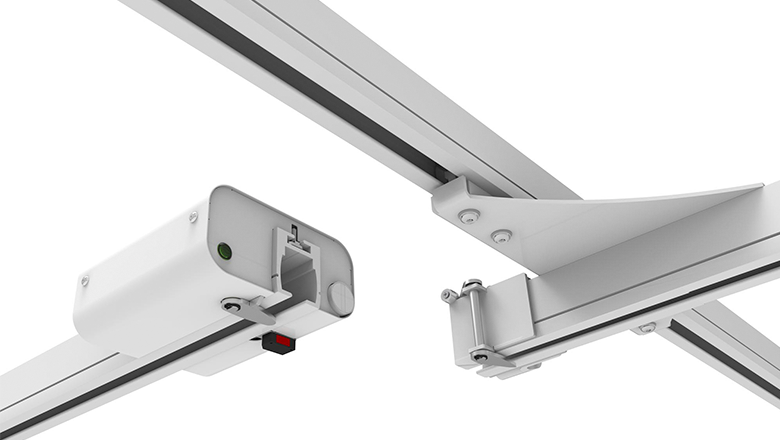
Sean Ram, account manager at Sentech, has guided the development of the hall sensor from the very beginning. “We first look at the problem and consider all factors and circumstances before we start devising solutions. Based on that, we try to find suitable standard sensors for the specific sensor tasks and conditions. That is the fastest and most effective. If that doesn't yield an optimal solution, then we proceed to modify suitable sensors.”
From the relatively short development process, the hall sensor emerged as the most suitable. Ram: “Sentech now only supplies the sensor and wiring. The next step is to create a complete assembly, which could make the entire unit even more reliable.”
New developments in an ‘open kitchen’
Ram appreciates the open attitude of PLS and Van den Brandt: “We work together in a kind of open kitchen. We share as much as possible about our development processes to get the best out of it. I often come to Renswoude to go into the workshop with Marcel and brainstorm about progress and new developments. Because everything is demand-driven, we don't know in advance where we will end up.”
In the spring of 2016, PLS approached Ram with a new development request. A request that, at first glance, didn't seem like a sensor-related question. Van den Brandt: “We've been using standard hand-held controls for operating the lift system for some time. The design of these controls isn't entirely optimal for our application. For example, the cord is mounted underneath, whereas we'd prefer it on top for added comfort and convenience. The controls are also not splash-proof.”
Something new was needed that also had a more exclusive feel. “The current supplier cannot provide that. I told him in an open conversation about our need for a new hand control. Sean surprised me by saying he saw potential in that.”
Van den Brand hits the nail on the head with that. Sentech is a sensor integrator that develops complete sensor assemblies with sensors, wiring, housings, and connectors. Ram on his reaction to PLS: “My first thought was that this didn't seem like sensor technology to me. But when you dive into it, you discover that manual operation actually falls perfectly within Sentech's competencies. So I immediately passed the question on to our engineers.”
R&D also involves a degree of creativity. So the engineers got to work on this challenge. They came up with a custom integral technical design, including an injection molded model for a new exclusive look of the casing. Ram: “I hope we can move from development to production early next year.”
How open is your kitchen? Share Your challenge with us.
Agrifac is a pioneer in agricultural technology with innovative sprayers and beet harvesters. A quintessentially Dutch company that is gaining international fame with its technology. What Audi and Tesla mean for innovations in the automotive world, Agrifac means for innovations in agriculture.
The relationship between Sentech and Agrifac dates back to the very beginning of Sentech. Over the years, Sentech has become Agrifac's R&D partner for sensor technology in its high-end agricultural machinery.
The goal is to continuously add functional innovations to the equipment. This has already led to several successful sensor solutions, enabling farmers worldwide to cultivate their fields more efficiently.
Agrifac wants to reduce the ecological footprint of the world population.
Agrifac CTO Martijn van Alphen on Agrifac: “Agrifac wants to help its customers, farmers and contractors, achieve higher yields from agricultural land with innovative agricultural sprayers and beet harvesters. We are aware of the growing ecological footprint of the expanding global population and want to help reduce that footprint.”
The technological possibilities are there, but Argifac still sees a large gap between current agricultural yields and the potential for increasing them. “With innovative field sprayers, we offer the technological capability to achieve higher yields with less crop protection. The field sprayers are developed according to the ‘4e for growers’ concept. Efficiency, economy, ergonomics, and ecology are leading in our development processes. This gives us a global lead in innovation and technology,” according to the CTO.
This is how Agrifac contributes to the sustainability of agriculture and can help farmers continue to meet the growing demand for food.
Agrifac field sprayers: innovation with Hall sensors
The Steenwijk-based company develops and manufactures a wide range of high-end field sprayers for farmers and contractors in Europe, North America, Australia, and New Zealand. Quality and reliability of all machine components are crucial.
Agrifac CTO Martijn van Alphen explains that sensor technology plays a significant role in agricultural sprayers. “Until we connected with Sentech, we used standard Honeywell sensors for various functions.”
It was Rob Pieters, account manager at Sentech, who contacted Agrifac thirteen years ago. That turned out to be the start of a fruitful collaboration that has led to several concrete sensor solutions for agricultural sprayers.
Van Alphen: “However, we are currently also working on projects with Sentech to add new functionalities to our sprayers with innovative sensor technology.” Sentech thus makes a significant contribution to the innovations in Agrifac's field sprayers.
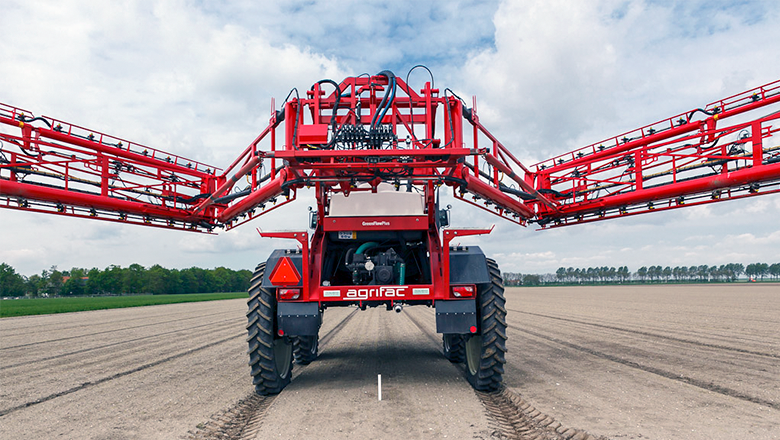
Sensors in production: low-pressure sensor and Hall sensor
Currently, two types of sensor assemblies are supplied for the agricultural sprayers. Van Alphen: “We use a low-pressure sensor that measures the level of the clean water tank; a sensor that we also want to use in the fuel tank.”
Pieters adds, “This is an assembly of a sensor and housing, which is simply off the shelf. The principle here was: if it doesn't need to be difficult, you can effectively make use of standard sensor products.”
That's a different story for the angle sensor of the extendable boom of the agricultural sprayer. Van Alphen: “We wanted to move towards fully automated boom extension. And it had to happen a lot faster. This required replacing the angle sensor that monitors the boom extension. The sensor development based on Hall sensor technology is nearly complete and is becoming an off-the-shelf option for Agrifac.”
Pieters indicates that this has become a special. “The development went smoothly, but it still took two years before the first machine could be equipped with it. That's not about the number of hours.”
Van Alphen: “It took a while to assess and test whether Sentech's idea was practical. Now, a few years later, it turns out to be a great solution.”
Sentech proactively addressed the problem that a loose angle sensor or other issues with the boom could not be detected. Van Alphen: “The challenge was to have a sensor that signals a defect in the boom. When rapidly extending the boom, you want to be sure that everything is working. The hall sensor, which detects problems in time, prevents the boom from incurring (more) damage during extension.”
The sensor solution developed by Sentech ensures that the overall function of the agricultural sprayer becomes more reliable.
Customer focus is paramount
When asked about Van Alphen's view on Sentech's position, he responds: “Sentech is an R&D partner in the field of sensor technology and is absolutely unique in this regard in the Netherlands and Europe! We are currently collaborating on new promising sensor technologies, which we want to integrate into our agricultural sprayers in the future.”
Collaborating and innovating with Sentech is very pleasant according to the CTO. “We gain new insights and discover possibilities that we couldn't have come up with on our own. Sentech helps us to realize our mission.”
Pieters reacts: “That's nice to hear. I often compare us with other competitors. Sentech is truly progressive in many things, but you don't really want to say that about yourself. That sounds arrogant. There is a kernel of truth in it. Most sensor suppliers start from their product range; ‘do we have this and does it fit?’ Sentech starts from a customer's measurement and control needs and then looks for or develops the most optimal sensor solution for them.”
Numbers don't matter to Sentech in this regard. “The added value of our company lies in adding sensor knowledge and technology to machines, vehicles, and installations. Additions that make a product better and more reliable. Sentech proactively seeks solutions and opportunities for improvement.”
Sentech does not trade in standard sensors and does not compete on price. “We want to deliver added value. It doesn't matter to us if a customer buys one hundred or a thousand. They always receive the same service and commitment. The importance is just as great for every company. The fact that these interests are not only financial is evident from our collaboration with Agrifac. It is wonderful to be able to contribute to innovations in agriculture and to a solution for the growing demand for food.”
Your sensor choice is based on?
Always challenge yourself in a project and take the time to gather the right knowledge. Only then can you collaborate successfully and implement sensor technology effectively.
In our e-book, we share a lot of knowledge, but also practical examples of common sensor challenges and solutions.
In 2025, Microsure will begin clinical trials for its microsurgery robot. The encoder systems, which ensure highly precise movements, were designed by the Eindhoven-based company in consultation with sensor specialist Sentech, who sat at the table as a development partner with Microsure and system builder MTA.
This article was written by Alexander Pil and appeared in Link Magazine
Sentech became involved in the development of the Musa-3, the third generation of Microsure's microsurgery robot, at an early stage. Because Sentech also works very regularly with MTA, who is involved in the project as a system developer and production partner, the triangle was quickly formed. ‘It was quite a challenge in the first phase because it was clear which direction we needed to go, but how do you translate that into actual specifications?"
’The numbers were sometimes more gut feeling than exact science,‘ recalls Sean Ram, Account Manager at Sentech. ’It occasionally rubbed in a positive way, by challenging each other and by continuing to ask questions. We could brainstorm openly.'
As a sensor specialist, Sentech sat at the table to advise Microsure and MTA on all possible sensor techniques. ‘What are the pros and cons of each choice? How big or small is it? And what specs can you achieve with it?’ Ram lists. But importantly, it helped translate the specs. ‘You can easily say: I want an accuracy of 0.01 degrees. But what does that mean in practice, at the system level and at the sensor level? Because if a sensor is installed incorrectly by a tenth of a millimeter – and that's very human – the error is already ten times too large. How do you deal with that? We had interesting discussions to question each other thoroughly.’
To say no
Pieter van Wegberg, Project Leader at MTA, on the collaboration with Sentech: ‘There are many companies that, frankly, just move boxes. Sentech, however, is very good at thinking along.’ To be able to properly control the rotational movements in the robot arm, an encoder was needed that could offer that little bit extra within a limited installation space. ‘We ultimately settled on a standard component that we all got the most out of.’

Pieter van Wegberg, Project leader MTA
“They're also brave enough to say ‘no’ when something really isn't possible. Not everyone does that. In that regard, Sentech is not a supplier but a development partner.’
Apart printed circuit board
Ram adds: ‘There were also alternative components on the table, but they were exorbitantly more expensive. Then you have to wonder if that's worth it.’ It is because of considerations like that that Van Wegberg values Sentech: ‘They are very good at finding a solution that fits the business case.'.
The chosen absolute encoder is actually no more than a small chip. It was an option to integrate it directly into the small PCB that contains all the electronics for such a joint. ‘But what if that encoder breaks? Then you have to replace the entire module,’ says Jurre van Son, Account Manager at Sentech. ‘With our knowledge and expertise in sensor technology and integration, Microsure has therefore come up with a design where the encoder chip is on a separate circuit board.’
Sentech is responsible for the production of that sensor PCB. They have also set up the supply chain for it. ‘There are quite a few critical process steps involved in processing those encoder chips correctly’, according to Van Son. ‘That's why we prefer to manage it ourselves so that we can take responsibility if something goes wrong.’ The same applies to the ruler with the stripe pattern that the sensor uses to determine its position. Together with Sentech, MTA has designed and produced a small hub for this, onto which Sentech then very accurately glues the ruler. Van Son: ‘We check if the design has been executed correctly and arrange the supply chain.’
Flexible and rigid at the same time
When asked about the greatest challenge, Ram mentions the flexibility required during prototype development combined with a process that needs to be strictly regulated. ‘After all, it's a medical application, so your methodology must comply with the ISO 13485 standard. This requires very structured processes where everything is well secured. At the same time, you're in the middle of a development where something inevitably changes regularly. You have to keep your head in the game to ensure you continue to meet the standards while still being able to adapt flexibly.’
Sentech regularly works on medical systems, but these are usually patient assistance systems or equipment for laboratory environments. This project was therefore a new application. Van Son: ‘For our automotive customers, we integrated the very strict IATF standard into our organization. A great deal of precision also needs to be guaranteed there. In this process with Microsure, we had to record and document things differently, but the underlying structure and how you deal with tightly controlled processes and supply chains was not new to us.’
Ram excitedly decides: ‘It's super cool that we can be involved with this kind of development in the Netherlands. Someone comes up with something and within a radius of 60 kilometers, there's a complete chain that can answer the question in open collaboration: how?’
This is how you integrate successful sensor technology
Integrating successful sensor technology presents challenges. How do you prepare for environmental factors you are not yet aware of? And what sensor trends can you expect in the future as an engineer?
In our free e-book, you'll find answers to these, including practical examples of common sensor issues and solutions.