

Wearing face masks does not lead to more risk-taking behavior, and one-way traffic appears to be effective. Using a Social Distancing Sensor (SDS) also works when properly instructed. This is evident from a recent experimental behavioral study with real-time tracing by the Smart Distance Lab. Technology company Sentech is therefore launching the Social Distancing Sensor (SDS) on the market.
In the Smart Distance Lab, an initiative of the University of Amsterdam, cameras and sensors were used to measure how much distance people kept from each other. Researchers compared different interventions.
Sensor
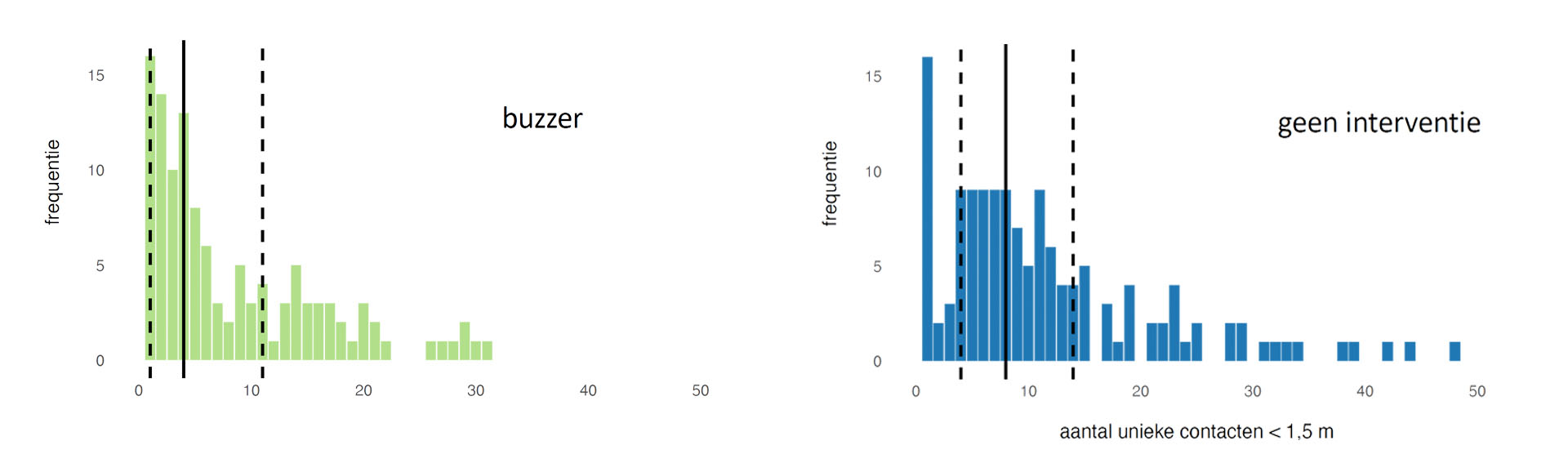
The use of the Social Distancing Sensor leads to fewer contacts than when visitors do not wear a sensor. This tag provides direct feedback on behavior. The study also shows that this intervention must be clearly and consistently explained to visitors. People should also be able to try it out for a bit.
For example, the Social Distancing Sensor gives employees a warning signal if they come within 1.5 meters of a colleague with such a tag. There is a choice of different types of signals: vibration, sound, and/or light. The SDS not only makes office environments safer. Event and production locations, warehouses, and construction sites also benefit from such a solution.
Face masks and direction of travel
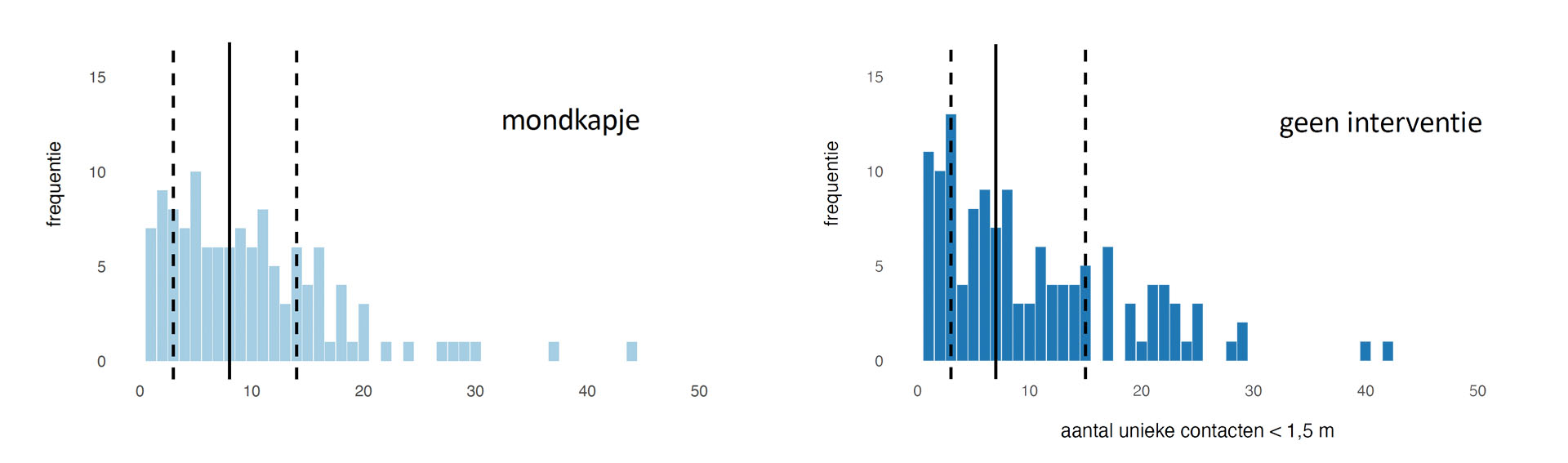
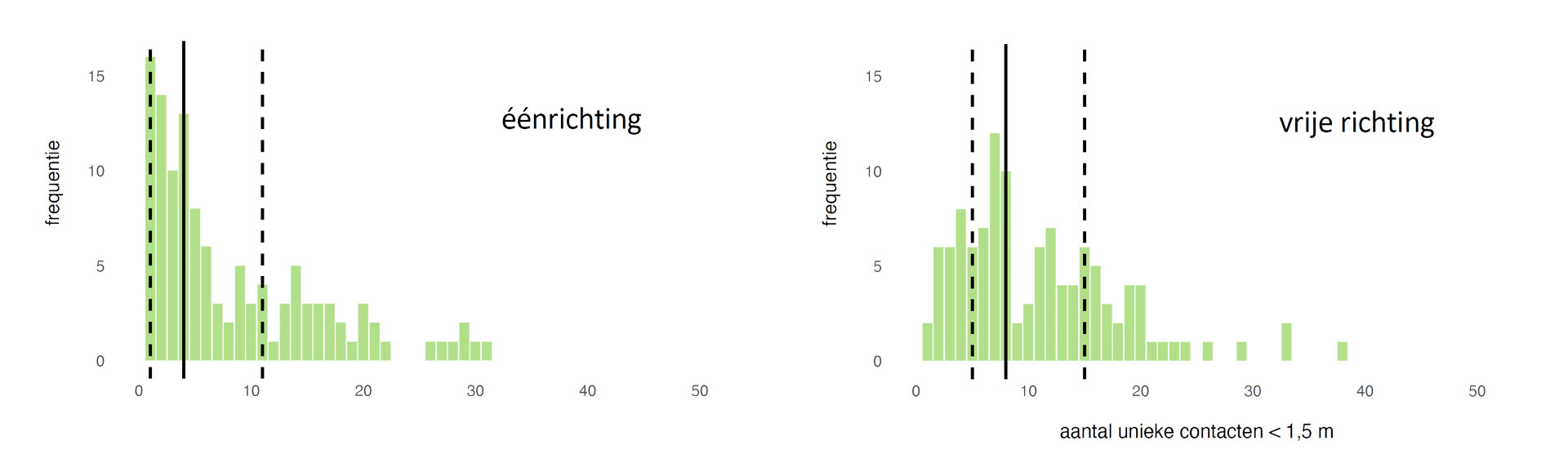
Wearing face masks does not lead to additional contacts. Visitors wearing face masks felt more protected than visitors without face masks. In addition, a one-way route leads to fewer contacts than a free-direction route. The distribution of the number of contacts that a visitor might be infected with is more favorable.
Reliability
Incidentally, there are other systems that alert users to maintain a distance of 1.5 meters from one another. The CoronaMelder app even notifies you if you’ve been near an infected person. The app uses Bluetooth to track proximity, which isn’t 100% reliable. “Whether you have a phone in your pocket also makes a difference,” Ron Roozendaal told NOS earlier. He is the Chief Information Officer at the Ministry of Health.
The CoronaMelder is now issuing around 10,000 notifications per day, even at distances greater than 1.5 meters. How reliable is the measurement then? The need for a system that is accurate is growing with the increasing number of Corona infections.
The ultra-wideband (UWB) technology is used in the Social Distancing Sensor. You can put it in your pocket or wear it around your neck, and the distance measurement is fully maintained. The measurements are much more accurate and reliable than, for example, Bluetooth. Sensor specialist Rob Pieters from Sentech: “Measurements are taken twice per second at the speed of light, with an accuracy of centimeters. You know immediately if you are too close to someone.”
Sentech is further developing its sensor software in collaboration with Focus Technologies. This will soon allow for measurements of how long people have been in contact with each other, when those contacts occurred, and where. Such time-based measurements are interesting for source and contact tracing. “For example, the GGD (Municipal Health Service) in Breda has already purchased sensors. They have many employees who work under high pressure, and maintaining a minimum distance of 1.5 meters is difficult in those situations,” says Pieters.
Best way to organize an event
“Larger events can be safe if carefully planned,” according to researchers at the Smart Distance Lab. The 1.5-meter rule needs a time duration specification. “With the specification ‘more than 20 seconds,’ we measure no contact in a corner with good airflow. This is important in communication from politicians to citizens.”
Based on the initial results, the research recommendation is that you best organize an event by applying one-way directional guidance. “You can also use a sensor that informs visitors whether they are succeeding in keeping their distance,” says the Smart Distance Lab. It is crucial to clearly explain to visitors how the Social Distancing Sensor works. They need to know what is expected of them when it activates.
“It would be fantastic if we could then link a reward to that; that the visitor with the fewest violations receives something (editor's note: a drink, an entrance ticket). We know that rewards work much better than punishments. By linking it to behavior in such a way, we can encourage social distancing,” the researchers conclude.
Frank Wijnveld, Crowd Management Expert at the Event Safety Institute, emphasizes this. He does so in this video: