

An optical encoder measures positions, lengths, and displacements without contact. They are often used as a feedback loop for positioning in machine control. This position sensor operates based on light and a ruler with a reflection pattern. They position with low resolution, accurate to within 1.2 nm! Furthermore, this technology has low power consumption, making the optical encoder suitable for applications in vacuum environments.
You want to move a machine. With an encoder, you know where the object is and what distance it needs to travel to reach the desired position. Does your application require position control with low resolution and high speeds?
Even in a vacuum environment, the optical encoder can be the solution. Read all about the possibilities of this position sensor.
How does an optical encoder work?
Similar to magnetic and inductive encoders, optical encoders also work with a ruler. In optical technology, the ruler consists of a pattern of reflectors, or the light-sensitive layer. As an object moves, the encoder is moved across the ruler. These rulers are available in both straight and circular designs.
Peter Verstappen, Account Manager at Sentech explains: “The transmitter of an optical encoder is a light source. Often this is a VCSEL, a piece of silicon that emits light. As soon as the ruler is illuminated by the transmitter, the pattern of reflectors reflects the light back to the receiver. This creates a waveform, an amplitude. This movement is converted into a sine and a cosine, which are translated into a signal. This signal tells the motor's controller the actual position of an object.”
Positioning feedback loop
Encoders are often used as a feedback loop for positioning in a machine. What does such a position control look like?
“A motor is tasked with moving an object from A to B. To know where the object is during the movement between A and B, you need a measurement. This measurement is the feedback loop to the motor's control. If the motor's control knows where the object is, the motor can supply the correct amount of power to bring the object to the desired position,” according to Verstappen.
Incremental or absolute
Optical encoders are available as incremental and absolute systems. What is the difference between these two types of encoders?
Incremental encoders
An incremental encoder measures step by step. This is because they measure the change and direction of movement. When starting up, an incremental system must ‘home’ to find the index – or the zero position.
Absolute encoders
An absolute encoder directly indicates the actual position. This encoder type does not need to ‘home.’ The system sees every position as a unique signal.
Compared to incremental encoders, absolute encoders are more complex and have higher latency values, resulting in a delay in data transmission.
If component size plays a significant role, precise placement is of great importance. Placement speed is also crucial here. This allows you to offer end products at competitive prices.
5 benefits of an optical encoder
- Very accurateWith a resolution of up to 1.2 nm, optical encoders are among the most accurate measuring systems for positioning.
- Small building formDue to its small form factor, the optical encoder is easy to integrate into compact machines. Housings are available as small as 9 x 7 x 1.2 mm.
- High speedsThanks to their advanced technology, optical encoders are suitable for high-speed applications. From 3 meters per second in entry-level systems to 10 meters per second in advanced systems.
- Suitable for vacuumBecause the light source of the optical encoder is a VCSEL, they require less power, making them generate significantly less heat. This also makes this technology suitable for vacuum environments.
- Immune to electromagnetic interferenceThey are immune to external electronic interference. Optical systems work with a balanced A and B signal. If this signal is disturbed, the differences between the A and B signals remain. This results in a good signal.
When do you use an encoder?
Before you select a specific type of encoder, it's important to know what an encoder does. With an encoder, you measure positions, lengths, and displacements. They are often used to control a position, in other words, as a feedback loop for positioning in the control of a motor or machine.
Depending on the requirements and environmental factors, you can determine which type of encoder best fits your application. For example, an inductive encoder or magnetic encoder is more suitable for a contaminated environment.

Optical encoders from Celera Motion with MicroE-technology are built from materials suitable for vacuum environments.
Position control in vacuum
In vacuum environments, there are no air molecules. Without air molecules, electronic systems can lose their heat poorly or not at all. “For optical encoders with a lens, this means they overheat, causing them to break down quickly. Because the MicroE encoders contain a VCSEL, they consume less power and generate much less heat. This makes these encoders suitable for vacuum environments,” Verstappen explains.
Do you want to use a system that overheats in a vacuum space? Connect the system to a conductive material. This is the only way to lose heat in a vacuum.
Measure displacements with extreme accuracy
An optical encoder measures displacements with an accuracy of up to 1.2 nm. However, the actual accuracy is determined by various factors, which also affects the system's price. Therefore, it's important to know what level of accuracy your application truly requires.
Absolute and repeat accuracy
Encoder systems are built from two factors that determine the precision of your measurement. Namely, absolute accuracy and repeat accuracy. When selecting a position sensor, it's good to know the extent to which these factors are important for your application.
Absolute accuracy is the actual position in space, without prior calibration or calling a reference signal. With repeat accuracy, an index signal is present. When the machine starts, the encoder always moves to this preset point first. That point is always the same. All movements are then made from the index.
Explanation:
With absolute accuracy, you move 10,000 mm, but how accurate is this 10,000 mm in reality? That 10,000 mm could actually be 10,004 mm. Repeatability is when you send the machine to the same position ten times. How much this position deviates from that position is the repeatability.
Tolerance field
Both absolute accuracy and repeatability have gradations in precision. The smaller the tolerance field, the more precise the measurement. If the absolute accuracy is 10 mu, and the repeatability is 1 mu, then the encoder may deviate by a maximum of 1 mu from the reference point. This margin may deviate by 10 mu from the actual (absolute) position.
The degree of absolute accuracy has a significant impact on the price of an encoder system. If repeatability is particularly important, you can usually find a more affordable system. Often, high repeatability is sufficient for reliable measurement.
Ruler material
Every material has its own coefficient of thermal expansion. For example, a metal ruler expands at high temperatures and with temperature changes. In contrast, glass has no coefficient of thermal expansion, making a glass ruler more reliable at higher temperatures.
Interpolation: An Even Lower Resolution
Do you want a lower resolution? You can do that! By interpolating the signal, you can measure more steps per second. The original signal is divided into even smaller steps. How much you can interpolate depends on the capacity of your controller: the input frequency must be able to handle the pulse train. Ensure that the input frequency of the controller is higher than the output frequency of the encoder.
How to prevent a dirty encoder
Because optical systems work with light, dust and dirt are fatal to the measurement results. To limit contamination, you can take this into account when integrating the encoder.
The Account Manager explains: “The design includes options that will make the system less prone to getting dirty. For example, you can mount it upside down or place it under a cover. Also, consider fingerprints. In certain positions, the ruler will come into contact with fingers more quickly. Furthermore, optical systems are suitable for cleaning. It's also advisable to reserve space for this in the design.”
How to select the right optical encoder?
Among optical systems, various options are available. To select the right optical encoder, it is important to know which requirements and environmental factors are relevant. It is important to be specific here.
For example, if you know that low latency is important for your application, you will also want to know how precise your system needs to be. And whether your system's control capabilities can handle that.
Map out which specifications are truly needed for your application with our sensor expert.
When integrating absolute encoders, OEMs and machine builders push the limits of catalog products. Unfortunately, these off-the-shelf components often prove unsuitable for your application. For instance, they may be too large, too heavy, or have the wrong form factor. Sensor manufacturers are aware of this. And they are responding to this need.
Increasingly, the available features in such a component are becoming the stumbling block. Then there are features included that developers don't need at all, while the functionality that could make a difference is precisely what's missing.
Sensor manufacturers are tapping into this trend. They are bringing stripped-down versions of their products to market. They are going back to the basics of their solutions. The functionality of the sensors remains solid, but the rest of the features have been removed. In other words, bare electronics.
A machine developer or sensor integrator can build a shell around it according to their own wishes and insights. Such a component requires more attention in terms of integration. But then it is also perfectly tailored for the application. The result is more compact and lighter, which is interesting in places where space is limited or mass plays an important role.
For example, a component that was previously only available in a robust aluminum housing is now also available in a stripped-down version. Such a stripped-down sensor consists of a small circuit board or even a single component that the user can place on a circuit board themselves. The complete functionality is retained, while all extraneous elements are removed, allowing such a version to form the basis for many secondary applications.
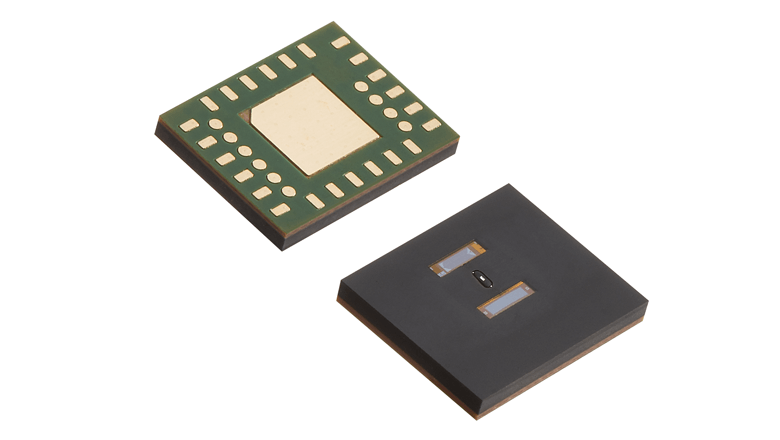
Celera Motion launched a line of absolute optical encoders with a focus on flexibility. The Aura chip encoders stripped of all non-essentials without compromising the intelligence of the sensors. Users can choose which features they want to add and fully customize the encoder for their specific application.
Easily integrable absolute encoder through minimalistic design
A good example of this development is Celera Motion's Aura encoder line. The variants in this series of absolute optical encoders all have a minimalist design. “They are chip encoders, PCB components that you can integrate into your own design,” says Rob Kuijpers, Product Manager at Sentech. “That's very interesting for OEMs because they can do anything with it. They do have to put in more effort for it. But they can implement it exactly as they want, allowing them to build the encoder system to precisely match their specific application.”
The Aura encoders are highly suitable for applications in, among others, the high-tech market, high-end robotics, and pick-and-place machines. “Think of applications where the sensor needs to be very small or where mass is of great importance, such as when it's integrated into an end-effector,” Kuijpers explains. “And it concerns situations where optical encoders are required to provide a very precise absolute position value.”
Optical miniature encoder
The Aura is not the first absolute optical encoder on the market. Existing solutions are significantly larger and more expensive. Celera Motion's chip encoders are very small (9 by 7 by 1.1 mm), feather-light (about one and a half grams), and considerably cheaper.
Please note that the encoders due to their optical character perform best in relatively clean environments. Dirt and moisture are detrimental to the extremely precise measurement.
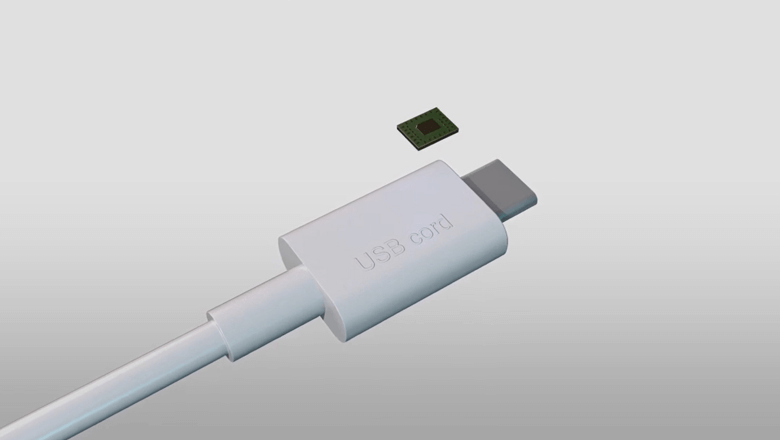
How big is such a chip encoder really? This Aura chip encoder is 9 by 7 by 1.1 mm. Here are the proportions compared to a USB-C connector.
Absolute positive value
The Aura encoders work with an LED as the light source. The light from the LED in the Aura is blue, and this was a deliberate choice. The shorter the wavelength, the smaller the details that can be distinguished. This means that these absolute optical encoders from Celera Motion therefore perform better.
The beam falls on a pattern of chrome stripes deposited on glass. The reflection of light on all these stripes creates a diffraction pattern that can be read out with a receiver. “The Aura encoders contain two such stripe patterns,” Kuijpers knows. “One is neatly repeating, the other semi-random. By combining the two diffraction patterns, the system can calculate an absolute positional value.”
How accurate are Aura encoders?
It's not possible to express exactly how good Aura encoders are with a single number. Usually, three main specifications are considered: absolute accuracy, repetition accuracy, and resolution.
Absolute accuracy
“The first spec is determined by the ruler you use,” explains Kuijpers. Celera Motion has opted for a glass scale with an accuracy of +/- 3 µm per meter. The manufacturer is tinkering with a variant based on a Metal tape measure. That is slightly less accurate at +/- 5 µm per meter, but much cheaper and therefore interesting for applications that don't require the absolute best in terms of absolute accuracy.”
Repeatability
The repeatability of the Aura encoders is, according to the spec sheet, 1 LSB, which stands for least significant bit. Kuijpers explains: “The value depends on the resolution of the encoder. In this case, the repeat accuracy therefore corresponds to the smallest resolution step.”
Resolution
Celera Motion provides a resolution for the Aura's in the range of 12.5 to 200 nanometers. Kuijpers: “You can achieve a resolution of less than a micrometer, that's for sure. Another major advantage of the Aura encoders is that they are very fast. So you can sample quickly, allowing you to average multiple measurements without too many negative side effects, thereby improving the resolution.”
New perspective on integration
The integration of Aura encoders is more involved than with a standard sensor. “It requires a new way of looking at integration. That approach fits well with our way of working, ”in which we work together with our customers towards the best implementation and integration,“ states Kuijpers. ”In consultation, we look at which variations, features, and cabling we add. That ultimate flexibility opens many doors."
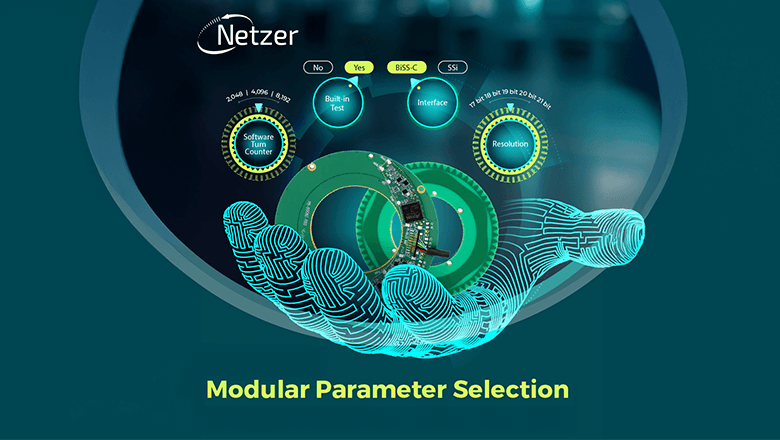
Development starts with the right choices, and that can begin right at the workbench. The EVL Evaluation Encoder from Netzer is a configurable development tool that gives engineers insight into performance, protocols, and integration early in the process. This allows you to easily test if an encoder fits your system before you build further.
The EVL is a practical development tool designed for rapid system integration and early-stage optimization. For example, the resolution and protocol (BISS-C or SSI) are configurable. The EVL works with a software-based multi-turn counter and built-in tests (BIT). This gives you direct insight into performance and integration, right from your workbench.
This makes the EVL suitable for robotics, aerospace actuators, and industrial automation, among other applications.
Complete and immediately deployable
The EVL is delivered in the familiar VL encoder housing (Ø13–247 mm), including a pre-assembled cable and D-sub connector. With the Encoder Explorer software, you have access to all parameters and diagnostics, such as:
- Limits View to illustrate limit values
- Map View for protocol behavior and integration effects
Want to learn more or get started?
Would you like to know if the EVL encoder is suitable for your application, or discuss integration into your prototype right away? Contact us. We will help you with configuration, choices in the development process, and smooth integration of the EVL into your system.
In the defense sector, the field is not a forgiving environment. From sand and dust to rain and extreme heat, only robust sensor technologies like lidar, radar, and high-quality encoders provide accurate and reliable measurements, enabling vehicles and drones to perform their tasks safely and dependably.
Lidar, radar, and encoders each offer unique advantages depending on the application, from autonomous navigation and distance measurements to angle and position measurement. Below, we discuss the features and applications of these technologies in defense applications.
Lidar: Measuring Distances for Autonomous Movement
Lidar uses laser pulses to measure distances to objects. The technology creates a 3D point cloud of the environment, enabling autonomous navigation. Lidar systems are widely used in autonomous aerial, maritime, and ground vehicles, such as mine detection robots.
Lidar is very accurate and performs well in varying light and weather conditions. There are rotating variants with a 360-degree view and compact solid-state lidars without moving parts, making them more resistant to wear and tear.
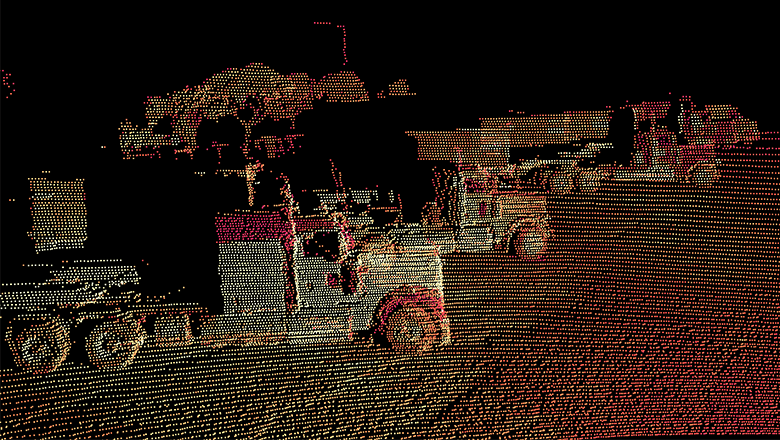
A 3D point cloud says more than a thousand words. This is the output of lidar.
Radar: measuring distances and levels
Radar sensors measure distance, speed, and level using radio waves. Thanks to the high penetration power of radar signals, radars can see through plastics. This makes the modules easy to install and usable in harsh and rough conditions. Weather influences and contamination do not affect the measurement results.
Radar sensors are very well suited for defense applications and the specific challenges of that sector. They are used not only for speed and distance measurements, but also for level measurements in silos and tanks, for example.
Encoders: position and angle measurement
Encoders measure the position, speed, and direction of a moving object. They are available in various technologies. For position and angle measurements, inductive and capacitive encoders are most suitable. They measure contactlessly, are insensitive to contamination, and meet the EMC requirements of the defense market.
Inductive encoders work with electromagnetic induction and are particularly robust. Capacitive variants measure with high resolution and are easily shielded within a housing – ideal for harsh environments.
In the world of modern technology, sensor integration is key to innovation. Increasingly, sensors are supplied as bare chips, offering manufacturers the flexibility to produce these components on a large scale. However, the challenge lies in further integration: from simple housings to complex, custom modules for specific applications.
Egbert Stellinga (Product Marketing Manager) and Rob Kuijpers (Product Manager) discuss the six levels of sensor integration, ranging from bare chip to fully integrated module. Due to the growing need for compact, accurate solutions, sensor integration is becoming increasingly important for efficient and innovative technological developments.
Read it full article on the High-Tech Systems website…
This article appeared in High-Tech Systems and was written by Hans van Eerden
The choice is enormous when looking for the right encoder. Does your application need an incremental or absolute encoder? And do you opt for inductive, capacitive, or optical technology? Later in the search, you'll also have to decide on the sensor form factor... Many facets for which you could use some help.
Absolute encoders have been around for years. Meanwhile, the capabilities of the implementations of this sensor type are growing enormously. Sean Ram, Account Manager at Sentech, can speak to this: “Rotary absolute encoders, in particular, have made significant progress.”
“This way, there's a choice in both the different techniques and the executions. Which encoder fits your application depends on the specific use case. Of course, we also consider whether the investment is profitable,” Ram adds.
Absolute vs. incremental encoders
Where absolute encoders provide an absolute position, incremental encoders measure changes in position. They count the number of encoder steps moved during movement.
Such an incremental system needs a fixed reference point to achieve an absolute position measurement. “Incremental encoders are less suitable for applications with fast movements. If they miss a pulse, they don't know their position,” Sean explains.
“An absolute encoder can sometimes be wrong. This is easily corrected at the next measurement point. Therefore, the control for a motor with an incremental or absolute system is very different.”
What does your application need?
Can a reference point be added to your system? Then an incremental encoder is often a suitable solution. “If homing isn't possible in your application, for example due to safety reasons, then you'll often end up with an absolute system,” says Ram.
Rotary encoders for robotics applications
Absolute and incremental encoders are available in linear and rotary versions. Ram notices that demand for rotary absolute encoders has increased: “We see more and more customers building their robots from scratch.”
“This can be seen in the medical sector and in agriculture and horticulture, for example. Companies are developing their own robotic solutions everywhere. In some situations with one degree of freedom, but even then the rotation must be measured accurately. This is because such systems often work with brushed or brushless motors. These types of motors need to know precisely where the coil is located relative to the magnets during startup. This allows them to regulate the control properly. So, you need an absolute position for that.”
In addition, more and more Dutch companies are working with a combination of AGVs and robots. Sean sees that companies build the system themselves: “They need something special. A ready-made system doesn't fit that. They often have the capacity to build a system in-house, which also makes it more cost-effective.”
Solution for rotations
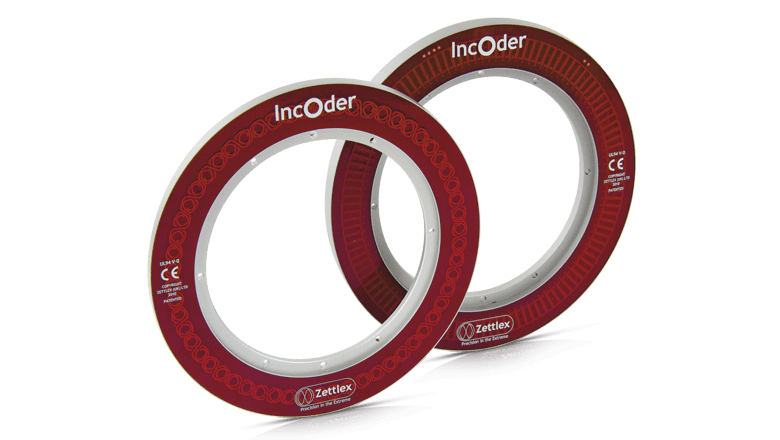
For systems like robots, you usually deal with a lot of rotations. In those cases, a hollow-shaft encoder can be the solution. “These are ring-shaped encoders with an open inner mechanism. You then run the cables for data signals and power through the inside of the system,” Sean explains.
Hollow shaft encoders consist of two parts: a transmitter and a receiver that can rotate contactlessly. Ram sees a second advantage in this: “Because the parts don't touch each other, the components don't wear out. That's the case with traditional absolute encoders with shafts and bearings.”
Pros and cons of absolute encoders
When it comes to absolute encoders, there are quite a few variants and technologies on the market. They all work slightly differently. Each has its own advantages and disadvantages.
Broadly speaking, this is how it works: one of the encoder components has onboard electronics and generates a field. That field can be magnetic-inductive, electric-capacitive, or optical. The other part of the encoder is passive and influences that field. This disturbance is measured and provides information about the angular displacement.
The passive encoder part has a pattern. That pattern has a unique encoding and therefore a unique disturbance over the entire 360 degrees. This allows the system to always know the angle of the encoder.
Levels of accuracy
The accuracy of encoders varies by technology and brand, Sean knows: “When integrating inductive encoders, we often opt for Zettlex from Celera Motion. With those, you can measure with approximately 0.01 degrees accuracy. When we work with capacitive encoders, we often choose Netzer. Those achieve an impressive 0.005 degrees.".
Then there's a third type of encoder: optical technology. “Celera optical encoders from MicroE achieve accuracy comparable to capacitive encoders,” Ram knows.
Sean emphasizes that it's not just about precision. “There are more factors involved. Ultimately, the application determines which technology is best suited.”
When do you choose which encoder?
Environmental conditions play a big role in choosing your encoder type. “Are you dealing with a clean environment? And is the encoder built in such a way that no dirt can get to it? Then an optical encoder can be an excellent solution. Such an encoder is light, relatively inexpensive, and achieves high performance,” says Sean.
If contamination such as dust is involved, an optical encoder is not suitable.
“For less clean applications, you often end up with a capacitive encoder from Netzer,” says Ram.
Capacitive technology is susceptible to moisture. This is because moisture particles can disrupt the capacitance. That's why Ram usually opts for inductive encoders in humid environments: “They are even suitable for a remotely operated submarine that is 500 meters underwater, for example.”
Calibration
What should you pay attention to when integrating absolute encoders? “Such an encoder consists of two separate parts that you must position correctly – relative to each other. No matter how precisely you work, a human error can easily happen,” says Ram.
“For the air gap and the non-eccentricity of the rings, you should think in terms of accuracy to a tenth of a millimeter. These are familiar specifications for many companies. Some partners, like Netzer, help you by incorporating a calibration run. The two parts probe each other's position, allowing you to correct any installation errors relatively easily.”
Close-up engine montage
Generally, encoders are deeply embedded in a machine, close to motors. What is the influence of the strong magnetic fields from motors on encoder measurements?
“All technologies are insensitive to external interference fields. Here's how it works: developers cleverly modulate the signal between the two parts and chose different frequencies. Interference from external magnetic fields is therefore a thing of the past,” Sean explains.
In addition, the encoders are very flat and lightweight. “This makes this technology very suitable for robots with high accelerations, where every gram counts.”
This article appeared in Mechatronics & Mechanical Engineering issue 3 2021 and was written by Alexander Pil
Sentech recently added Celesco’s new SG1 draw wire encoder to its product line. This encoder has a maximum range of 3 m and, thanks to its robust and reliable industrial pulley system, offers a repeatability of ± 0.05%.
In practice, this high repeatability may be even more important than the specified ± 0.35% accuracy. Robotics and/or mechanical engineering are a breeze for this draw-wire encoder.
The heart of this sensor is the measuring element. This consists of a 10 kOhm potentiometer, specially designed for its industrial application, which is guaranteed for over 250,000 full measuring cycles.
With a maximum supply voltage of 30 V, this encoder, which functions as a voltage divider, provides an easy-to-process analog output signal. With an allowable temperature range of -18 °C to +70 °C, this sensor exceeds the temperature requirements for its application in mechanical engineering, instrument construction, and robotics.
Freely configurable
A special feature of the SG1 series is that this draw-wire encoder is freely configurable. This allows the sensor to meet the demands of its use in series production for OEM applications. For example, when making the electrical connection, you can choose between an M12 connector, cable (with a variety of connectors), or even a solder tab.
Furthermore, various mounting brackets, industrial potentiometers, and output signals can be chosen from. When using a good electrical connection (plug), the sealed polycarbonate housing provides protection up to IP67.