If sensor technology were not to grow exponentially at the same pace as computing power, we would not be able to fully benefit from the possibilities that artificial intelligence offers. This is according to TUE fellow Carlo van de Weijer. Because without accurate, preferably real-time, data, the unconditioned external world is incomprehensible to AI. In that sense, the integration of sensors in the AI era we are in is many times more important than the quality of actuators.
Carlo van de Weijer also sees it happening: the hype around artificial intelligence. ‘Some startups are just saying they're doing AI to raise more money.’ The director of the Eindhoven AI Systems Institute (EAISI) at Eindhoven University of Technology compares the situation to how the internet was viewed about thirty years ago. ‘Everyone said you had to get on the internet, but nobody knew exactly how or what, so in practice not much happened. We now know how impactful that technology has been. The reason we're talking so much about AI now is because we foresee that machines will become smarter than ourselves in the foreseeable future. We need to get to work on it.’
Van de Weijer substantiates that statement with three arguments. ‘To begin with, technological development, and thus the growth of computing power, is not stopping. There is no reason whatsoever why that development would stop,’ according to Van de Weijer.
Bag with algorithms
The second reason is that the development of AI does not stop at human intelligence. ‘Our brains are limited to one skull with a clock speed a million times slower,’ Van de Weijer explains. ‘If we collaborate with machines, we are more intelligent and can postpone the moment when computers surpass human computing power. But humans have finished evolving; machines have not.’
Don't people then have an advantage because they have consciousness, character, humor, or a soul? That question leads Van de Weijer to his third argument: ‘You then enter into a philosophical discussion. Can a machine ever enjoy a piece of chocolate? We can, but isn't that also just because we've learned that chocolate gives us energy? I admit, it's not the most romantic way to view a human, but aren't we essentially more than just a bag of algorithms? If there is any difference between human consciousness and AI, I don't think it will give us an advantage anymore.’
What is intelligence?
Scientists don't entirely agree on how long it will take for AI to surpass human intelligence, also known as the singularity point. The renowned futurist Ray Kurzweil, in his book ‘The Singularity Is Nearer’ (2024), suggests we will reach that point as early as 2029. Others estimate it to be somewhere around 2055-2060. ‘In any case, very few scientists are still saying it will never happen,’ Van de Weijer notes, immediately emphasizing that AI can already have a tremendous impact much sooner. ‘We're already seeing that now.’
To properly categorize the level of artificial intelligence, we must first define intelligence. Van der Weijer likes to use the description by American psychologists Robert Sternberg and William Salter. ‘They describe intelligence as...“goal-directed adaptive behavior”In classical automation, you start with the input. You run a program on it, and then you get your output. Many things called AI are actually nothing more than that. For me, something is truly artificial intelligence only if you provide the input, define the output, and let the machine determine how to get there itself. If the output isn't satisfactory, true AI can adjust the program until the output is correct.’
Sensors crucial for AI
For Van de Weijer, there's another important reason why the attention for AI has exploded in recent years, and that's sensor technology. ‘Computing power is developing exponentially. When something develops exponentially, people always underestimate it because we are linear thinkers,’ he begins his explanation. ‘Many systems can be reduced to a sensor that measures something, computing capacity or a bit of intelligence that, based on the measured data, draws a conclusion and then gives an order to an actuator. On top of that is a feedback loop to assess whether the action actually leads to a better measurement. That's how a system iterates towards the right outcome.’
Of course, actuators are improving, Van de Weijer admits. ‘Electric motors, pistons, hydraulic systems, you name it, the performance of such components increases every year. But that development is linear, not exponential.’ That's in contrast to sensors, Van de Weijer argues: ‘They ride the wave of Moore's Law, just like available computing power. Look at cameras, lasers, lidars. That type of technology all starts very expensive but gets incredibly small very quickly. And especially much cheaper. At a certain point, it even goes on-chip. It's happening incredibly fast.’
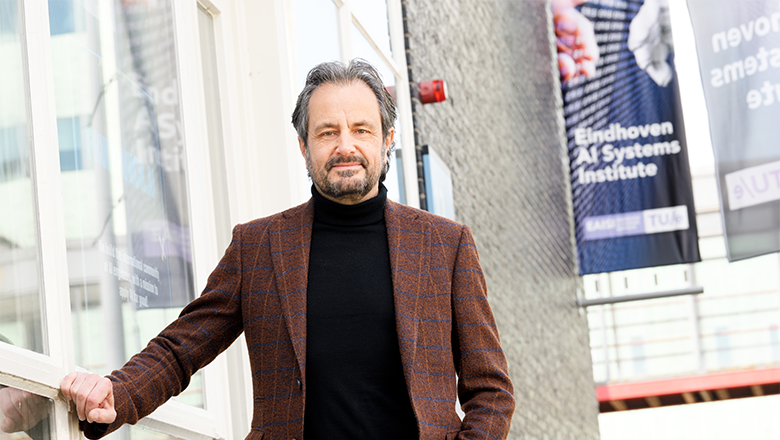
EAISI Director Carlo van de Weijer: ‘Start experimenting with AI; you will almost certainly become more productive.’ Photo: Bart van Overbeeke
Blame it on the sensors
Van de Weijer believes that the faster development of sensors compared to actuators is good news for AI. To clarify, he provides an example: ‘Try driving a car blindfolded. That won't work. However, if the steering system isn't working perfectly, you can still avoid all sorts of things. As long as you're getting the right data, there's still something you can work with. Without data, or with the wrong data, you have a serious problem.’
Sensors are therefore key players in the development of AI. With only exponentially growing computing power, it wouldn't progress nearly as fast, states Van de Weijer. But because sensor technology is also developing exponentially and sensors are being integrated more and more effectively, AI algorithms continue to receive the right – and sufficient – data, allowing intelligence to truly continue developing exponentially.
Unconditional world
Artificial intelligence sets conditions for the data it receives via sensors. But what those conditions precisely are is highly unpredictable. ‘As a sensor supplier and integrator, you will have to deal with that adequately and decisively,’ according to Van de Weijer. ‘You cannot make the world predictable. That would be nice for AI, as artificial intelligence functions best in a conditioned world. But then you would have to install traffic lights everywhere, regulate the weather, and so on, which is obviously impossible. You can only make AI work in the unconditioned, real world if you know the conditions of that world in real-time. That is the essence.’ And that requires well-integrated sensors.
Experiment
As stated, even AI evangelist Van de Weijer believes that sometimes too many rosy promises are made when it comes to AI. ‘I don't believe artificial intelligence will replace humans. But I do think that people who work with AI will replace people who don't work with AI. Because AI makes you structurally much more productive. We need that efficiency boost to continue economic growth.’
The director of EAISI is therefore not in favor of banning the use of tools like ChatGPT in schools. In fact, he urges everyone to get started with AI tools. ‘Just ask ChatGPT which tools could be interesting for your field,’ he smiles. ‘And start experimenting. You will almost certainly become more productive. Humans are distinguished from other animals because we use tools and share them with each other, further developing and improving them. Until now, these were tools that supported our arms or legs, but with AI, we have arrived at tools that help our brains. This is a development that cannot be stopped, so you might as well make the best of it. With sensors as a fundamental component.’
Discover the Six Levels of Sensory Integration: A Look into the Future
The development of AI goes hand in hand with advances in sensor technology. Sensors provide the crucial data that feeds AI algorithms, but without smart integration, we cannot fully utilize these technologies.
Would you like to learn more about the trends and challenges in sensor integration? Then read our blog about the future of sensor integration,in which our experts discuss the six levels of integration and explain how they contribute to innovation.