With lidar, self-driving vehicles, such as AGVs, can map their surroundings. They scan using light pulses. Despite the simplicity of this optical sensor technology, the technique remains expensive. Developers are innovating to make autonomous driving more affordable, compact, and reliable. This makes this type of transport more accessible to consumers and B2B markets.
Affordable alternatives are entering the market, such as solid-state lidar. Depending on the desired resolution, you determine whether your application requires a basic or a high-end lidar sensor. Furthermore, a sensor alone is not sufficient for autonomous driving. For reliable measurement, you need to combine multiple techniques.
How lidar works
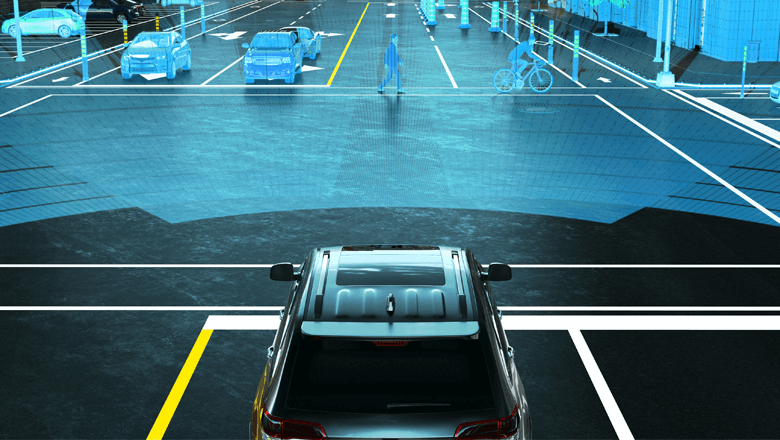
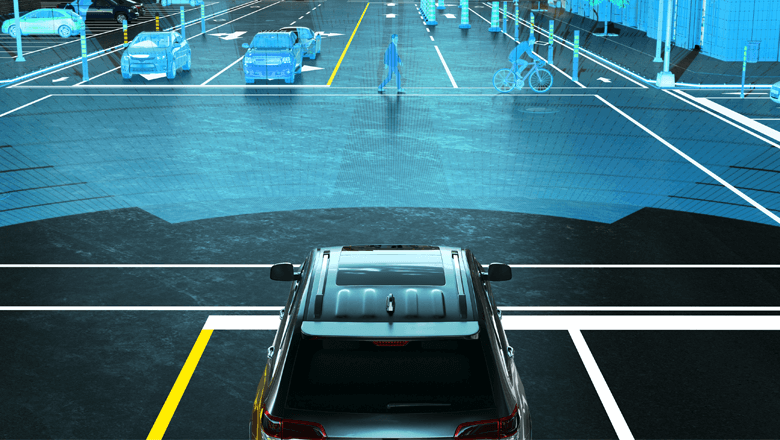
Just as radar works based on radio waves, lidar uses light pulses. When light pulses reach objects or surfaces, detectors capture their reflection. The system calculates how long it took for the light to travel from the laser, via the object, to the sensor. This is converted into distance. All the distances together form a detailed point cloud of the surroundings.
What determines the price of autonomous vehicles?
Self-driving cars, like Google's Waymo, drive autonomously thanks to lidar. The roofs of these vehicles feature a noticeable bulge. This is where the lidar sensor is housed, which the car uses to map its surroundings. For car designers, it's a challenge to inconspicuously integrate the technology into the design.
These lidars are scanning electromechanical systems, consisting of many moving parts. This makes them difficult to produce and miniaturize, causing the price to barely decrease.
At Velodyne, you pay $75,000 for a lidar module. Even simpler technologies cost thousands of dollars. Besides this sensor technology, more is needed to make a vehicle drive autonomously. The total price quickly adds up to 100,000 euros.
Lidar originally arose from the words ‘light’ and ‘radar’. It is now an acronym for ‘light imaging, detection and ranging’.
Affordable lidar alternative
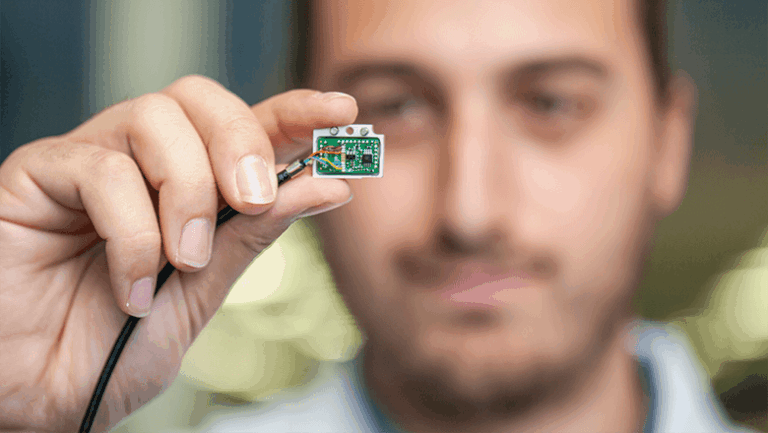
Solid-state lidar is a smaller and more affordable alternative. Instead of scanned beams, this technique works with broad light flashes. A solid-state laser shoots pulses, which are spread via a diffuser over an angle of 9 to 120 degrees.
The range of solid-state lidar is smaller than that of scanning lidars. However, they are also significantly cheaper. At Canadian LeddarTech, the price for a flash lidar module is around a few hundred dollars. Furthermore, they are much smaller and more robust. This makes them easy and affordable to integrate into vehicles.
Compared to flash, scanning lidar offers several advantages. “If you need high resolution, you should look at high-end lidar sensors,” explains Marco Leeggangers, Operations Director at Sentech. “Furthermore, scanning lidars achieve that higher resolution across their entire 360-degree field of view.”
Adjust range and viewing angle
Lidar manufacturers are not transparent about the frequency and intensity of laser pulses. “During the design phase, you can play around with it to adjust the lidar's range or field of view,” says Olivier Gernier-Lafond of LeddarTech. “With our software, users can adjust various parameters to choose the range and update frequency. This is how we differentiate ourselves from the competition.”
Gernier-Lafond adds: “The wavelength of the laser is approximately 905 nm (nanometers). Many competitors are above 1,000 nanometers. Although lasers around 1550 nm are more powerful, optical components in our wavelength range are more affordable, robust, and reliable. This allows us to deliver cheaper lidar systems. Thanks to our advanced signal processing algorithms, we still achieve the same performance as the competition.”
Noise cancellation in rain and snow
Lidar sensor measurements must be translated into usable data: the perception platform that recognizes and classifies objects. “LeddarTech is exceptionally strong in that translation,’ says Leeggangers. ‘The Canadian signal processing software is very good at noise reduction. Even at night, in rain and snow, it delivers reliable results.’
All detection technologies have their advantages and limitations. Lidar meets in all lighting conditions very accurately the distances. Moreover, this technique can handle both stationary and moving objects perfectly. “Our off-the-shelf systems achieve an accuracy of 5 cm, with a repeatability of 6 mm,” says Vincent Racine, product manager at LeddarTech.
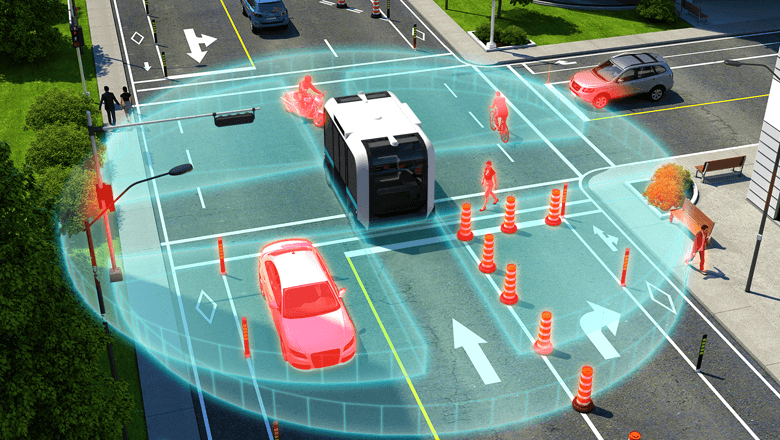
Detecting objects at a great distance
The reflectivity of an object affects detection distance, or its visible range. For example, pedestrians with 10 percent reflectivity are ‘seen’ by LeddarTech lidars up to 200 meters away. Objects with higher reflectivity, such as license plates, are detected at even greater distances. This was successfully demonstrated during CES 2019.
Besides reflectivity, the field of view also depends on the laser's intensity. The more power, the larger the field of view. There are limits to increasing laser intensity, as lasers are used in public areas and should not blind passersby.
Racine adds: “We place a high value on safety. Additionally, we comply with the strict legislation for pulsed lasers. With our software, we ensure that we achieve optimal performance within those limits.”
Combining technologies
Experts agree that you cannot build a fully autonomous vehicle without Lidar. “But it will never succeed with a single sensor type,” emphasizes Leeggangers. “Lidar must be combined with cameras, GPS, and other technologies. Only then will you get reliable measurements.”
Fields of application
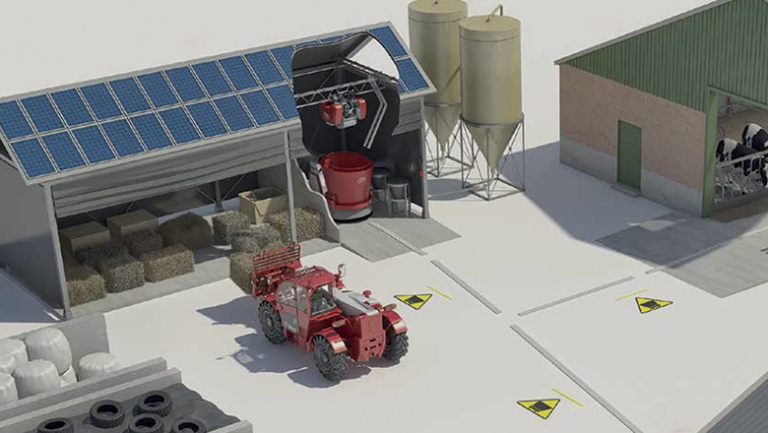
Because fully autonomous cars are still mostly research objects for the time being, Leeggangers is looking ahead. “The market for autonomous vehicles is booming. Think of the Second Maasvlakte where carts drive autonomously on a closed site. You also see more and more AGVs in controlled environments like large warehouses and in agriculture.”
In many mobile applications, there are plenty of opportunities for solid-state lidar. “But you can also perfectly use the technology to detect, for example, if drivers are changing lanes in time during a lane closure.’
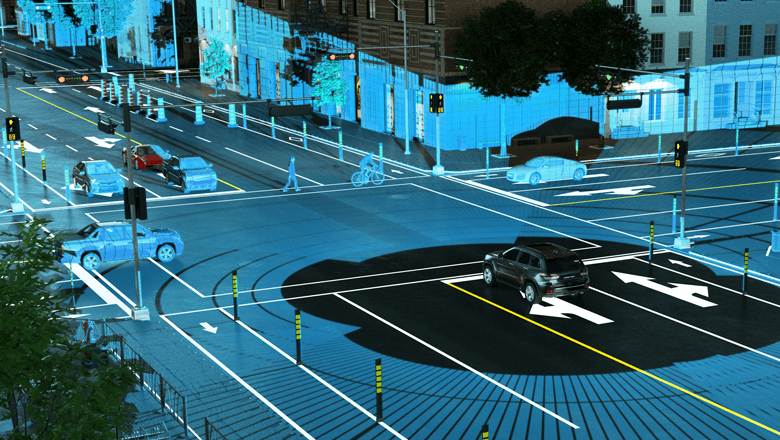
Innovating with lidar
LeddarTech is currently working on several innovations, including various 3D versions. “We started with 2D lidars. They are fine for simple collision detection, for example,” says Racine. “With 3D lidar, you can see more and recognize objects more easily. This technology is now in full development to meet the requirements of automotive and other mobility applications, such as autonomous shuttles and robotaxis.”
Long-range and high-definition 3D lidars are also planned. “Those system-on-chip devices are based on MEMS technology. Although they do have moving parts, they can still be classified as solid-state components. This is also because their dimensions and robustness make them resistant to shocks and vibrations,” according to Racine.
Collaboration for Successful Integration
A few years ago, Sentech signaled the rise of lidar technology. The market wasn't ready for high-end scanning sensors at that time. So, an alternative was sought. In 2016, they discovered LeddarTech's solid-state lidars.
“LeddarTech was looking for a partner who could provide high-level customer support, particularly during development and integration,” says Olivier Gernier-Lafond, Distribution Network Manager at LeddarTech. “We have specialized partners in Germany, France, and Asia, among other regions. The Netherlands has a dynamic market with many innovative companies that we want to connect with.”
Marco Leeggangers of Sentech adds: “Lidars are not simple systems. You always have to integrate them with other hardware and software. They produce an enormous amount of data that you have to translate into usable information with complex algorithms. Sentech can help with that. We can also advise on the position of the sensors and what images that will yield. We often draw on our experience with radar for this, because the technologies and applications are comparable.”
Explore the possibilities of lidar
Where do you start with the integration of lidar? There are various lidar technologies on the market. The speed of the vehicle and the reflectivity of surrounding objects determine the required field of vision. And therefore, which technology is needed to make your vehicle safely drive autonomously.