

The choice is enormous when looking for the right encoder. Does your application need an incremental or absolute encoder? And do you opt for inductive, capacitive, or optical technology? Later in the search, you'll also have to decide on the sensor form factor... Many facets for which you could use some help.
Absolute encoders have been around for years. Meanwhile, the capabilities of the implementations of this sensor type are growing enormously. Sean Ram, Account Manager at Sentech, can speak to this: “Rotary absolute encoders, in particular, have made significant progress.”
“This way, there's a choice in both the different techniques and the executions. Which encoder fits your application depends on the specific use case. Of course, we also consider whether the investment is profitable,” Ram adds.
Absolute vs. incremental encoders
Where absolute encoders provide an absolute position, incremental encoders measure changes in position. They count the number of encoder steps moved during movement.
Such an incremental system needs a fixed reference point to achieve an absolute position measurement. “Incremental encoders are less suitable for applications with fast movements. If they miss a pulse, they don't know their position,” Sean explains.
“An absolute encoder can sometimes be wrong. This is easily corrected at the next measurement point. Therefore, the control for a motor with an incremental or absolute system is very different.”
What does your application need?
Can a reference point be added to your system? Then an incremental encoder is often a suitable solution. “If homing isn't possible in your application, for example due to safety reasons, then you'll often end up with an absolute system,” says Ram.
Rotary encoders for robotics applications
Absolute and incremental encoders are available in linear and rotary versions. Ram notices that demand for rotary absolute encoders has increased: “We see more and more customers building their robots from scratch.”
“This can be seen in the medical sector and in agriculture and horticulture, for example. Companies are developing their own robotic solutions everywhere. In some situations with one degree of freedom, but even then the rotation must be measured accurately. This is because such systems often work with brushed or brushless motors. These types of motors need to know precisely where the coil is located relative to the magnets during startup. This allows them to regulate the control properly. So, you need an absolute position for that.”
In addition, more and more Dutch companies are working with a combination of AGVs and robots. Sean sees that companies build the system themselves: “They need something special. A ready-made system doesn't fit that. They often have the capacity to build a system in-house, which also makes it more cost-effective.”
Solution for rotations
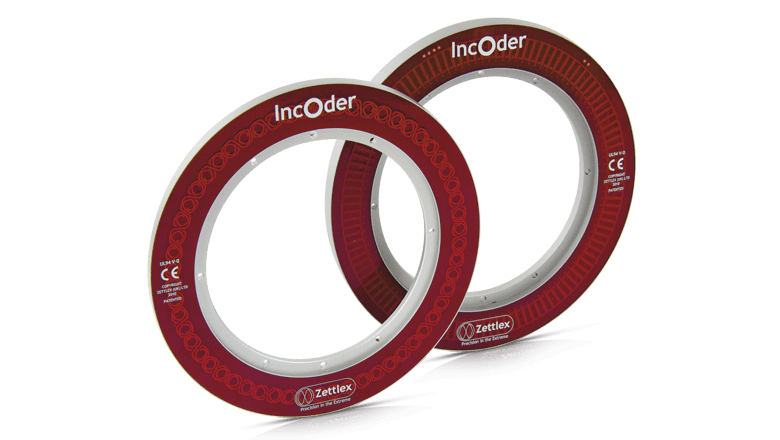
For systems like robots, you usually deal with a lot of rotations. In those cases, a hollow-shaft encoder can be the solution. “These are ring-shaped encoders with an open inner mechanism. You then run the cables for data signals and power through the inside of the system,” Sean explains.
Hollow shaft encoders consist of two parts: a transmitter and a receiver that can rotate contactlessly. Ram sees a second advantage in this: “Because the parts don't touch each other, the components don't wear out. That's the case with traditional absolute encoders with shafts and bearings.”
Pros and cons of absolute encoders
When it comes to absolute encoders, there are quite a few variants and technologies on the market. They all work slightly differently. Each has its own advantages and disadvantages.
Broadly speaking, this is how it works: one of the encoder components has onboard electronics and generates a field. That field can be magnetic-inductive, electric-capacitive, or optical. The other part of the encoder is passive and influences that field. This disturbance is measured and provides information about the angular displacement.
The passive encoder part has a pattern. That pattern has a unique encoding and therefore a unique disturbance over the entire 360 degrees. This allows the system to always know the angle of the encoder.
Levels of accuracy
The accuracy of encoders varies by technology and brand, Sean knows: “When integrating inductive encoders, we often opt for Zettlex from Celera Motion. With those, you can measure with approximately 0.01 degrees accuracy. When we work with capacitive encoders, we often choose Netzer. Those achieve an impressive 0.005 degrees.".
Then there's a third type of encoder: optical technology. “Celera optical encoders from MicroE achieve accuracy comparable to capacitive encoders,” Ram knows.
Sean emphasizes that it's not just about precision. “There are more factors involved. Ultimately, the application determines which technology is best suited.”
When do you choose which encoder?
Environmental conditions play a big role in choosing your encoder type. “Are you dealing with a clean environment? And is the encoder built in such a way that no dirt can get to it? Then an optical encoder can be an excellent solution. Such an encoder is light, relatively inexpensive, and achieves high performance,” says Sean.
If contamination such as dust is involved, an optical encoder is not suitable.
“For less clean applications, you often end up with a capacitive encoder from Netzer,” says Ram.
Capacitive technology is susceptible to moisture. This is because moisture particles can disrupt the capacitance. That's why Ram usually opts for inductive encoders in humid environments: “They are even suitable for a remotely operated submarine that is 500 meters underwater, for example.”
Calibration
What should you pay attention to when integrating absolute encoders? “Such an encoder consists of two separate parts that you must position correctly – relative to each other. No matter how precisely you work, a human error can easily happen,” says Ram.
“For the air gap and the non-eccentricity of the rings, you should think in terms of accuracy to a tenth of a millimeter. These are familiar specifications for many companies. Some partners, like Netzer, help you by incorporating a calibration run. The two parts probe each other's position, allowing you to correct any installation errors relatively easily.”
Close-up engine montage
Generally, encoders are deeply embedded in a machine, close to motors. What is the influence of the strong magnetic fields from motors on encoder measurements?
“All technologies are insensitive to external interference fields. Here's how it works: developers cleverly modulate the signal between the two parts and chose different frequencies. Interference from external magnetic fields is therefore a thing of the past,” Sean explains.
In addition, the encoders are very flat and lightweight. “This makes this technology very suitable for robots with high accelerations, where every gram counts.”
This article appeared in Mechatronics & Mechanical Engineering issue 3 2021 and was written by Alexander Pil