

If sensor technology were not to grow exponentially at the same pace as computing power, we would not be able to fully benefit from the possibilities that artificial intelligence offers. This is according to TUE fellow Carlo van de Weijer. Because without accurate, preferably real-time, data, the unconditioned external world is incomprehensible to AI. In that sense, the integration of sensors in the AI era we are in is many times more important than the quality of actuators.
Carlo van de Weijer also sees it happening: the hype around artificial intelligence. ‘Some startups are just saying they're doing AI to raise more money.’ The director of the Eindhoven AI Systems Institute (EAISI) at Eindhoven University of Technology compares the situation to how the internet was viewed about thirty years ago. ‘Everyone said you had to get on the internet, but nobody knew exactly how or what, so in practice not much happened. We now know how impactful that technology has been. The reason we're talking so much about AI now is because we foresee that machines will become smarter than ourselves in the foreseeable future. We need to get to work on it.’
Van de Weijer substantiates that statement with three arguments. ‘To begin with, technological development, and thus the growth of computing power, is not stopping. There is no reason whatsoever why that development would stop,’ according to Van de Weijer.
Bag with algorithms
The second reason is that the development of AI does not stop at human intelligence. ‘Our brains are limited to one skull with a clock speed a million times slower,’ Van de Weijer explains. ‘If we collaborate with machines, we are more intelligent and can postpone the moment when computers surpass human computing power. But humans have finished evolving; machines have not.’
Don't people then have an advantage because they have consciousness, character, humor, or a soul? That question leads Van de Weijer to his third argument: ‘You then enter into a philosophical discussion. Can a machine ever enjoy a piece of chocolate? We can, but isn't that also just because we've learned that chocolate gives us energy? I admit, it's not the most romantic way to view a human, but aren't we essentially more than just a bag of algorithms? If there is any difference between human consciousness and AI, I don't think it will give us an advantage anymore.’
What is intelligence?
Scientists don't entirely agree on how long it will take for AI to surpass human intelligence, also known as the singularity point. The renowned futurist Ray Kurzweil, in his book ‘The Singularity Is Nearer’ (2024), suggests we will reach that point as early as 2029. Others estimate it to be somewhere around 2055-2060. ‘In any case, very few scientists are still saying it will never happen,’ Van de Weijer notes, immediately emphasizing that AI can already have a tremendous impact much sooner. ‘We're already seeing that now.’
To properly categorize the level of artificial intelligence, we must first define intelligence. Van der Weijer likes to use the description by American psychologists Robert Sternberg and William Salter. ‘They describe intelligence as...“goal-directed adaptive behavior”In classical automation, you start with the input. You run a program on it, and then you get your output. Many things called AI are actually nothing more than that. For me, something is truly artificial intelligence only if you provide the input, define the output, and let the machine determine how to get there itself. If the output isn't satisfactory, true AI can adjust the program until the output is correct.’
Sensors crucial for AI
For Van de Weijer, there's another important reason why the attention for AI has exploded in recent years, and that's sensor technology. ‘Computing power is developing exponentially. When something develops exponentially, people always underestimate it because we are linear thinkers,’ he begins his explanation. ‘Many systems can be reduced to a sensor that measures something, computing capacity or a bit of intelligence that, based on the measured data, draws a conclusion and then gives an order to an actuator. On top of that is a feedback loop to assess whether the action actually leads to a better measurement. That's how a system iterates towards the right outcome.’
Of course, actuators are improving, Van de Weijer admits. ‘Electric motors, pistons, hydraulic systems, you name it, the performance of such components increases every year. But that development is linear, not exponential.’ That's in contrast to sensors, Van de Weijer argues: ‘They ride the wave of Moore's Law, just like available computing power. Look at cameras, lasers, lidars. That type of technology all starts very expensive but gets incredibly small very quickly. And especially much cheaper. At a certain point, it even goes on-chip. It's happening incredibly fast.’
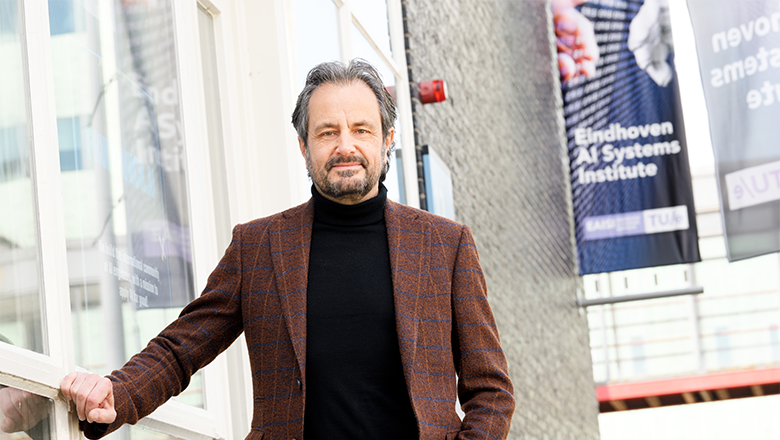
EAISI Director Carlo van de Weijer: ‘Start experimenting with AI; you will almost certainly become more productive.’ Photo: Bart van Overbeeke
Blame it on the sensors
Van de Weijer believes that the faster development of sensors compared to actuators is good news for AI. To clarify, he provides an example: ‘Try driving a car blindfolded. That won't work. However, if the steering system isn't working perfectly, you can still avoid all sorts of things. As long as you're getting the right data, there's still something you can work with. Without data, or with the wrong data, you have a serious problem.’
Sensors are therefore key players in the development of AI. With only exponentially growing computing power, it wouldn't progress nearly as fast, states Van de Weijer. But because sensor technology is also developing exponentially and sensors are being integrated more and more effectively, AI algorithms continue to receive the right – and sufficient – data, allowing intelligence to truly continue developing exponentially.
Unconditional world
Artificial intelligence sets conditions for the data it receives via sensors. But what those conditions precisely are is highly unpredictable. ‘As a sensor supplier and integrator, you will have to deal with that adequately and decisively,’ according to Van de Weijer. ‘You cannot make the world predictable. That would be nice for AI, as artificial intelligence functions best in a conditioned world. But then you would have to install traffic lights everywhere, regulate the weather, and so on, which is obviously impossible. You can only make AI work in the unconditioned, real world if you know the conditions of that world in real-time. That is the essence.’ And that requires well-integrated sensors.
Experiment
As stated, even AI evangelist Van de Weijer believes that sometimes too many rosy promises are made when it comes to AI. ‘I don't believe artificial intelligence will replace humans. But I do think that people who work with AI will replace people who don't work with AI. Because AI makes you structurally much more productive. We need that efficiency boost to continue economic growth.’
The director of EAISI is therefore not in favor of banning the use of tools like ChatGPT in schools. In fact, he urges everyone to get started with AI tools. ‘Just ask ChatGPT which tools could be interesting for your field,’ he smiles. ‘And start experimenting. You will almost certainly become more productive. Humans are distinguished from other animals because we use tools and share them with each other, further developing and improving them. Until now, these were tools that supported our arms or legs, but with AI, we have arrived at tools that help our brains. This is a development that cannot be stopped, so you might as well make the best of it. With sensors as a fundamental component.’
Discover the Six Levels of Sensory Integration: A Look into the Future
The development of AI goes hand in hand with advances in sensor technology. Sensors provide the crucial data that feeds AI algorithms, but without smart integration, we cannot fully utilize these technologies.
Would you like to learn more about the trends and challenges in sensor integration? Then read our blog about the future of sensor integration,in which our experts discuss the six levels of integration and explain how they contribute to innovation.
When integrating absolute encoders, OEMs and machine builders push the limits of catalog products. Unfortunately, these off-the-shelf components often prove unsuitable for your application. For instance, they may be too large, too heavy, or have the wrong form factor. Sensor manufacturers are aware of this. And they are responding to this need.
Increasingly, the available features in such a component are becoming the stumbling block. Then there are features included that developers don't need at all, while the functionality that could make a difference is precisely what's missing.
Sensor manufacturers are tapping into this trend. They are bringing stripped-down versions of their products to market. They are going back to the basics of their solutions. The functionality of the sensors remains solid, but the rest of the features have been removed. In other words, bare electronics.
A machine developer or sensor integrator can build a shell around it according to their own wishes and insights. Such a component requires more attention in terms of integration. But then it is also perfectly tailored for the application. The result is more compact and lighter, which is interesting in places where space is limited or mass plays an important role.
For example, a component that was previously only available in a robust aluminum housing is now also available in a stripped-down version. Such a stripped-down sensor consists of a small circuit board or even a single component that the user can place on a circuit board themselves. The complete functionality is retained, while all extraneous elements are removed, allowing such a version to form the basis for many secondary applications.
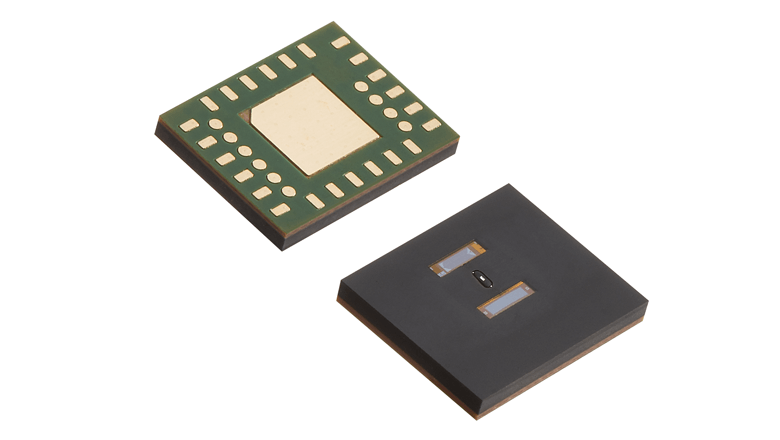
Celera Motion launched a line of absolute optical encoders with a focus on flexibility. The Aura chip encoders stripped of all non-essentials without compromising the intelligence of the sensors. Users can choose which features they want to add and fully customize the encoder for their specific application.
Easily integrable absolute encoder through minimalistic design
A good example of this development is Celera Motion's Aura encoder line. The variants in this series of absolute optical encoders all have a minimalist design. “They are chip encoders, PCB components that you can integrate into your own design,” says Rob Kuijpers, Product Manager at Sentech. “That's very interesting for OEMs because they can do anything with it. They do have to put in more effort for it. But they can implement it exactly as they want, allowing them to build the encoder system to precisely match their specific application.”
The Aura encoders are highly suitable for applications in, among others, the high-tech market, high-end robotics, and pick-and-place machines. “Think of applications where the sensor needs to be very small or where mass is of great importance, such as when it's integrated into an end-effector,” Kuijpers explains. “And it concerns situations where optical encoders are required to provide a very precise absolute position value.”
Optical miniature encoder
The Aura is not the first absolute optical encoder on the market. Existing solutions are significantly larger and more expensive. Celera Motion's chip encoders are very small (9 by 7 by 1.1 mm), feather-light (about one and a half grams), and considerably cheaper.
Please note that the encoders due to their optical character perform best in relatively clean environments. Dirt and moisture are detrimental to the extremely precise measurement.
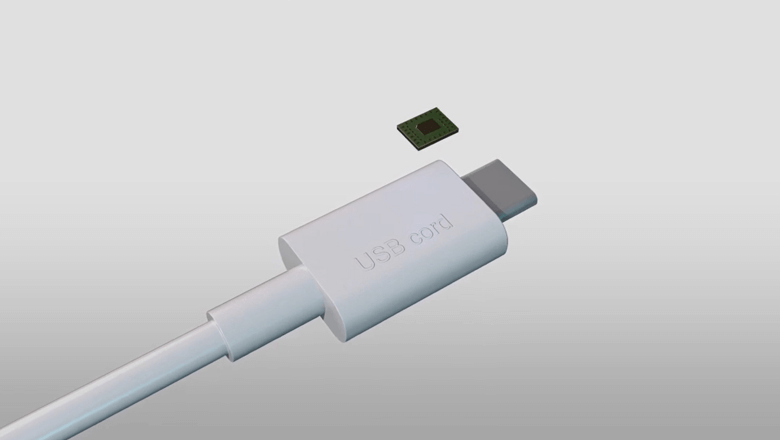
How big is such a chip encoder really? This Aura chip encoder is 9 by 7 by 1.1 mm. Here are the proportions compared to a USB-C connector.
Absolute positive value
The Aura encoders work with an LED as the light source. The light from the LED in the Aura is blue, and this was a deliberate choice. The shorter the wavelength, the smaller the details that can be distinguished. This means that these absolute optical encoders from Celera Motion therefore perform better.
The beam falls on a pattern of chrome stripes deposited on glass. The reflection of light on all these stripes creates a diffraction pattern that can be read out with a receiver. “The Aura encoders contain two such stripe patterns,” Kuijpers knows. “One is neatly repeating, the other semi-random. By combining the two diffraction patterns, the system can calculate an absolute positional value.”
How accurate are Aura encoders?
It's not possible to express exactly how good Aura encoders are with a single number. Usually, three main specifications are considered: absolute accuracy, repetition accuracy, and resolution.
Absolute accuracy
“The first spec is determined by the ruler you use,” explains Kuijpers. Celera Motion has opted for a glass scale with an accuracy of +/- 3 µm per meter. The manufacturer is tinkering with a variant based on a Metal tape measure. That is slightly less accurate at +/- 5 µm per meter, but much cheaper and therefore interesting for applications that don't require the absolute best in terms of absolute accuracy.”
Repeatability
The repeatability of the Aura encoders is, according to the spec sheet, 1 LSB, which stands for least significant bit. Kuijpers explains: “The value depends on the resolution of the encoder. In this case, the repeat accuracy therefore corresponds to the smallest resolution step.”
Resolution
Celera Motion provides a resolution for the Aura's in the range of 12.5 to 200 nanometers. Kuijpers: “You can achieve a resolution of less than a micrometer, that's for sure. Another major advantage of the Aura encoders is that they are very fast. So you can sample quickly, allowing you to average multiple measurements without too many negative side effects, thereby improving the resolution.”
New perspective on integration
The integration of Aura encoders is more involved than with a standard sensor. “It requires a new way of looking at integration. That approach fits well with our way of working, ”in which we work together with our customers towards the best implementation and integration,“ states Kuijpers. ”In consultation, we look at which variations, features, and cabling we add. That ultimate flexibility opens many doors."
Sentech works technology-independently. The customer's needs determine which sensor technology is the best fit. Therefore, we carefully select our technology partners based on quality, roadmap, and continuity.
With this step, we combine our integration knowledge with Baumer's technology. This way, we support machine builders, OEMs, and high-tech companies in the Benelux in developing their systems faster, smarter, and more reliably.
Baumer meets this standard. We have added Baumer to our technology portfolio, an internationally respected manufacturer of sensors, encoders, and measuring systems for automation and mechanical engineering. From now on, we can deploy Baumer technology wherever it offers the best solution for your application.
What this means for our customers?
Baumer expands our technological playing field. With Baumer, we can offer a better choice, tailored to your application, the environment, and lifecycle requirements. Our approach doesn't change: we start with the application, select the best technology, and build the solution entirely in-house: from engineering and (custom) assembly to validation and continuous supply.
By aligning component selection and integration technically from the start, you prevent unnecessary test cycles and redesign. This saves time in your development process and helps keep your schedule achievable.
What Baumer adds
Baumer is known for high-quality sensor technology for demanding environments, from positioning and detection to precise measurement. We apply this technology where it fits: as part of a broader solution, tailored to your system.

Egbert Stellinga, Product Manager, Sentech
With Baumer, we are expanding our technological playing field. Not because we want to carry a new brand, but because Baumer is the best choice for our customers in certain applications. This fits perfectly with how we work: customer demand determines the technology.
Are you considering Baumer for your machine design?
Are you working on a new machine or optimizing an existing application? Then we'd love to help you determine if Baumer is the right choice, and how we can best integrate it into your system.
Feel free contact us.
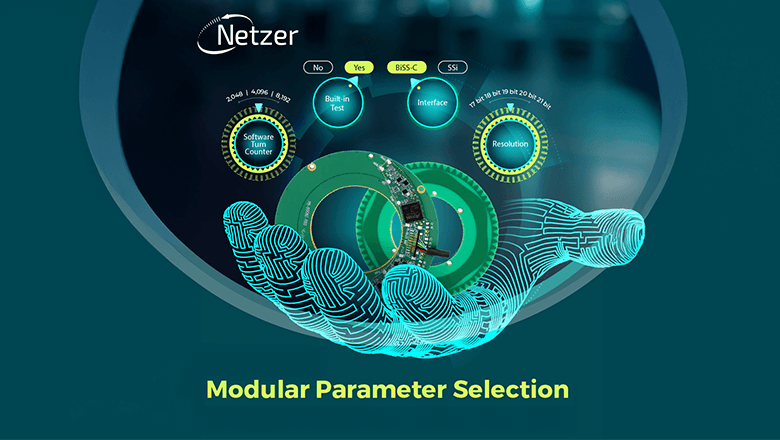
Development starts with the right choices, and that can begin right at the workbench. The EVL Evaluation Encoder from Netzer is a configurable development tool that gives engineers insight into performance, protocols, and integration early in the process. This allows you to easily test if an encoder fits your system before you build further.
The EVL is a practical development tool designed for rapid system integration and early-stage optimization. For example, the resolution and protocol (BISS-C or SSI) are configurable. The EVL works with a software-based multi-turn counter and built-in tests (BIT). This gives you direct insight into performance and integration, right from your workbench.
This makes the EVL suitable for robotics, aerospace actuators, and industrial automation, among other applications.
Complete and immediately deployable
The EVL is delivered in the familiar VL encoder housing (Ø13–247 mm), including a pre-assembled cable and D-sub connector. With the Encoder Explorer software, you have access to all parameters and diagnostics, such as:
- Limits View to illustrate limit values
- Map View for protocol behavior and integration effects
Want to learn more or get started?
Would you like to know if the EVL encoder is suitable for your application, or discuss integration into your prototype right away? Contact us. We will help you with configuration, choices in the development process, and smooth integration of the EVL into your system.
In use cases requiring three-dimensional environmental perception, such as navigation, object detection, or environmental monitoring, lidar is often the most suitable technology.
We have added Ouster to our technology portfolio, a respected manufacturer of digital lidar sensors for industrial automation, robotics, mobility, and smart infrastructure.
Sentech works technology-independently: the application determines which sensor best fits, and we select our technology partners based on quality, roadmap, and continuity. Ouster meets that standard.
When is lidar the right choice?
Lidar is relevant when accurate 3D data is needed in dynamic or complex environments. Consider AGVs and mobile robots that need to navigate safely, machine safety where objects at close range need to be reliably detected, or infrastructure monitoring where a complete spatial image is required.
Ouster's digital architecture is distinguished by a number of points that are practically relevant for engineers:
- High-resolution 3D imaging, useful for object detection and navigation, even at short distances.
- Robust performance in challenging conditions such as rain, dust, vibrations, or changing light conditions.
- Modular platform, the same sensors can be used in different applications without needing constant readjustments.
- Standardized interfaces and SDKs that help to quickly prototype or upgrade an existing machine.
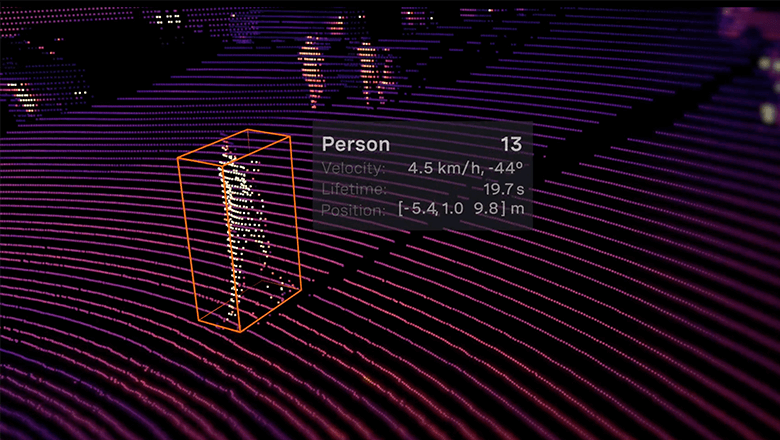
This 3D point cloud is generated by a lidar and shows thousands of measurement points that together form a 3D image of the environment. This allows machines to recognize objects and navigate safely.
Our approach is not changing
Ouster expands our technological playing field. We always start with your application: what is the measurement challenge, what are the environmental requirements, and what is the best technological choice? Sometimes that's lidar. Sometimes radar, vision, or another sensor technology. We select and build the solution entirely in-house: from engineering and (custom) assembly to validation and supply chain management.
“Ouster builds lidar sensors that perform where it counts: in complex environments, over long periods, in diverse applications. This aligns with what our customers expect from us, and what we expect from our technology partners.”
Egbert Stellinga – Product Manager, Sentech
Curious if lidar fits your application?
Are you working on a machine or system where 3D environmental perception plays a role? Then we'd be happy to discuss with you whether Ouster is the right choice, how it integrates into your system, and what that means for your development path.
Feel free to contact us.
In the world of modern technology, sensor integration is key to innovation. Increasingly, sensors are supplied as bare chips, offering manufacturers the flexibility to produce these components on a large scale. However, the challenge lies in further integration: from simple housings to complex, custom modules for specific applications.
Egbert Stellinga (Product Marketing Manager) and Rob Kuijpers (Product Manager) discuss the six levels of sensor integration, ranging from bare chip to fully integrated module. Due to the growing need for compact, accurate solutions, sensor integration is becoming increasingly important for efficient and innovative technological developments.
Read it full article on the High-Tech Systems website…
This article appeared in High-Tech Systems and was written by Hans van Eerden