

In the future, sensors will only become smarter and measure more accurately. Sensor technology is the foundation within machine applications. For an (R&D) Engineer, without the right sensor knowledge, a successful implementation of new sensor technologies becomes a real challenge! What can you expect from sensors in the future? Our list of 21 technological trends in sensor applications will give you a complete picture.
For your problem, it is becoming increasingly unclear which type of sensor is suitable for your specific situation. You are encountering challenges and issues at the component level, where you could use some help. This article discusses, among other things, where smart sensors are heading, sensor data fusion, and the most important development goals.
Why is the demand for smart sensors growing?
Our need for new insights is growing, and with these insights comes greater ability to steer. By being more proactive, processes can become more effective and efficient. Thus, you achieve more with less effort. In essence, everyone always strives for efficiency.
Previously, we didn't focus on measuring things and saving costs. This became possible because we transitioned from a world primarily using mechanical measurement principles to a digital era with sensor technology. As a result, more is also directly expected of us and our machines.
Digitalization has a positive effect on, among other things, the cost aspect, quality, and lead time of production. We want to produce more in less time. This leaves us with more time to do other things. And that's why the demand for intelligent sensors is growing.
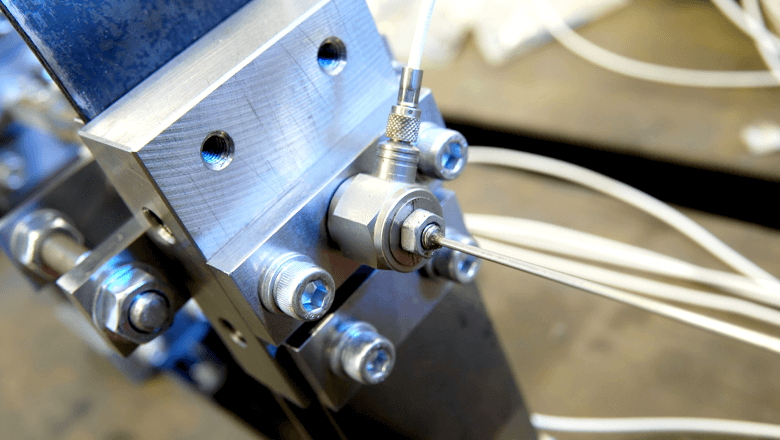
The demand for smart sensors is growing as we measure more and more.
Key Development Goals for Sensor Technology
As a development party, supplier, or customer of sensor technology, you weigh different interests. Think about costs, quality, and lead time. This influences the choice to, for example, opt for lower quality because it is cheaper and perhaps available tomorrow.
Kobus: “When it comes to innovation, we realize that we’re depleting the Earth and its resources. The balance of interests is different for everyone, especially when you know that your choice will lead to complete depletion within two or a hundred years. Sustainability is already a key goal in sensor development and innovation, but in the future, 100% will be a central theme.”
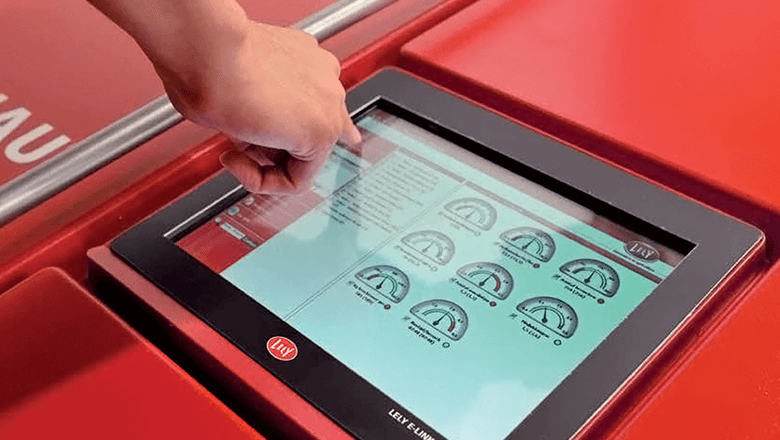
Lely helps farmers with smart machines in agriculture to make food production more efficient.
Efficiency and sustainability
The balance between sustainability and economic gain is always present in an innovation process. You can choose to make a large agricultural machine heavy and incredibly durable. However, this would require more fuel (and thus more money) to move it across land than a lighter machine.
If you make the same agricultural machine ‘of lesser quality,’ it burdens the environment more but may cost less to produce. At the same time, a shorter lifespan creates more room for faster innovation. With a very durable machine, long-term innovation is not possible or necessary.
The consideration mentioned naturally always involves costs versus benefits. Sustainability is therefore, in multiple facets, an advantage in the development of a new machine with smart sensors.
Expertise lies with the expert
Everyone knows about the existence of sensors in the future, but the awareness of which quantity they measure is becoming smaller and smaller. A company like Sentech adds value at this point because the underlying knowledge resides with the sensor experts.
The customer is assisted in choosing the right sensor technology for them and how to integrate it properly. Because knowledge will soon be scarce, a situation could arise, for example, where someone tries to measure length with a pressure sensor.
This might seem like a strange example, but the deeper know-how is missing, and this changes the added value of a sensor expert.
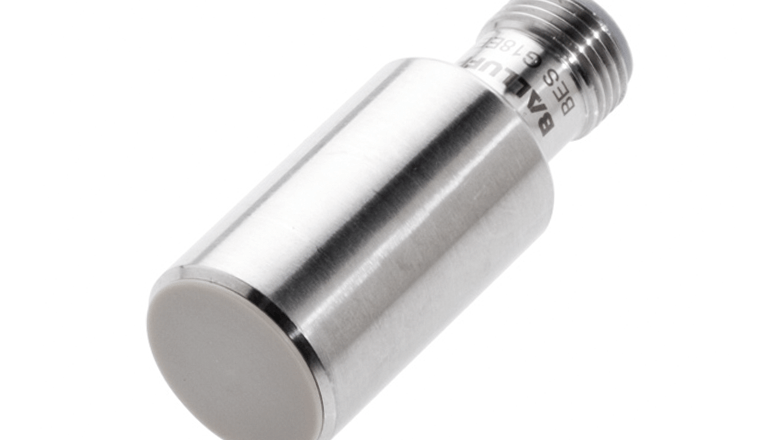
Balluff IP69K sensor
The basis for new applications for sensors
The drive to improve a customer's machine is the foundation for developing new sensor applications. What is important to the customer, what specifically can help them further, and do they see this themselves, or does a sensor expert add value to it? This requires continuous learning and innovation with new technologies. Are you already aware of the sensor trends for the coming years?
Innovation is accelerating, partly due to the arrival of‘sensor fusion’. Here, you integrate various sensors into one compact sensor application. The combination of two sensor techniques yields more new information to make applications smarter and more efficient. You are performing ‘sensor data fusion.’.
Sensor fusion as a person
The most suitable example of sensor data fusion is you as a person. You bring together different quantities and are then able to predict and anticipate in an efficient way. For that, you need all the senses in your body. In the future, sensors will also be able to work independently in this way. A machine will then be self-learning. Artificial intelligence with deep learning algorithms is the outcome of this.
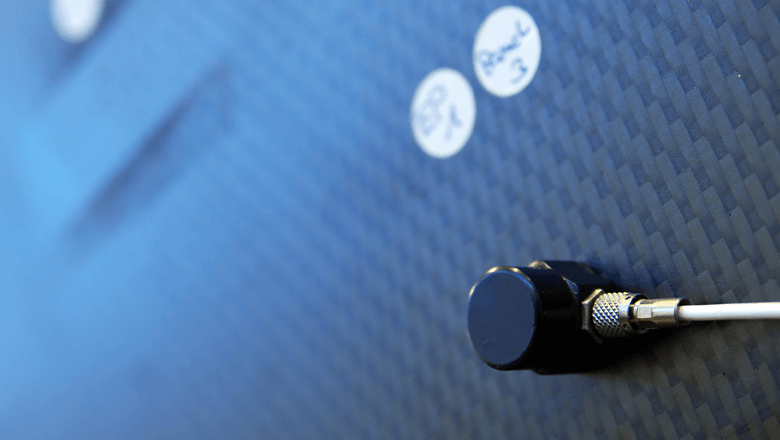
Sensor fusion makes applications more compact and smarter. Prediction based on sensor data and algorithms is taking off.
Making large amounts of data available via sensors, analyzing it quickly, and establishing connections (between application areas) is the strength of modern applications. Smart devices discover many more possibilities and models in this process than humans can.
If sensors can function together as a brain, then people and job roles will be quickly replaced in the future. This is also about efficiency and cost savings. New developments are implemented at high speed out of our human needs, and sometimes also necessity. Thus, the circle is complete again through sensor fusion.
Hesitant to share data
Making large amounts of data available is key to future sensor developments. This data is not just for yourself, but you share it (after consultation) with partners, each with their own specialization. Only through collaboration can you enable new revenue models and improve your machine.
The biggest hurdle is right at the point of disclosing (sensor fusion) data. Data is power, your money, your trade secret. By sharing data with a partner, you are giving away value. So the question of what you get in return will be a daily concern. Sensor innovation and the data released with it therefore create not only new opportunities but also collaboration challenges.
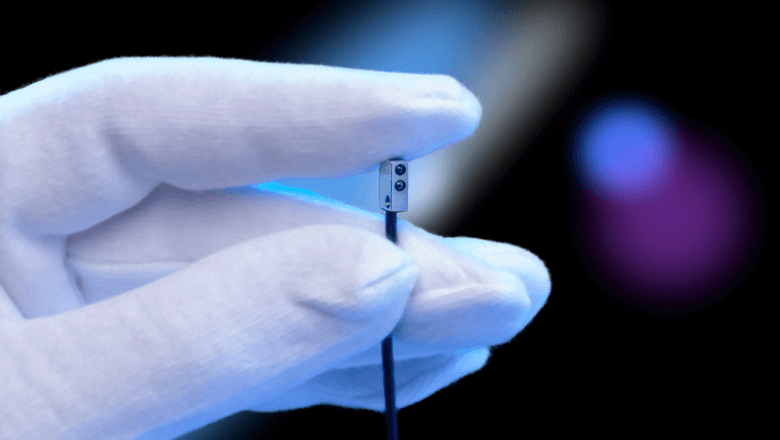
Such a sensor that measures light reflections can work wirelessly in the future.
The development process of wireless systems will continue until battery capacity becomes sufficiently powerful and chips are truly small enough to use less power. Battery usage efficiency will therefore improve. All of this combined will make wireless sensors a success.
The innovation wheel is only spinning faster
You see that in the future, there won't be one specific benefit coming from sensors, but a combination of benefits, focused on an application area. The realization of ‘this gain’ is growing for everyone, and at the same time, it's squeezing the margin on products and services.
So we're not only becoming more aware of the possibilities of technological advancement, but also of the associated costs and lead times. As we've started measuring everything and will do even more in the future, this ‘innovation wheel’ will spin even faster and our needs will grow. Sensors will replace our own senses in this process.
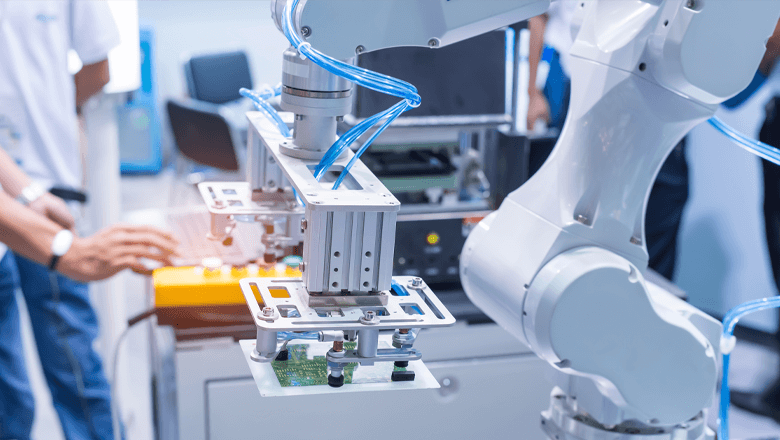
Active sensor innovation from a Research and Development driven department makes new sensor technologies for machines available faster.
21 sensor trends in future applications
Slimmer, more accurate, faster, wireless, more secure, self-learning, smaller, standardized… There are many sensor developments underway that all revolve around these points.
As an R&D Engineer, you can expect the task of keeping up with all developments and possibilities to become more challenging in the coming years. This list of 21 intelligent sensor applications will help you align your expectations with your projects.
Door sensor innovation, but also by increasingly rapid development of sensor fusion at the chip level:
- Predictive maintenance on machines and devices is becoming increasingly efficient, easier, cheaper, and improves uptime. The maintenance of the future with sensors will be performed on demand instead of according to schedules.
- Is safety also increased here, because unsafe situations are easy to predict?.
- Becomes autonomous sensor technology Possible. Wireless connection over long distances with integrated power supply.
- Can sensors work self-learning, lifelong, without maintenance, adjustments, or calibration?.
- The possibilities and application areas of robotic technology are increasing rapidly.
- New and old chip-level techniques are emerging. As transmitters, receivers, and printed circuit boards become smaller, more is possible with sensor fusion.
- Are more complex detections possible: compensation of techniques.
- Sensors will increasingly offer insights that change our behavior. As a result, we will place different demands on air quality, travel, car maintenance, lifestyle, insurance, energy consumption, etc.
- Is fully automated herd management possible? Precision agriculture would then also be within reach.
- Improve farmers' yields so that they can compete effectively on high quality and outputs. Sensors are increasingly being used to investigate soil quality, climate, crops, diseases, pests, and weeds.
- Will the (production) costs for farmers decrease and will working conditions in the fields and stables improve?.
- Do new lidar systems really give autonomous vehicles ‘eyesight.’.
- Are soccer balls equipped with sensor technology.
- Are we dealing with synthetic sensors?.
- Are cities becoming smarter, and can we complete the ecosystem? Consider addressing waterlogging, air quality, blue-green algae, parking, safe playgrounds, ensuring monumental trees survive, and improving soil conditions.
- Components take over the role of human senses. Data is collected more reliably and continuously. Smart software and algorithms convert the data into useful information.
- We are increasingly making decisions ourselves based on self-collected sensor information. We leave nothing to chance anymore.
- We encounter sensor technology in every aspect of our lives.
- Shall we deploy more sensors for a better environment, better energy management, and green office buildings?.
- Sensors are well-integrated measurement modules that are easy to use and quick to adapt to the respective application.
- Are sensors becoming true ‘smart sensors’: intelligent measuring units that monitor themselves, send status diagnoses to the operating system, and create a reliable network of measurement and calibration data.
Were you aware of all these developments? Is anything missing from the list, from your experience? Let us know!
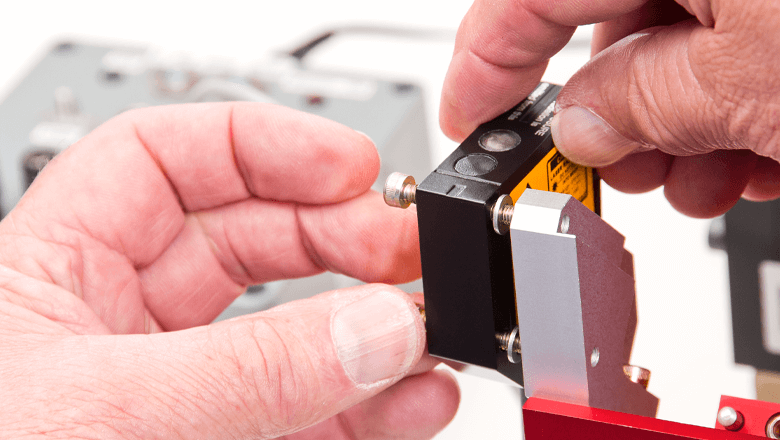
The added value of a sensor expert lies, among other things, in selecting the sensor technology that best suits you. They produce sensor solutions specifically for integration, which will improve your machine.
On to the successful implementation of sensor technology!
A successful implementation of new sensor technologies can be a real challenge. You want to make your machines smarter. So how do you use data to improve efficiency? And what awaits you as an engineer of the future?
In our free e-book, you'll find the answers to these questions, including practical examples of common sensor challenges and solutions.
Challenge yourself and take the time for it this download.
If sensor technology were not to grow exponentially at the same pace as computing power, we would not be able to fully benefit from the possibilities that artificial intelligence offers. This is according to TUE fellow Carlo van de Weijer. Because without accurate, preferably real-time, data, the unconditioned external world is incomprehensible to AI. In that sense, the integration of sensors in the AI era we are in is many times more important than the quality of actuators.
Carlo van de Weijer also sees it happening: the hype around artificial intelligence. ‘Some startups are just saying they're doing AI to raise more money.’ The director of the Eindhoven AI Systems Institute (EAISI) at Eindhoven University of Technology compares the situation to how the internet was viewed about thirty years ago. ‘Everyone said you had to get on the internet, but nobody knew exactly how or what, so in practice not much happened. We now know how impactful that technology has been. The reason we're talking so much about AI now is because we foresee that machines will become smarter than ourselves in the foreseeable future. We need to get to work on it.’
Van de Weijer substantiates that statement with three arguments. ‘To begin with, technological development, and thus the growth of computing power, is not stopping. There is no reason whatsoever why that development would stop,’ according to Van de Weijer.
Bag with algorithms
The second reason is that the development of AI does not stop at human intelligence. ‘Our brains are limited to one skull with a clock speed a million times slower,’ Van de Weijer explains. ‘If we collaborate with machines, we are more intelligent and can postpone the moment when computers surpass human computing power. But humans have finished evolving; machines have not.’
Don't people then have an advantage because they have consciousness, character, humor, or a soul? That question leads Van de Weijer to his third argument: ‘You then enter into a philosophical discussion. Can a machine ever enjoy a piece of chocolate? We can, but isn't that also just because we've learned that chocolate gives us energy? I admit, it's not the most romantic way to view a human, but aren't we essentially more than just a bag of algorithms? If there is any difference between human consciousness and AI, I don't think it will give us an advantage anymore.’
What is intelligence?
Scientists don't entirely agree on how long it will take for AI to surpass human intelligence, also known as the singularity point. The renowned futurist Ray Kurzweil, in his book ‘The Singularity Is Nearer’ (2024), suggests we will reach that point as early as 2029. Others estimate it to be somewhere around 2055-2060. ‘In any case, very few scientists are still saying it will never happen,’ Van de Weijer notes, immediately emphasizing that AI can already have a tremendous impact much sooner. ‘We're already seeing that now.’
To properly categorize the level of artificial intelligence, we must first define intelligence. Van der Weijer likes to use the description by American psychologists Robert Sternberg and William Salter. ‘They describe intelligence as...“goal-directed adaptive behavior”In classical automation, you start with the input. You run a program on it, and then you get your output. Many things called AI are actually nothing more than that. For me, something is truly artificial intelligence only if you provide the input, define the output, and let the machine determine how to get there itself. If the output isn't satisfactory, true AI can adjust the program until the output is correct.’
Sensors crucial for AI
For Van de Weijer, there's another important reason why the attention for AI has exploded in recent years, and that's sensor technology. ‘Computing power is developing exponentially. When something develops exponentially, people always underestimate it because we are linear thinkers,’ he begins his explanation. ‘Many systems can be reduced to a sensor that measures something, computing capacity or a bit of intelligence that, based on the measured data, draws a conclusion and then gives an order to an actuator. On top of that is a feedback loop to assess whether the action actually leads to a better measurement. That's how a system iterates towards the right outcome.’
Of course, actuators are improving, Van de Weijer admits. ‘Electric motors, pistons, hydraulic systems, you name it, the performance of such components increases every year. But that development is linear, not exponential.’ That's in contrast to sensors, Van de Weijer argues: ‘They ride the wave of Moore's Law, just like available computing power. Look at cameras, lasers, lidars. That type of technology all starts very expensive but gets incredibly small very quickly. And especially much cheaper. At a certain point, it even goes on-chip. It's happening incredibly fast.’
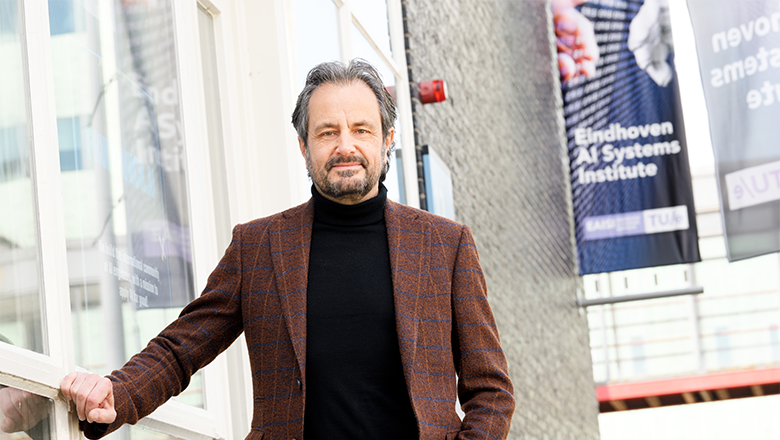
EAISI Director Carlo van de Weijer: ‘Start experimenting with AI; you will almost certainly become more productive.’ Photo: Bart van Overbeeke
Blame it on the sensors
Van de Weijer believes that the faster development of sensors compared to actuators is good news for AI. To clarify, he provides an example: ‘Try driving a car blindfolded. That won't work. However, if the steering system isn't working perfectly, you can still avoid all sorts of things. As long as you're getting the right data, there's still something you can work with. Without data, or with the wrong data, you have a serious problem.’
Sensors are therefore key players in the development of AI. With only exponentially growing computing power, it wouldn't progress nearly as fast, states Van de Weijer. But because sensor technology is also developing exponentially and sensors are being integrated more and more effectively, AI algorithms continue to receive the right – and sufficient – data, allowing intelligence to truly continue developing exponentially.
Unconditional world
Artificial intelligence sets conditions for the data it receives via sensors. But what those conditions precisely are is highly unpredictable. ‘As a sensor supplier and integrator, you will have to deal with that adequately and decisively,’ according to Van de Weijer. ‘You cannot make the world predictable. That would be nice for AI, as artificial intelligence functions best in a conditioned world. But then you would have to install traffic lights everywhere, regulate the weather, and so on, which is obviously impossible. You can only make AI work in the unconditioned, real world if you know the conditions of that world in real-time. That is the essence.’ And that requires well-integrated sensors.
Experiment
As stated, even AI evangelist Van de Weijer believes that sometimes too many rosy promises are made when it comes to AI. ‘I don't believe artificial intelligence will replace humans. But I do think that people who work with AI will replace people who don't work with AI. Because AI makes you structurally much more productive. We need that efficiency boost to continue economic growth.’
The director of EAISI is therefore not in favor of banning the use of tools like ChatGPT in schools. In fact, he urges everyone to get started with AI tools. ‘Just ask ChatGPT which tools could be interesting for your field,’ he smiles. ‘And start experimenting. You will almost certainly become more productive. Humans are distinguished from other animals because we use tools and share them with each other, further developing and improving them. Until now, these were tools that supported our arms or legs, but with AI, we have arrived at tools that help our brains. This is a development that cannot be stopped, so you might as well make the best of it. With sensors as a fundamental component.’
Discover the Six Levels of Sensory Integration: A Look into the Future
The development of AI goes hand in hand with advances in sensor technology. Sensors provide the crucial data that feeds AI algorithms, but without smart integration, we cannot fully utilize these technologies.
Would you like to learn more about the trends and challenges in sensor integration? Then read our blog about the future of sensor integration,in which our experts discuss the six levels of integration and explain how they contribute to innovation.
It's not surprising that acoustic sensors are increasingly being used for measurement tasks. Everything around us produces vibrations and can therefore be measured acoustically. They are versatile and still in the early stages of their development.
At Sentech, we've been closely following the developments around acoustic sensors for years. Below are the main highlights from our analysis.
Why acoustic wave sensors?
Acoustic wave sensors are incredibly versatile sensors whose commercial potential is just beginning to be realized. They are cost-effective, robust, sensitive, and intrinsically reliable. Additionally, they can be applied passively and wirelessly. Wireless sensors are useful for monitoring parameters on moving objects, such as tire pressure in cars or torque on axles (for predictive maintenance).
Sensors that do not require a power supply are essential for remote monitoring of chemical vapors, moisture, and temperature. Other applications include measuring force, acceleration, shock, angular velocity, viscosity, displacement, and flow. The sensors also have an acoustic-electric sensitivity, enabling the detection of pH levels, ionic contaminants, and electric fields.
Acoustic surface wave sensors have generally proven to be the most sensitive due to their high energy density at the surface. For liquid sensing, a special class of shear-horizontal acoustic surface wave sensors, called ‘Love wave sensors,’ has proven to be the most sensitive. Much work remains to be done in the development of these sensors for future applications.
9 types of measurements with acoustic sensors
Acoustic sensors can measure various physical quantities by detecting sound waves or vibrations. Here are 9 examples of what they can measure:
- Distance
Acoustic sensors measure the time it takes for a sound wave to return after reflecting off an object. This is similar to echolocation. - Strength
They measure the force exerted on a surface by analyzing how sound waves propagate through the material. - Displacement
Vibrations or displacements of an object can be measured by changes in sound waves traveling through the object. - Temperature
Acoustic sensors detect temperature changes by measuring the speed of sound waves in different materials. - Fluid levels
By measuring the time it takes for sound to travel from the sensor to the liquid surface and back, they can determine the liquid level in tanks or pipes. - Shocks and acceleration
They detect the speed and direction of shocks or accelerations by looking at how sound waves react to movement. - Humidity
Acoustic sensors measure changes in air humidity by observing the influence of water vapor on the sound signal. - Chemicals
Some sensors can detect chemicals and contaminants by analyzing how sound waves interact with molecules in the air or on surfaces. - Viscosity
Acoustic sensors measure the viscosity of liquids by observing how sound waves change in response to the fluid.
A Century of Innovation
The history of acoustic wave technology spans over 60 years, with its largest application being in the telecommunications industry. This industry uses approximately 3 billion acoustic wave filters annually, primarily in mobile phones and base stations. These filters, typically Surface Acoustic Wave (SAW) devices, are crucial in the radio frequency and intermediate frequency sections of transceiver electronics. Recently, there has been a growing interest in using acoustic wave sensors in various other sectors, such as the automotive industry, the medical sector, and industrial applications.
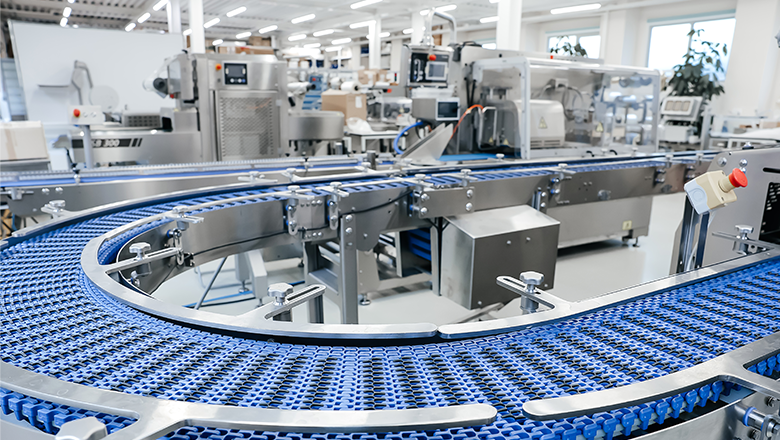
Acoustic sensors are suitable for predictive maintenance. They can, for example, detect abnormal noises from conveyor belts, which may indicate wear. In this way, they reduce the chance of unexpected failures.
The operation of acoustic wave sensors
Acoustic wave sensors use a mechanical or acoustic wave as the detection mechanism. When an acoustic wave propagates through or on the surface of a material, changes in the propagation path affect the wave's velocity and/or amplitude. These velocity changes are detected by measuring and correlating the sensor's frequency or phase characteristics with the measured physical quantity.
From piezoelectric substrate to sensor
The production of these sensors begins with the careful polishing and cleaning of a piezoelectric substrate, such as quartz, lithium tantalate, or lithium niobate. These materials are chosen for their specific properties, including cost, temperature dependence, and propagation speed. The manufacturing process involves depositing a metal layer, typically aluminum, and using photolithographic techniques to form an interdigital transducer (IDT).
Bulk waves versus surface waves
Acoustic wave sensors are distinguished by their propagation modes, such as bulk wave and surface wave. The most commonly used bulk acoustic wave (BAW) devices are the thickness-shear mode (TSM) resonator and the shear-horizontal acoustic plate mode (SH-APM) sensor. Surface wave devices such as the surface acoustic wave (SAW) sensor and the shear-horizontal surface acoustic wave (SH-SAW) sensor are also popular. The choice of device depends on the specific application and required sensitivity.
From the automotive to the medical sector: the versatility of acoustic sensors
Acoustic wave sensors are applied in a wide range of sectors. In the automotive industry, they are used for torque and tire pressure sensors. In the medical sector, they are found as chemical sensors. They can also be used in industrial and commercial applications as vapor, humidity, temperature, and mass sensors. Thanks to their sharp price, robustness, high sensitivity, and reliability, these sensors are rapidly gaining popularity. Furthermore, some sensors can be read out passively and wirelessly, offering additional advantages in certain applications.
The future of acoustic wave sensors
Recent developments in acoustic wave technology include the creation of higher frequency and sensitivity sensors, utilizing advanced materials and micro-fabrication techniques. These innovations open doors to new applications and improvements in sensor performance. The focus is on increasing sensitivity, reducing costs, and broadening the scope of applications.
Acoustic wave sensors are on the verge of a new wave of technological innovations and applications. With their versatility, cost-effectiveness, robustness, and high sensitivity, they offer promising opportunities for diverse industries. Whether it's monitoring tire pressure in moving vehicles, detecting chemical vapors remotely, or measuring force and acceleration, acoustic wave sensors will greatly advance the way we understand our environment.
Stay ahead in sensor innovation
In a world where technology is developing at lightning speed, it's difficult to stay up-to-date. Do you want to stay informed about the latest developments in sensor technology? Our newsletter will give you a head start.
Via our monthly newsletter receive your technology blogs, news, trends, and background stories in your inbox. Sign up now and discover what sensor technology holds for the future!