

After many years of successful collaboration, sensor specialist Sentech and drive technology expert Zilvertron are making their business relationship official on May 1, 2024. Together, they will continue to build on their shared goal: to offer customers a total solution.
Synergy is the keyword in the strategic collaboration between Sentech and Zilvertron: both strongly believe in the 1+1=3 principle of their collaboration. Together, they can serve their customers more broadly in motion solutions, and that is precisely the question Marco Leeggangers, Sentech's Chief Business Development Officer, increasingly hears from the market: ’But then you don't want to collaborate with just anyone. It has to be a company with the same vision.' That's why the search for suitable partners began a few years ago. Smile Invest stepped in as a financially strong partner and offers significant added value with its expertise in (international) growth for Sentech's ambitions.
Same standards and values
Now Zilvertron is joining, a specialized supplier of drive technology with engineering capabilities, who, like Sentech, puts the customer first. And, like Sentech, goes the extra mile in serving its customers, for example, when a new product is introduced at their facility. Leeggangers: ‘We sit at the table with our clients and brainstorm solutions with them. We are not a distributor who pushes a box to the customer, but we integrate the necessary technology ourselves with our own engineering department for seamless implementation. Zilvertron has the same way of working. That's why this is such a good match.’
It's not just the visions that meet: the expertise of Sentech and Zilvertron, sensors and drive technology respectively, are both needed for a good motion solution. In their new form, they will offer their customers totally integrated motion solutions.
No big changes
With both Sentech and Zilvertron, the customer has always come first. From this perspective, the optimal details of this collaboration naturally fall into place, explains René Jansen, director at Zilvertron: ‘No new contracts, so no new logos, names, or contact persons, no hassle. But even more possibilities.’ The companies will retain their own identities and will form a group as of May 1st through the acquisition of all Zilvertron shares.
Future plans
So, no major changes on the horizon for the newly-techs for now. But when it comes to the long-term vision, there are indeed big dreams: together, they want to continue growing into a total technology provider. A journey that, if it's up to them, will take them abroad.
The choice is enormous when looking for the right encoder. Does your application need an incremental or absolute encoder? And do you opt for inductive, capacitive, or optical technology? Later in the search, you'll also have to decide on the sensor form factor... Many facets for which you could use some help.
Absolute encoders have been around for years. Meanwhile, the capabilities of the implementations of this sensor type are growing enormously. Sean Ram, Account Manager at Sentech, can speak to this: “Rotary absolute encoders, in particular, have made significant progress.”
“This way, there's a choice in both the different techniques and the executions. Which encoder fits your application depends on the specific use case. Of course, we also consider whether the investment is profitable,” Ram adds.
Absolute vs. incremental encoders
Where absolute encoders provide an absolute position, incremental encoders measure changes in position. They count the number of encoder steps moved during movement.
Such an incremental system needs a fixed reference point to achieve an absolute position measurement. “Incremental encoders are less suitable for applications with fast movements. If they miss a pulse, they don't know their position,” Sean explains.
“An absolute encoder can sometimes be wrong. This is easily corrected at the next measurement point. Therefore, the control for a motor with an incremental or absolute system is very different.”
What does your application need?
Can a reference point be added to your system? Then an incremental encoder is often a suitable solution. “If homing isn't possible in your application, for example due to safety reasons, then you'll often end up with an absolute system,” says Ram.
Rotary encoders for robotics applications
Absolute and incremental encoders are available in linear and rotary versions. Ram notices that demand for rotary absolute encoders has increased: “We see more and more customers building their robots from scratch.”
“This can be seen in the medical sector and in agriculture and horticulture, for example. Companies are developing their own robotic solutions everywhere. In some situations with one degree of freedom, but even then the rotation must be measured accurately. This is because such systems often work with brushed or brushless motors. These types of motors need to know precisely where the coil is located relative to the magnets during startup. This allows them to regulate the control properly. So, you need an absolute position for that.”
In addition, more and more Dutch companies are working with a combination of AGVs and robots. Sean sees that companies build the system themselves: “They need something special. A ready-made system doesn't fit that. They often have the capacity to build a system in-house, which also makes it more cost-effective.”
Solution for rotations
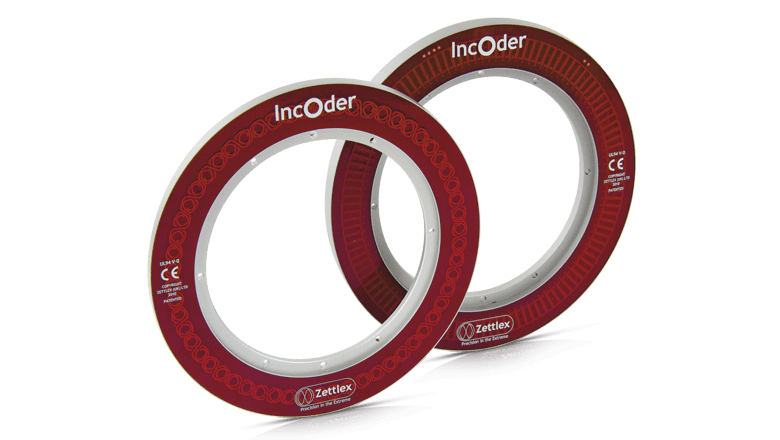
For systems like robots, you usually deal with a lot of rotations. In those cases, a hollow-shaft encoder can be the solution. “These are ring-shaped encoders with an open inner mechanism. You then run the cables for data signals and power through the inside of the system,” Sean explains.
Hollow shaft encoders consist of two parts: a transmitter and a receiver that can rotate contactlessly. Ram sees a second advantage in this: “Because the parts don't touch each other, the components don't wear out. That's the case with traditional absolute encoders with shafts and bearings.”
Pros and cons of absolute encoders
When it comes to absolute encoders, there are quite a few variants and technologies on the market. They all work slightly differently. Each has its own advantages and disadvantages.
Broadly speaking, this is how it works: one of the encoder components has onboard electronics and generates a field. That field can be magnetic-inductive, electric-capacitive, or optical. The other part of the encoder is passive and influences that field. This disturbance is measured and provides information about the angular displacement.
The passive encoder part has a pattern. That pattern has a unique encoding and therefore a unique disturbance over the entire 360 degrees. This allows the system to always know the angle of the encoder.
Levels of accuracy
The accuracy of encoders varies by technology and brand, Sean knows: “When integrating inductive encoders, we often opt for Zettlex from Celera Motion. With those, you can measure with approximately 0.01 degrees accuracy. When we work with capacitive encoders, we often choose Netzer. Those achieve an impressive 0.005 degrees.".
Then there's a third type of encoder: optical technology. “Celera optical encoders from MicroE achieve accuracy comparable to capacitive encoders,” Ram knows.
Sean emphasizes that it's not just about precision. “There are more factors involved. Ultimately, the application determines which technology is best suited.”
When do you choose which encoder?
Environmental conditions play a big role in choosing your encoder type. “Are you dealing with a clean environment? And is the encoder built in such a way that no dirt can get to it? Then an optical encoder can be an excellent solution. Such an encoder is light, relatively inexpensive, and achieves high performance,” says Sean.
If contamination such as dust is involved, an optical encoder is not suitable.
“For less clean applications, you often end up with a capacitive encoder from Netzer,” says Ram.
Capacitive technology is susceptible to moisture. This is because moisture particles can disrupt the capacitance. That's why Ram usually opts for inductive encoders in humid environments: “They are even suitable for a remotely operated submarine that is 500 meters underwater, for example.”
Calibration
What should you pay attention to when integrating absolute encoders? “Such an encoder consists of two separate parts that you must position correctly – relative to each other. No matter how precisely you work, a human error can easily happen,” says Ram.
“For the air gap and the non-eccentricity of the rings, you should think in terms of accuracy to a tenth of a millimeter. These are familiar specifications for many companies. Some partners, like Netzer, help you by incorporating a calibration run. The two parts probe each other's position, allowing you to correct any installation errors relatively easily.”
Close-up engine montage
Generally, encoders are deeply embedded in a machine, close to motors. What is the influence of the strong magnetic fields from motors on encoder measurements?
“All technologies are insensitive to external interference fields. Here's how it works: developers cleverly modulate the signal between the two parts and chose different frequencies. Interference from external magnetic fields is therefore a thing of the past,” Sean explains.
In addition, the encoders are very flat and lightweight. “This makes this technology very suitable for robots with high accelerations, where every gram counts.”
This article appeared in Mechatronics & Mechanical Engineering issue 3 2021 and was written by Alexander Pil
If you want to work according to high quality standards, ISO 9001 is sometimes not sufficient. That is why the automotive industry developed IATF 16949. With this quality standard, you develop a reliable and durable end product.
Automotive companies like to work with manufacturers that comply with IATF standards. For example, in 2009, the collaboration with DAF prompted Sentech to obtain an IATF certificate.
Certification
In 2021, IATF introduced changes to the standard. As a result, Sentech decided to continue working according to the standard, but not renew the certification.
Therefore, after twelve years, our IATF certification will expire on July 9, 2021. If customers require IATF certification again, we will discuss the possibility of recertifying.
Maintain quality with high quality standards
The core tools and processes – originating from IATF certification – have been interwoven for twelve years our method. In 5 phases, we identify risks in a timely manner and make them manageable. This is how we guarantee the quality of the end product. After not renewing the certification, we will continue to work according to these high quality standards.
Continuously developing and optimizing our processes, as well as developing our employees, remains an important theme. We do this in addition to our ISO 9001 certification, which remains in effect.
What does working according to IATF 16949 standards look like?
For industries like automotive, ISO 9001 is not sufficient. They go a step further and work with IATF 16949.
This high-quality standard also ensures a reliable and durable end product in your market. In addition, you can fully adapt the process to your quality needs.
Discover what IATF means and how you can applied on your project.
On March 25, 2022, Smile Invest will acquire a majority stake in Sentech. In order to achieve its growth ambitions and long-term objectives, Sentech held exploratory discussions with several financial partners last year. Following a careful selection and due diligence process, the decision was made to collaborate with Smile Invest.
Sentech was founded in 2000 by Marcel Figge and now has more than 60 employees. Sentech's sensor solutions are used worldwide in applications within the semiconductor industry, automotive, healthcare, and agromarkets. Due to the rise of innovations such as autonomous vehicles, the Internet of Things, and artificial intelligence, the sensor market is expected to continue to grow strongly in the coming years.
Commercial Director Marco Leeggangers and Operations Director Hermen Kobus will take on the day-to-day management of Sentech as a two-person executive team. Founder Marcel Figge will continue to focus on long-term strategic projects. Marcel Figge: “With Smile Invest, we’re bringing on board a partner that not only has the necessary network, capital, and technical expertise, but also aligns with our vision of creating long-term value for our customers in a transparent manner. Smile’s entry into the shareholder structure comes at a time when we are ready to take the next major step. With these new resources and expertise, we will invest in building a solid footprint outside the Netherlands and further professionalizing our operational facilities.”
Marco Leeggangers and Hermen Kobus add: “In recent years, we have been actively involved as managers in building the foundation. Now, in our new roles, we can set the direction ourselves to become a leading supplier of integrated sensor solutions in Northwestern Europe, and to make Sentech an even stronger company. This feels like a logical step for us, but it remains a new chapter, which is why we are pleased to bring in an experienced partner like Smile Invest who will help us navigate the next phase.”
Ad Notenboom and Bart Cauberghe, partners at Smile Invest: “For us, Sentech is the prime example of a Dutch high-tech gem with a unique market position. The professionalism of the organization, the quality of its solutions, and its high customer satisfaction are at a level typically seen in companies that are a few years ahead. Sentech's technically innovative profile, combined with its strong growth ambitions, aligns perfectly with our investment focus. We will support Sentech in achieving these ambitions and believe the company is perfectly equipped for both organic and inorganic growth of its activities.”
Over Smile Invest
Smile Invest (Smart Money for Innovation Leaders) is a European evergreen investment company with €350 million in capital under management, funded by 40 entrepreneurial families with a long-term focus on innovative growth companies. Smile Invest focuses on companies within three investment themes: digitalization, health, and sustainability. From offices in The Hague and Leuven, the team supports ambitious entrepreneurs and managers in achieving their growth plans.
Wearing face masks does not lead to more risk-taking behavior, and one-way traffic appears to be effective. Using a Social Distancing Sensor (SDS) also works when properly instructed. This is evident from a recent experimental behavioral study with real-time tracing by the Smart Distance Lab. Technology company Sentech is therefore launching the Social Distancing Sensor (SDS) on the market.
In the Smart Distance Lab, an initiative of the University of Amsterdam, cameras and sensors were used to measure how much distance people kept from each other. Researchers compared different interventions.
Sensor
The use of the Social Distancing Sensor leads to fewer contacts than when visitors do not wear a sensor. This tag provides direct feedback on behavior. The study also shows that this intervention must be clearly and consistently explained to visitors. People should also be able to try it out for a bit.
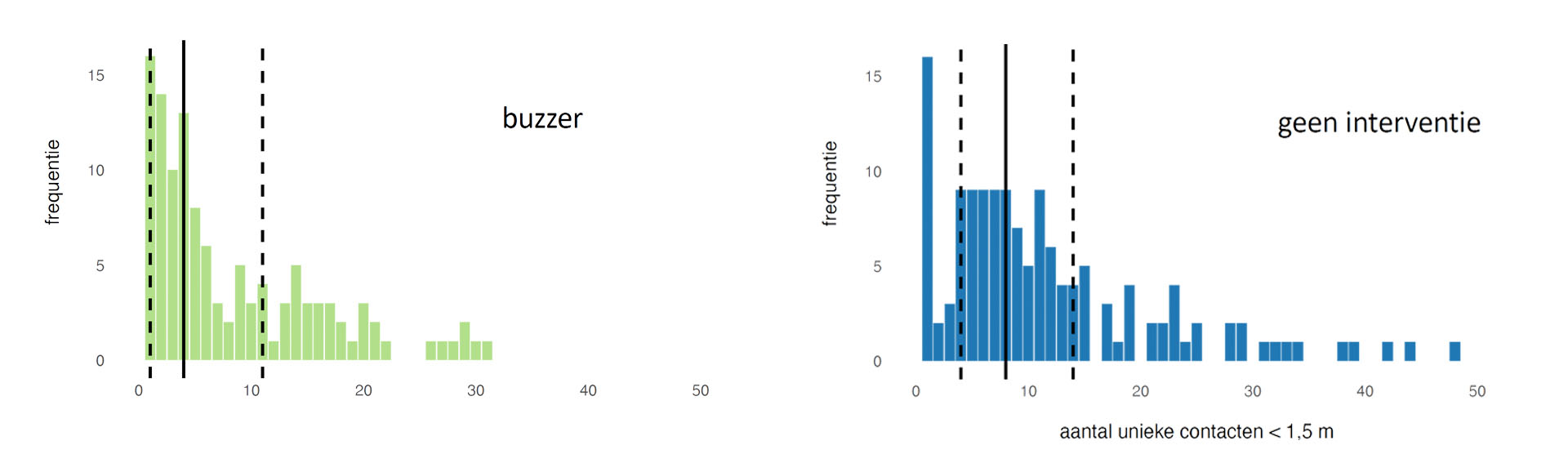
For example, the Social Distancing Sensor gives employees a warning signal if they come within 1.5 meters of a colleague with such a tag. There is a choice of different types of signals: vibration, sound, and/or light. The SDS not only makes office environments safer. Event and production locations, warehouses, and construction sites also benefit from such a solution.
Face masks and direction of travel
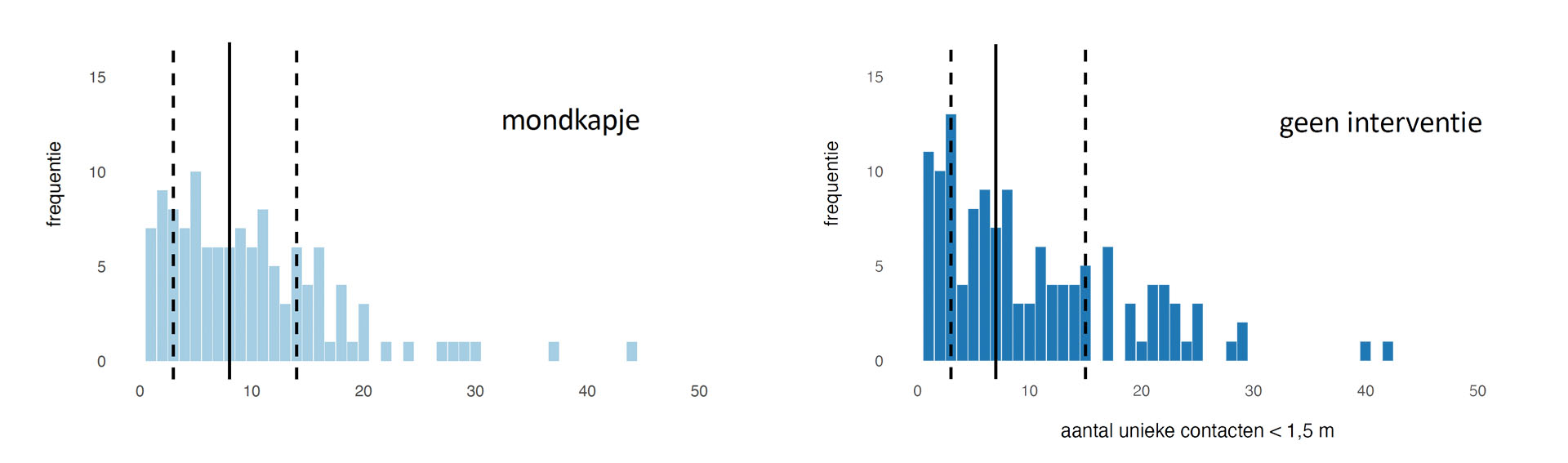
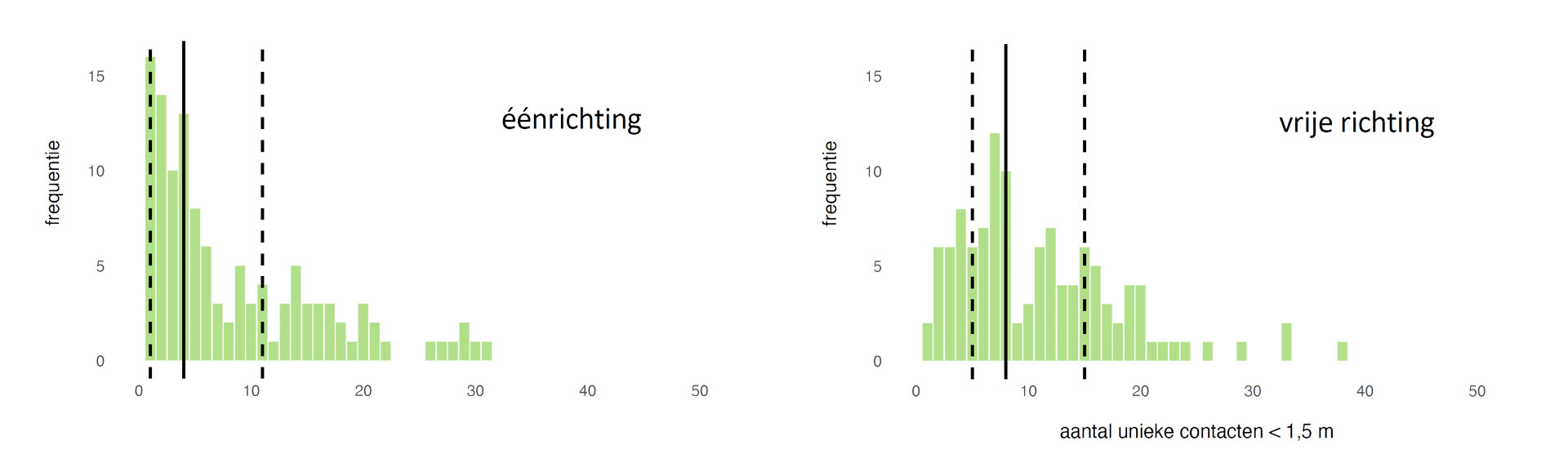
Wearing face masks does not lead to additional contacts. Visitors wearing face masks felt more protected than visitors without face masks. In addition, a one-way route leads to fewer contacts than a free-direction route. The distribution of the number of contacts that a visitor might be infected with is more favorable.
Reliability
Incidentally, there are other systems that alert users to maintain a distance of 1.5 meters from one another. The CoronaMelder app even notifies you if you’ve been near an infected person. The app uses Bluetooth to track proximity, which isn’t 100% reliable. “Whether you have a phone in your pocket also makes a difference,” Ron Roozendaal told NOS earlier. He is the Chief Information Officer at the Ministry of Health.
The CoronaMelder is now issuing around 10,000 notifications per day, even at distances greater than 1.5 meters. How reliable is the measurement then? The need for a system that is accurate is growing with the increasing number of Corona infections.
The ultra-wideband (UWB) technology is used in the Social Distancing Sensor. You can put it in your pocket or wear it around your neck, and the distance measurement is fully maintained. The measurements are much more accurate and reliable than, for example, Bluetooth. Sensor specialist Rob Pieters from Sentech: “Measurements are taken twice per second at the speed of light, with an accuracy of centimeters. You know immediately if you are too close to someone.”
Sentech is further developing its sensor software in collaboration with Focus Technologies. This will soon allow for measurements of how long people have been in contact with each other, when those contacts occurred, and where. Such time-based measurements are interesting for source and contact tracing. “For example, the GGD (Municipal Health Service) in Breda has already purchased sensors. They have many employees who work under high pressure, and maintaining a minimum distance of 1.5 meters is difficult in those situations,” says Pieters.
Best way to organize an event
“Larger events can be safe if carefully planned,” according to researchers at the Smart Distance Lab. The 1.5-meter rule needs a time duration specification. “With the specification ‘more than 20 seconds,’ we measure no contact in a corner with good airflow. This is important in communication from politicians to citizens.”
Based on the initial results, the research recommendation is that you best organize an event by applying one-way directional guidance. “You can also use a sensor that informs visitors whether they are succeeding in keeping their distance,” says the Smart Distance Lab. It is crucial to clearly explain to visitors how the Social Distancing Sensor works. They need to know what is expected of them when it activates.
“It would be fantastic if we could then link a reward to that; that the visitor with the fewest violations receives something (editor's note: a drink, an entrance ticket). We know that rewards work much better than punishments. By linking it to behavior in such a way, we can encourage social distancing,” the researchers conclude.
Frank Wijnveld, Crowd Management Expert at the Event Safety Institute, emphasizes this. He does so in this video: