

What started as a bold step in a single-family home has grown into a leading technology company in sensor integration. On October 11, 2025, Sentech will celebrate its 25th anniversary. A milestone that not only makes us proud but also grateful, because it began with one decision that truly made a difference for customers. And we continue to do so today.
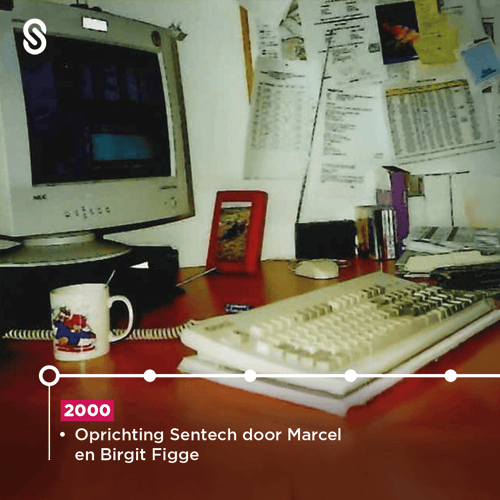
In 2000, Marcel worked for a sensor supplier that sold two product lines to a competitor. The competitor immediately declared the products obsolete and replaced them with their own sensors. Customers had to adapt their machines, which led to great frustration. Marcel thought: this needs to be different; customers shouldn't have to suffer for this. He arranged direct delivery from the original manufacturers and let customers know they could come to him for their trusted sensors. Together with his wife Birgit, he started Sentech, from their home.
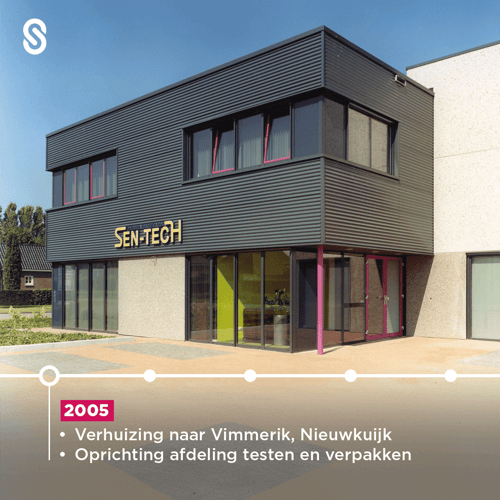
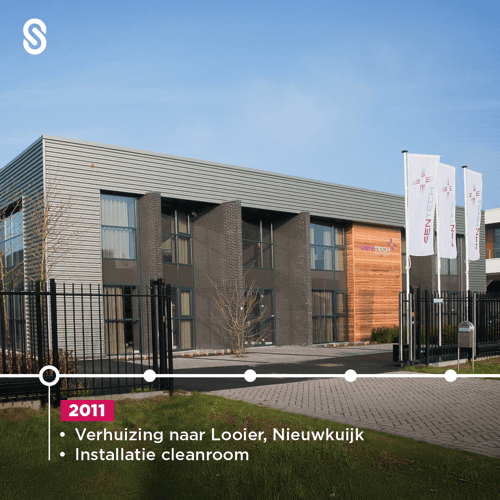
This building made way for an office building in ‘s-Hertogenbosch in 2001. In the following years, there were four more moves, to different locations in Nieuwkuijk.
Sensor integration as a specialization
Soon, the demand arose for more than just delivering sensors. Customers wanted customizations: a different connector, better integration into their machine, advice on integration. This is where Sentech's DNA was formed: we solve sensor challenges that cannot be solved with a standard sensor. With our knowledge of sensor technology and the application, we develop a suitable solution, often plug-and-play, that precisely meets the customer's requirements. We have since grown into a one-stop-shop, even taking responsibility for the entire supply chain. This way, we unburden our customers from start to finish.
From certification to more complex sensor solutions
Our perception of quality underwent significant development. In 2001, we obtained ISO 9001 certification. In 2008, we followed this with IATF 16949 certification, a stringent standard for the automotive sector. Thanks to this standard, we can also solve the most complex sensor challenges.
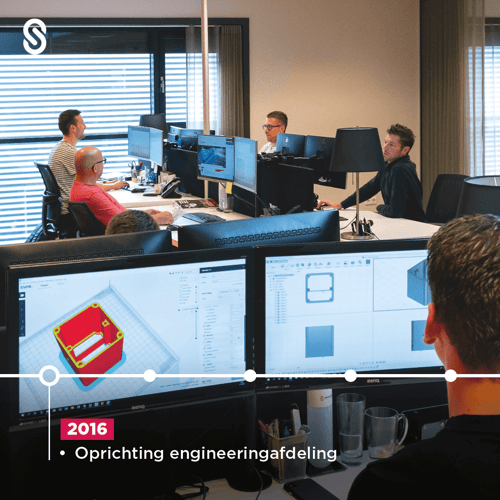
Our approach grew with technological advancements. In 2016, Sentech established its own Engineering department, allowing us to develop proprietary sensor solutions that are not yet on the market. This includes chip integration or applying radar technology in agricultural applications.
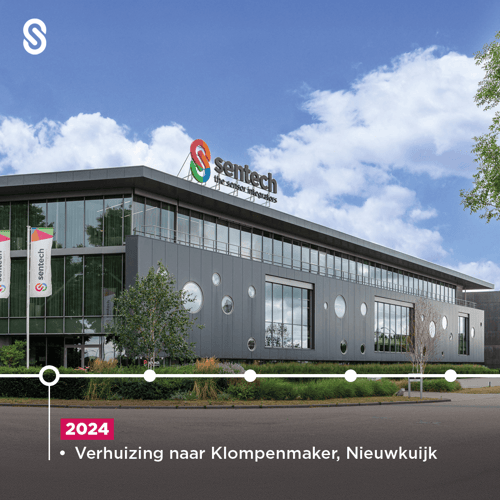
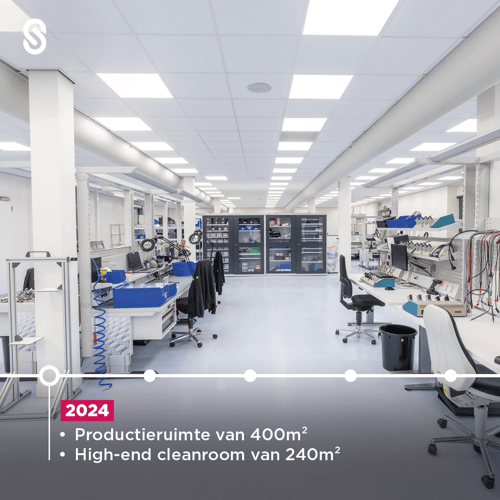
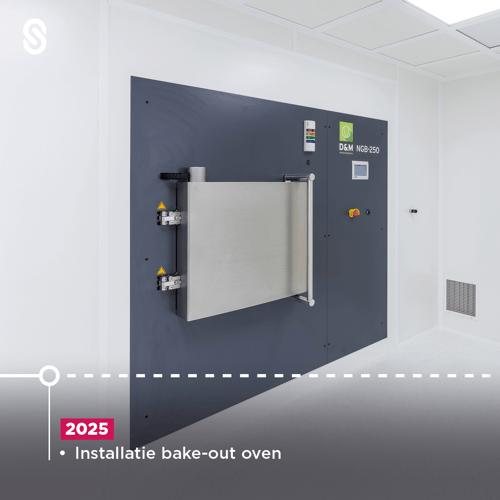
In early 2024, we moved into our new premises at Klompenmaker in Nieuwkuijk, right off the A59. A great step, as it significantly increased our space: 400 m² of production space and a high-end 240 m² cleanroom.
On to the future
After 25 years, our passion for technology is as strong as it was on day one. And just like then, we believe in building long-term relationships. With clients, partners, and colleagues.
We are broadening our foundation now. At Sentech, we are working on a larger plan where we will integrate motion and control solutions alongside sensors. We are doing this together with our sister company Zilvertron, with whom we are joining forces to offer customers even more complete solutions.
Without the trust, commitment, and collaboration of everyone around us, our growth would not have been possible. We are truly grateful for that. Here's to the next 25 years of smart innovations, strong collaborations, and technology that makes a difference.
Timeline: View Sentech's Milestones
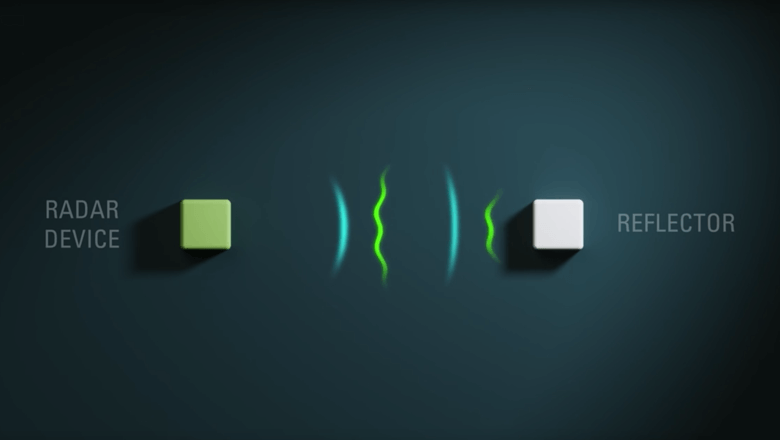
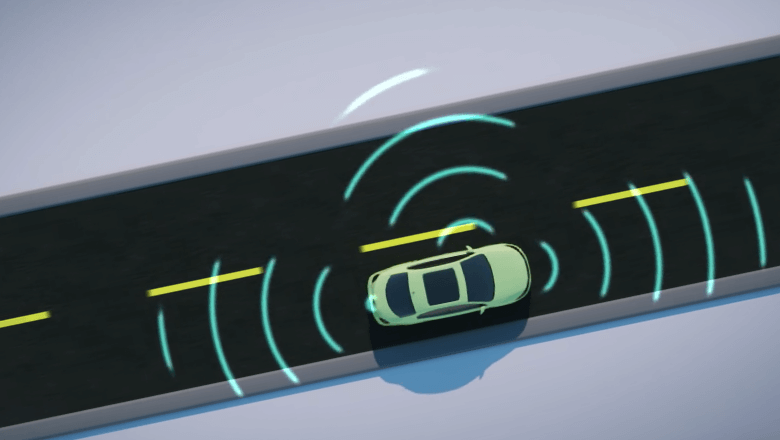
The radar sensor measures distances, movements, and speed. By reflecting a high-frequency signal off an object, the sensor calculates the distance to the object. The transmitted signal is reflected by, among other things, buildings and liquids. This makes this distance sensor suitable for applications such as liquid level measurements, distance measurements in traffic, and object detection.
Unlike distance sensors such as ultrasonic and laser, radar can measure through materials like plastic. This allows for the invisible integration of the radar sensor into your application. Furthermore, this robust technology is insensitive to wind and moisture.
How do radar sensors work?
Radar works based on time of flight: the sensor measures how long a signal has been traveling. The integrated antenna of the radar sensor transmits a high-frequency signal (62 GHz), which is the transmission signal. A lower frequency (10 MHz) is also modulated within this signal. When the signal is reflected by an object, the sensor receives the signal back. The sensor measures the phase shift between the two frequencies. The time difference between transmission and reception determines the distance between the object and the sensor.
Frequencies create opportunities
Every frequency has unique properties. Depending on the frequency's height, you will have a different type of reflection or none at all. For example, with a 5 GHz radar, you can very effectively detect rain clouds at very large distances. That frequency reflects very well off moisture crystals. If you use a 60 GHz radar, for instance, it will not recognize rain clouds and will go right through them. However, an airplane or another object will reflect the signal.
Unlike radio signals from broadcast stations, radar sensor signals are reflected by buildings and liquids. This is because radar frequencies are higher. The higher the frequency, the less impenetrable a wall becomes, for example.
Radar is an abbreviation for Radio Detection and Ranging. This means finding and measuring (objects) using radio signals.
The alternative to ultrasound and laser
Besides radar, you can also measure distances using ultrasound and lasers. Each technology has its own advantages and disadvantages. For example, ultrasound sound signals cannot measure through materials like plastic and crops. Light signals from lasers are also hindered by these materials. Additionally, sound is sensitive to displacement by wind.
Unlike sound and light signals, radar signals can measure through most materials. Only metal objects cause the signal to be dampened. Thanks to these properties, radar is suitable for agricultural machinery, for measuring the distance to the ground, without crops affecting the measurement results.
Applications
You will find radar in both indoor and outdoor applications. The radar sensor is used for distance measurement, both at long ranges and at heights. Because every frequency has different properties, radar is suitable for a wide range of applications.
Liquid level gauge
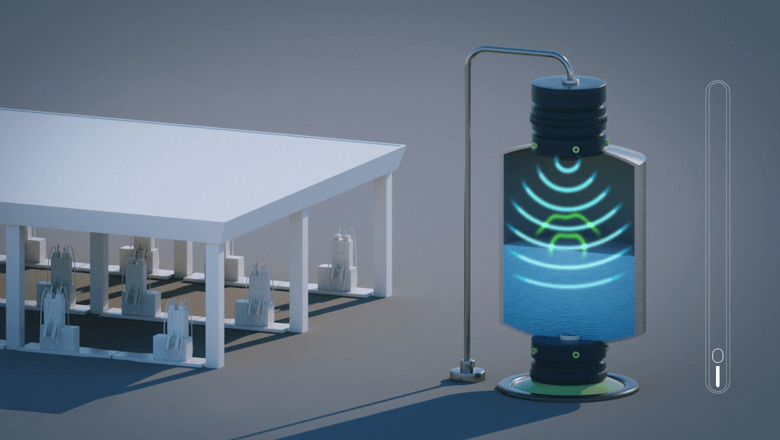
At the correct frequency, radar can measure the liquid level in a tank. The transmitted signal travels through the air to the liquid surface, which reflects the signal back. The sensor ensures reliable measurement, even under harsh conditions such as vapor and high temperatures.
Distance Measurement in Traffic
Radar is also used for distance measurements in traffic, such as adaptive cruise control in cars. Because the technology is reflected by metal at almost all frequencies, radar ensures a safe traffic situation.
Distance Measurement for Agricultural Machinery
In the agricultural sector, we also see radar making a return. For example, in the Agrifac spray booms. Here, radar sensors measure two distances: the distance between the spray boom and the ground, and the distance between the spray boom and the crop. The sensor also measures plant density.
5 benefits of the radar sensor
The properties of radar determine whether this sensor is a solution for your application. Here are 5 reasons to choose radar.
- Seamlessly integrate
Because radio signals can pass through plastic, the sensor can easily be hidden behind a plastic plate. This way, the technology does not detract from the design of your application. - Robust
Because radar is so easy to conceal behind materials, the sensor is not visible. This makes it robust and prevents vandalism. Furthermore, this integration protects the sensor from environmental factors such as moisture and dirt. - Suitable for demanding conditions
Compared to ultrasonic and laser sensors, radar sensors are less sensitive to rain, snow, heat, dust, steam, and dirt. Furthermore, measurements are reliable in strong winds because the transmitted signal does not blow away. - Many materials are measurable
Each frequency level has a different reflection and penetration on materials. If you want to measure a material or not, you can adjust the frequency accordingly. - Secure technology
The radar used by Sentech operates on a one-chip radar. This is a radar built on an Integrated Circuit (IC), or chip. Because of this small chip, you can transmit with minimal power. This makes this technology very safe for people and animals.
Challenges in radar integration
The radar's measurement range is 180 degrees. If the measurement range is too large for your application, it can lead to unreliable measurements. Sometimes you want to measure directly in front of the sensor and focus the transmission signal. In these cases, you place a dome over the radar sensor. Due to the time-of-flight difference between the different plastics, the transmission signal is focused to one point, similar to a directional antenna.
More measuring with sensor fusion
Combining multiple sensor technologies in one application. That's sensor fusion. This utilizes the benefits of both sensor types. Furthermore, the technologies eliminate each other's disadvantages.
This is how radar and lidar are combined to allow vehicles to drive autonomously, such as AGVs. Using two sensor types is necessary to ensure the safety of autonomous driving.
How do you integrate radar into your application?
If your application requires a distance sensor, the radar sensor can be an option. This robust technology can be invisibly integrated into your design. Moreover, the measurement results are reliable even in conditions such as wind, rain, dust, and high temperatures.
Whether it's liquid level measurement, distance measurement, or object detection, there's a good chance radar will fit your application.
Sensortrends: smart design and efficient purchasing (video podcast)

The demands on machines are constantly increasing. From extreme precision in high-tech applications to robustness in agricultural applications: sensors must continue to perform under ever more challenging conditions. How can engineers and purchasers ensure they make the right choices in both design and procurement? In this podcast, we dive into the world of sensor integration, with insights you can directly apply in your development and purchasing processes.
Our sensor experts discuss the challenges in sensor integration and share practical experiences. All from their own perspectives: sales, engineering, and R&D. They address concrete issues such as choosing the right housing, integrating rotation encoders in dirty environments, and ensuring long-term availability.
But it's about more than just technology. Good communication between engineering and procurement is essential for future-proof sensor integrations. How do you align technical requirements with costs, availability, and lifespan? And how do you respond to trends like digital twinning, chip integration, and the rise of radar and lidar?
What you can expect
In this podcast, you'll hear concrete practical examples, honest insights, and clear advice about:
- Balancing Precision vs. Robustness
- Managing changes in components
- The balance between innovation and security of supply
In short: an episode full of useful insights for anyone involved in designing or purchasing machines with sensor technology.
Watch or listen to the video podcast ‘sensor trends: smarter design and efficient purchasing’

Elias van Wijk has started as CEO of Sentech. With his international experience and strong focus on growth, we are ready for a new chapter in our development.
Elias brings a proven track record in achieving growth and leading technological organizations both domestically and internationally. His background in successful mergers and acquisitions aligns well with our ambitions.
Elias van Wijk is looking forward to his new role and sees plenty of opportunities to further strengthen Sentech: “Together with the team, I want to set the course towards a leading position in integrated sensor solutions in Northwestern Europe. Customer value, technological progress, and sustainable relationships will be central to this. I am convinced that with this focus, we can make a long-term impact.”
Part of the Techwell Group
With this change, we are also taking steps at the group level. Sentech is part of the Techwell Group, which also includes Zilvertron. Within this group, we focus on integrated sensor, motion, and control solutions for OEMs in sectors such as medical & robotics, defense & heavy vehicles, semicon, agrotechnology & aquahorticulture, and intralogistics. Elias van Wijk is also appointed as CEO of the Techwell Group.
It's not surprising that acoustic sensors are increasingly being used for measurement tasks. Everything around us produces vibrations and can therefore be measured acoustically. They are versatile and still in the early stages of their development.
At Sentech, we've been closely following the developments around acoustic sensors for years. Below are the main highlights from our analysis.
Why acoustic wave sensors?
Acoustic wave sensors are incredibly versatile sensors whose commercial potential is just beginning to be realized. They are cost-effective, robust, sensitive, and intrinsically reliable. Additionally, they can be applied passively and wirelessly. Wireless sensors are useful for monitoring parameters on moving objects, such as tire pressure in cars or torque on axles (for predictive maintenance).
Sensors that do not require a power supply are essential for remote monitoring of chemical vapors, moisture, and temperature. Other applications include measuring force, acceleration, shock, angular velocity, viscosity, displacement, and flow. The sensors also have an acoustic-electric sensitivity, enabling the detection of pH levels, ionic contaminants, and electric fields.
Acoustic surface wave sensors have generally proven to be the most sensitive due to their high energy density at the surface. For liquid sensing, a special class of shear-horizontal acoustic surface wave sensors, called ‘Love wave sensors,’ has proven to be the most sensitive. Much work remains to be done in the development of these sensors for future applications.
9 types of measurements with acoustic sensors
Acoustic sensors can measure various physical quantities by detecting sound waves or vibrations. Here are 9 examples of what they can measure:
- Distance
Acoustic sensors measure the time it takes for a sound wave to return after reflecting off an object. This is similar to echolocation. - Strength
They measure the force exerted on a surface by analyzing how sound waves propagate through the material. - Displacement
Vibrations or displacements of an object can be measured by changes in sound waves traveling through the object. - Temperature
Acoustic sensors detect temperature changes by measuring the speed of sound waves in different materials. - Fluid levels
By measuring the time it takes for sound to travel from the sensor to the liquid surface and back, they can determine the liquid level in tanks or pipes. - Shocks and acceleration
They detect the speed and direction of shocks or accelerations by looking at how sound waves react to movement. - Humidity
Acoustic sensors measure changes in air humidity by observing the influence of water vapor on the sound signal. - Chemicals
Some sensors can detect chemicals and contaminants by analyzing how sound waves interact with molecules in the air or on surfaces. - Viscosity
Acoustic sensors measure the viscosity of liquids by observing how sound waves change in response to the fluid.
A Century of Innovation
The history of acoustic wave technology spans over 60 years, with its largest application being in the telecommunications industry. This industry uses approximately 3 billion acoustic wave filters annually, primarily in mobile phones and base stations. These filters, typically Surface Acoustic Wave (SAW) devices, are crucial in the radio frequency and intermediate frequency sections of transceiver electronics. Recently, there has been a growing interest in using acoustic wave sensors in various other sectors, such as the automotive industry, the medical sector, and industrial applications.
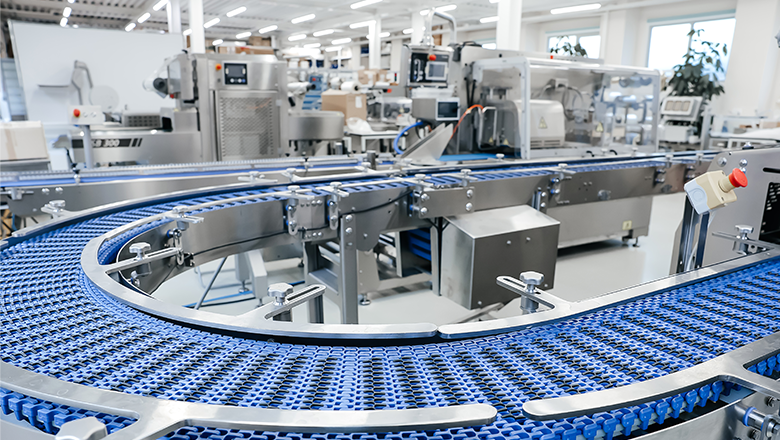
Acoustic sensors are suitable for predictive maintenance. They can, for example, detect abnormal noises from conveyor belts, which may indicate wear. In this way, they reduce the chance of unexpected failures.
The operation of acoustic wave sensors
Acoustic wave sensors use a mechanical or acoustic wave as the detection mechanism. When an acoustic wave propagates through or on the surface of a material, changes in the propagation path affect the wave's velocity and/or amplitude. These velocity changes are detected by measuring and correlating the sensor's frequency or phase characteristics with the measured physical quantity.
From piezoelectric substrate to sensor
The production of these sensors begins with the careful polishing and cleaning of a piezoelectric substrate, such as quartz, lithium tantalate, or lithium niobate. These materials are chosen for their specific properties, including cost, temperature dependence, and propagation speed. The manufacturing process involves depositing a metal layer, typically aluminum, and using photolithographic techniques to form an interdigital transducer (IDT).
Bulk waves versus surface waves
Acoustic wave sensors are distinguished by their propagation modes, such as bulk wave and surface wave. The most commonly used bulk acoustic wave (BAW) devices are the thickness-shear mode (TSM) resonator and the shear-horizontal acoustic plate mode (SH-APM) sensor. Surface wave devices such as the surface acoustic wave (SAW) sensor and the shear-horizontal surface acoustic wave (SH-SAW) sensor are also popular. The choice of device depends on the specific application and required sensitivity.
From the automotive to the medical sector: the versatility of acoustic sensors
Acoustic wave sensors are applied in a wide range of sectors. In the automotive industry, they are used for torque and tire pressure sensors. In the medical sector, they are found as chemical sensors. They can also be used in industrial and commercial applications as vapor, humidity, temperature, and mass sensors. Thanks to their sharp price, robustness, high sensitivity, and reliability, these sensors are rapidly gaining popularity. Furthermore, some sensors can be read out passively and wirelessly, offering additional advantages in certain applications.
The future of acoustic wave sensors
Recent developments in acoustic wave technology include the creation of higher frequency and sensitivity sensors, utilizing advanced materials and micro-fabrication techniques. These innovations open doors to new applications and improvements in sensor performance. The focus is on increasing sensitivity, reducing costs, and broadening the scope of applications.
Acoustic wave sensors are on the verge of a new wave of technological innovations and applications. With their versatility, cost-effectiveness, robustness, and high sensitivity, they offer promising opportunities for diverse industries. Whether it's monitoring tire pressure in moving vehicles, detecting chemical vapors remotely, or measuring force and acceleration, acoustic wave sensors will greatly advance the way we understand our environment.
Stay ahead in sensor innovation
In a world where technology is developing at lightning speed, it's difficult to stay up-to-date. Do you want to stay informed about the latest developments in sensor technology? Our newsletter will give you a head start.
Via our monthly newsletter receive your technology blogs, news, trends, and background stories in your inbox. Sign up now and discover what sensor technology holds for the future!
In the world of modern technology, sensor integration is key to innovation. Increasingly, sensors are supplied as bare chips, offering manufacturers the flexibility to produce these components on a large scale. However, the challenge lies in further integration: from simple housings to complex, custom modules for specific applications.
Egbert Stellinga (Product Marketing Manager) and Rob Kuijpers (Product Manager) discuss the six levels of sensor integration, ranging from bare chip to fully integrated module. Due to the growing need for compact, accurate solutions, sensor integration is becoming increasingly important for efficient and innovative technological developments.
Read it full article on the High-Tech Systems website…
This article appeared in High-Tech Systems and was written by Hans van Eerden
After many years of successful collaboration, sensor specialist Sentech and drive technology expert Zilvertron are making their business relationship official on May 1, 2024. Together, they will continue to build on their shared goal: to offer customers a total solution.
Synergy is the keyword in the strategic collaboration between Sentech and Zilvertron: both strongly believe in the 1+1=3 principle of their collaboration. Together, they can serve their customers more broadly in motion solutions, and that is precisely the question Marco Leeggangers, Sentech's Chief Business Development Officer, increasingly hears from the market: ’But then you don't want to collaborate with just anyone. It has to be a company with the same vision.' That's why the search for suitable partners began a few years ago. Smile Invest stepped in as a financially strong partner and offers significant added value with its expertise in (international) growth for Sentech's ambitions.
Same standards and values
Now Zilvertron is joining, a specialized supplier of drive technology with engineering capabilities, who, like Sentech, puts the customer first. And, like Sentech, goes the extra mile in serving its customers, for example, when a new product is introduced at their facility. Leeggangers: ‘We sit at the table with our clients and brainstorm solutions with them. We are not a distributor who pushes a box to the customer, but we integrate the necessary technology ourselves with our own engineering department for seamless implementation. Zilvertron has the same way of working. That's why this is such a good match.’
It's not just the visions that meet: the expertise of Sentech and Zilvertron, sensors and drive technology respectively, are both needed for a good motion solution. In their new form, they will offer their customers totally integrated motion solutions.
No big changes
With both Sentech and Zilvertron, the customer has always come first. From this perspective, the optimal details of this collaboration naturally fall into place, explains René Jansen, director at Zilvertron: ‘No new contracts, so no new logos, names, or contact persons, no hassle. But even more possibilities.’ The companies will retain their own identities and will form a group as of May 1st through the acquisition of all Zilvertron shares.
Future plans
So, no major changes on the horizon for the newly-techs for now. But when it comes to the long-term vision, there are indeed big dreams: together, they want to continue growing into a total technology provider. A journey that, if it's up to them, will take them abroad.
The question is not if, but when fully autonomous driving will arrive on public roads. The latest Teslas can already do it, and Automated Guided Vehicles (AGVs) are commonplace. The vehicles of the future will combine advanced technologies. Here, you can read about which sensor technologies these are and what their advantages and disadvantages are.
A pilotless airplane or a driverless bus is possible in the foreseeable future. Only legal and psychological objections stand in our way; just as the steam locomotive caused controversy and challenges in the 19th century.
“Cameras and various types of sensors in fused sensor applications are the eyes and ears of the future drivers of our cars,” predicts business development manager Marco Leeggangers.
The evolution of autonomous movement
Autonomous driving was one of the main themes at the IAA Frankfurt this year. The automotive industry is working on technologies that enable completely autonomous movement in public spaces.
The automotive world uses a Scale level from 0 to 5. Level 5 for a fully automated car ride, while you read a book or watch a movie.
According to Leeggangers, all new car models must be automated at level 2 from 2018 onwards to receive a 4- or 5-star safety rating. “The car will then be equipped with Advanced Driver Assistance Systems (ADAS). Such as Automatic Emergency Breaking, Lane Assistance, and Road Edge Detection.”
Tesla has made the leap from ADAS to autonomous in its latest models. The latest version of Tesla's Autopilot is already balancing on the border of level 4 and 5.
Business applications: AGVs
Businesses have long been using autonomously guided vehicles (AGVs) for distribution applications in particular. In many distribution centers, automatic forklifts operate, and order picking is done by robots.
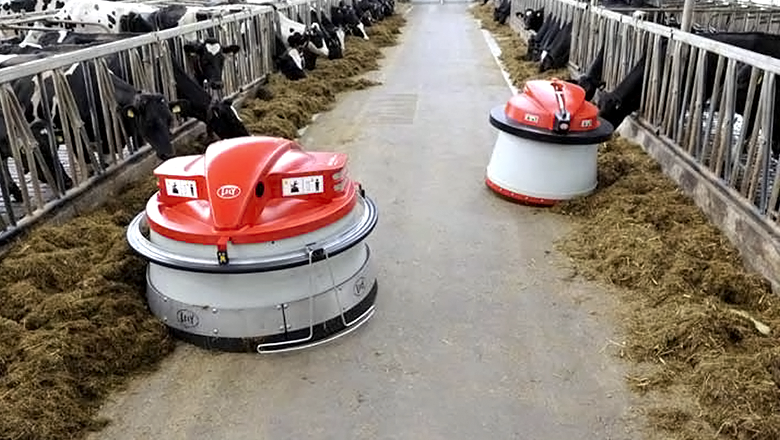
The Netherlands leads in innovation in Agricultural and horticultural automation met UAV's (drones) and AGV's (robots for cleaning stables, feeding livestock, and performing logistical tasks in greenhouses).
Why do we want self-driving vehicles?
Idlers: “In my eyes, this is a logical consequence of technological evolution. Actually, autonomous driving fits with the digital revolution because large amounts of sensor data need to be processed to react independently to the environment. Moreover, the self-driving car is part of the Internet of Things (IoT).”
The benefits of autonomous vehicles are numerous:
- Positive impact on traffic safety. Advanced computers can perform human tasks more efficiently, better, and safer.
- Better utilization of road capacity. Self-driving vehicles drive at shorter distances from each other. This allows them to utilize road capacity more efficiently, reducing and even preventing traffic jams.
- Improved car-sharing opportunities. The use of the self-driving car can be planned so that we can share it. The car for commuting can be available for someone else during the day. Autonomous driving will boost the predicted sharing economy.
- Sustainability: AGVs perform their tasks more efficiently than humans and save raw materials and energy in various industries.
- Productivity: An AGV never gets tired, can handle heavier tasks, and operates flawlessly.
- Cost savings: AGVs enable the full automation of distribution processes. Mobile robots also help reduce costs in agriculture and horticulture.
Detection challenges for distance measurement and positioning
To enable a vehicle to drive autonomously, it needs a comprehensive view of its surroundings. There are four detection challenges for dynamically generating an environmental model.
- 1. Determining the clear passing space on the road surface.
- Determining the geographical route via the navigable space.
- 3. Detecting moving objects (other road users and moving obstacles).
- 4. Recognizing and interpreting road signage, such as traffic signs, traffic lights, road markings, and other visual cues.
Sensor technology has advanced so much nowadays that there are solutions for all detection challenges.
Detection tools for autonomous vehicles
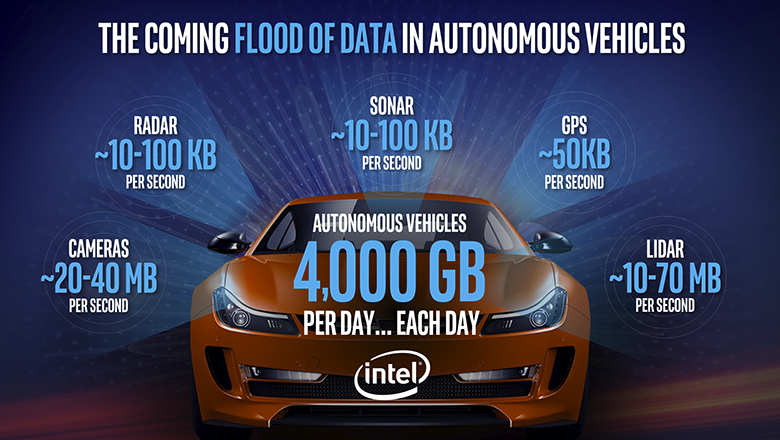
For autonomous driving and advanced driver-assistance systems, primarily radar, lidar, and sonar sensors applied. Combined with cameras and GPS, a vehicle thus dynamically scans its environment. Smart software processes the large amount of data, allowing it to always know its position relative to objects.
These techniques are possible because processors have become increasingly powerful and smaller.
Sensor technology development
Leeggangers indicates that Sentech plays a role in the development and R&D of sensor technology for AGVs. “For example, we already use radar, lidar, and ultrasonics in distance sensors and orientation sensors. As an independent sensor integrator, we are now working on integrating radar and lidar into compact ‘fused’ sensor applications.”
According to the Business Development Manager, sensor fusion leads to smarter and better customer applications, specifically in the area of autonomous movement.
Pros and cons of sensor techniques
The most promising sensor technologies for self-driving vehicles are lidar and radar. Lidar scans the environment with light (laser or infrared), while radar does so with radio waves. “The development of lidar and radar is progressing very rapidly. This is because processor chips are getting smaller and the technology has become more affordable,” according to Leeggangers.
Lidar has significant advantages in remote sensing. One of these is its high resolution, which is necessary for accurately detecting stationary and moving objects. On the other hand, weather conditions like fog and rain have a greater negative impact on accuracy. “Lidar is suitable for observing moving objects in the immediate vicinity of a vehicle,” explains Leeggangers.
Radar can see further, but as the distance increases, accuracy decreases. Therefore, according to him, radar is more suitable for remotely detecting moving objects in front of the vehicle.
The future of self-driving vehicles
“What's special is that the technological visions of car manufacturers differ. One prefers lidar, another prefers radar. The car manufacturers have a sensor-based system as a common starting point. We see a future with advanced fusion sensors in integrated sensor applications,” says Leeggangers.
He also sees new players on the autonomous driving market with a different technological approach, such as Google and Intel. Google has developed its own 3D technology, based on route information and 3D maps.
Intel, the processor manufacturer, has entered the autonomous driving market with the acquisition of Mobileye. The technology concern expects its first self-driving car on public roads in 2021. Intel uses the most advanced visual technology (cameras and software) in vehicles for environmental perception.
However, Leeggangers expects sensors to remain critical links in autonomous driving technology. “You will always need redundant sensor systems to supplement camera or GPS systems. No matter how advanced, anything can break. Redundancy will therefore become increasingly important as the fleet evolves toward full autonomy and driverless traffic.”
More about the development of lidar and radar
Sentech is focusing heavily on the further development of lidar and radar sensors, with an emphasis on sensor fusion. These are the most suitable sensor solutions for autonomous movement in public spaces and business environments.
Sensor fusion is the ultimate form of integration and enables next-generation automotive applications.
Read more about it and let yourself in good direction send.
Sentech has entered into a collaboration with lidar specialist Velodyne. This American company delivers smart lidar solutions. You can find this technology in AGVs, driver assistance, delivery, robotics, navigation, and mapping, among other applications.
Velodyne is a market leader and is globally known for its portfolio of groundbreaking lidar sensors. Her product line consists of a broad package of sensor solutions. These include the cost-effective Puck, the versatile Ultra Puck, the autonomy-enhancing Alpha Prime, and driver assistance software, Vella. In 2022 and 2023, the package will be expanded with solid-state 3D solutions, Velarray and Velabit.
How does lidar work?
Lidar stands for ‘LIght Detection And Ranging’. This technology uses laser beams to create a point cloud — a 3D representation — of the environment. Lidar delivers strong performance in a wide variety of lighting and weather conditions.
A lidar sensor emits pulses of invisible light that reflect off objects in the surroundings. How does the sensor calculate the distance? The sensor uses the time each pulse takes to return to the sensor for this. This is also known as the time-of-flight principle. This process is repeated millions of times per second. This creates an accurate real-time 3D map of the surroundings.
Lidar technology possibilities
Lidar is the only technology that accurately maps the environment and protects the privacy of that environment. Furthermore, the technology is suitable for environments with weather conditions such as rain with its IP69 rating. 3D solid state is available from 2022/2023.
Why partnership
The reasons why Velodyne chose a partnership with Sentech are clear, according to Maria Solovieva, Director of Sales EMEA at Velodyne Lidar. ‘Sentech has an excellent reputation in the market and an extensive customer base in our industry. Their expertise in sensor technologies is impressive. Sentech helps customers integrate the sensor into their application. They even support them in modifying this sensor to save time in the production process. In short; they are an ideal and reliable partner for us.’
The choice is enormous when looking for the right encoder. Does your application need an incremental or absolute encoder? And do you opt for inductive, capacitive, or optical technology? Later in the search, you'll also have to decide on the sensor form factor... Many facets for which you could use some help.
Absolute encoders have been around for years. Meanwhile, the capabilities of the implementations of this sensor type are growing enormously. Sean Ram, Account Manager at Sentech, can speak to this: “Rotary absolute encoders, in particular, have made significant progress.”
“This way, there's a choice in both the different techniques and the executions. Which encoder fits your application depends on the specific use case. Of course, we also consider whether the investment is profitable,” Ram adds.
Absolute vs. incremental encoders
Where absolute encoders provide an absolute position, incremental encoders measure changes in position. They count the number of encoder steps moved during movement.
Such an incremental system needs a fixed reference point to achieve an absolute position measurement. “Incremental encoders are less suitable for applications with fast movements. If they miss a pulse, they don't know their position,” Sean explains.
“An absolute encoder can sometimes be wrong. This is easily corrected at the next measurement point. Therefore, the control for a motor with an incremental or absolute system is very different.”
What does your application need?
Can a reference point be added to your system? Then an incremental encoder is often a suitable solution. “If homing isn't possible in your application, for example due to safety reasons, then you'll often end up with an absolute system,” says Ram.
Rotary encoders for robotics applications
Absolute and incremental encoders are available in linear and rotary versions. Ram notices that demand for rotary absolute encoders has increased: “We see more and more customers building their robots from scratch.”
“This can be seen in the medical sector and in agriculture and horticulture, for example. Companies are developing their own robotic solutions everywhere. In some situations with one degree of freedom, but even then the rotation must be measured accurately. This is because such systems often work with brushed or brushless motors. These types of motors need to know precisely where the coil is located relative to the magnets during startup. This allows them to regulate the control properly. So, you need an absolute position for that.”
In addition, more and more Dutch companies are working with a combination of AGVs and robots. Sean sees that companies build the system themselves: “They need something special. A ready-made system doesn't fit that. They often have the capacity to build a system in-house, which also makes it more cost-effective.”
Solution for rotations
For systems like robots, you usually deal with a lot of rotations. In those cases, a hollow-shaft encoder can be the solution. “These are ring-shaped encoders with an open inner mechanism. You then run the cables for data signals and power through the inside of the system,” Sean explains.
Hollow shaft encoders consist of two parts: a transmitter and a receiver that can rotate contactlessly. Ram sees a second advantage in this: “Because the parts don't touch each other, the components don't wear out. That's the case with traditional absolute encoders with shafts and bearings.”
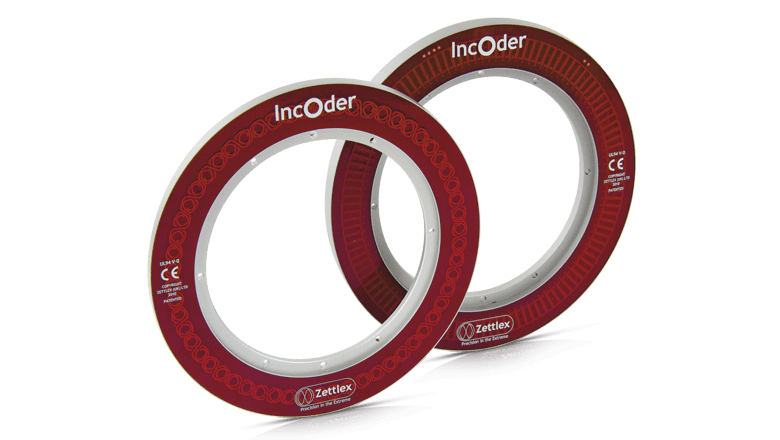
Pros and cons of absolute encoders
When it comes to absolute encoders, there are quite a few variants and technologies on the market. They all work slightly differently. Each has its own advantages and disadvantages.
Broadly speaking, this is how it works: one of the encoder components has onboard electronics and generates a field. That field can be magnetic-inductive, electric-capacitive, or optical. The other part of the encoder is passive and influences that field. This disturbance is measured and provides information about the angular displacement.
The passive encoder part has a pattern. That pattern has a unique encoding and therefore a unique disturbance over the entire 360 degrees. This allows the system to always know the angle of the encoder.
Levels of accuracy
The accuracy of encoders varies by technology and brand, Sean knows: “When integrating inductive encoders, we often opt for Zettlex from Celera Motion. With those, you can measure with approximately 0.01 degrees accuracy. When we work with capacitive encoders, we often choose Netzer. Those achieve an impressive 0.005 degrees.".
Then there's a third type of encoder: optical technology. “Celera optical encoders from MicroE achieve accuracy comparable to capacitive encoders,” Ram knows.
Sean emphasizes that it's not just about precision. “There are more factors involved. Ultimately, the application determines which technology is best suited.”
When do you choose which encoder?
Environmental conditions play a big role in choosing your encoder type. “Are you dealing with a clean environment? And is the encoder built in such a way that no dirt can get to it? Then an optical encoder can be an excellent solution. Such an encoder is light, relatively inexpensive, and achieves high performance,” says Sean.
If contamination such as dust is involved, an optical encoder is not suitable.
“For less clean applications, you often end up with a capacitive encoder from Netzer,” says Ram.
Capacitive technology is susceptible to moisture. This is because moisture particles can disrupt the capacitance. That's why Ram usually opts for inductive encoders in humid environments: “They are even suitable for a remotely operated submarine that is 500 meters underwater, for example.”
Calibration
What should you pay attention to when integrating absolute encoders? “Such an encoder consists of two separate parts that you must position correctly – relative to each other. No matter how precisely you work, a human error can easily happen,” says Ram.
“For the air gap and the non-eccentricity of the rings, you should think in terms of accuracy to a tenth of a millimeter. These are familiar specifications for many companies. Some partners, like Netzer, help you by incorporating a calibration run. The two parts probe each other's position, allowing you to correct any installation errors relatively easily.”
Close-up engine montage
Generally, encoders are deeply embedded in a machine, close to motors. What is the influence of the strong magnetic fields from motors on encoder measurements?
“All technologies are insensitive to external interference fields. Here's how it works: developers cleverly modulate the signal between the two parts and chose different frequencies. Interference from external magnetic fields is therefore a thing of the past,” Sean explains.
In addition, the encoders are very flat and lightweight. “This makes this technology very suitable for robots with high accelerations, where every gram counts.”
This article appeared in Mechatronics & Mechanical Engineering issue 3 2021 and was written by Alexander Pil
If you want to work according to high quality standards, ISO 9001 is sometimes not sufficient. That is why the automotive industry developed IATF 16949. With this quality standard, you develop a reliable and durable end product.
Automotive companies like to work with manufacturers that comply with IATF standards. For example, in 2009, the collaboration with DAF prompted Sentech to obtain an IATF certificate.
Certification
In 2021, IATF introduced changes to the standard. As a result, Sentech decided to continue working according to the standard, but not renew the certification.
Therefore, after twelve years, our IATF certification will expire on July 9, 2021. If customers require IATF certification again, we will discuss the possibility of recertifying.
Maintain quality with high quality standards
The core tools and processes – originating from IATF certification – have been interwoven for twelve years our method. In 5 phases, we identify risks in a timely manner and make them manageable. This is how we guarantee the quality of the end product. After not renewing the certification, we will continue to work according to these high quality standards.
Continuously developing and optimizing our processes, as well as developing our employees, remains an important theme. We do this in addition to our ISO 9001 certification, which remains in effect.
What does working according to IATF 16949 standards look like?
For industries like automotive, ISO 9001 is not sufficient. They go a step further and work with IATF 16949.
This high-quality standard also ensures a reliable and durable end product in your market. In addition, you can fully adapt the process to your quality needs.
Discover what IATF means and how you can applied on your project.
With lidar, self-driving vehicles, such as AGVs, can map their surroundings. They scan using light pulses. Despite the simplicity of this optical sensor technology, the technique remains expensive. Developers are innovating to make autonomous driving more affordable, compact, and reliable. This makes this type of transport more accessible to consumers and B2B markets.
Affordable alternatives are entering the market, such as solid-state lidar. Depending on the desired resolution, you determine whether your application requires a basic or a high-end lidar sensor. Furthermore, a sensor alone is not sufficient for autonomous driving. For reliable measurement, you need to combine multiple techniques.
How lidar works
Just as radar works based on radio waves, lidar uses light pulses. When light pulses reach objects or surfaces, detectors capture their reflection. The system calculates how long it took for the light to travel from the laser, via the object, to the sensor. This is converted into distance. All the distances together form a detailed point cloud of the surroundings.
What determines the price of autonomous vehicles?
Self-driving cars, like Google's Waymo, drive autonomously thanks to lidar. The roofs of these vehicles feature a noticeable bulge. This is where the lidar sensor is housed, which the car uses to map its surroundings. For car designers, it's a challenge to inconspicuously integrate the technology into the design.
These lidars are scanning electromechanical systems, consisting of many moving parts. This makes them difficult to produce and miniaturize, causing the price to barely decrease.
At Velodyne, you pay $75,000 for a lidar module. Even simpler technologies cost thousands of dollars. Besides this sensor technology, more is needed to make a vehicle drive autonomously. The total price quickly adds up to 100,000 euros.
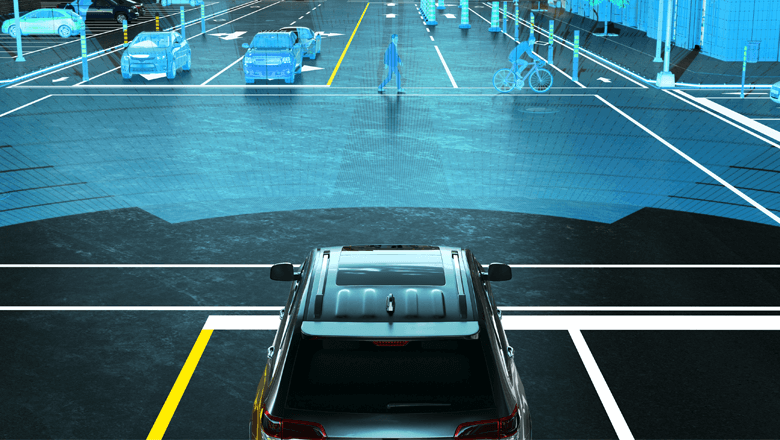
Lidar originally arose from the words ‘light’ and ‘radar’. It is now an acronym for ‘light imaging, detection and ranging’.
Affordable lidar alternative
Solid-state lidar is a smaller and more affordable alternative. Instead of scanned beams, this technique works with broad light flashes. A solid-state laser shoots pulses, which are spread via a diffuser over an angle of 9 to 120 degrees.
The range of solid-state lidar is smaller than that of scanning lidars. However, they are also significantly cheaper. At Canadian LeddarTech, the price for a flash lidar module is around a few hundred dollars. Furthermore, they are much smaller and more robust. This makes them easy and affordable to integrate into vehicles.
Compared to flash, scanning lidar offers several advantages. “If you need high resolution, you should look at high-end lidar sensors,” explains Marco Leeggangers, Operations Director at Sentech. “Furthermore, scanning lidars achieve that higher resolution across their entire 360-degree field of view.”
Adjust range and viewing angle
Lidar manufacturers are not transparent about the frequency and intensity of laser pulses. “During the design phase, you can play around with it to adjust the lidar's range or field of view,” says Olivier Gernier-Lafond of LeddarTech. “With our software, users can adjust various parameters to choose the range and update frequency. This is how we differentiate ourselves from the competition.”
Gernier-Lafond adds: “The wavelength of the laser is approximately 905 nm (nanometers). Many competitors are above 1,000 nanometers. Although lasers around 1550 nm are more powerful, optical components in our wavelength range are more affordable, robust, and reliable. This allows us to deliver cheaper lidar systems. Thanks to our advanced signal processing algorithms, we still achieve the same performance as the competition.”
Noise cancellation in rain and snow
Lidar sensor measurements must be translated into usable data: the perception platform that recognizes and classifies objects. “LeddarTech is exceptionally strong in that translation,’ says Leeggangers. ‘The Canadian signal processing software is very good at noise reduction. Even at night, in rain and snow, it delivers reliable results.’
All detection technologies have their advantages and limitations. Lidar meets in all lighting conditions very accurately the distances. Moreover, this technique can handle both stationary and moving objects perfectly. “Our off-the-shelf systems achieve an accuracy of 5 cm, with a repeatability of 6 mm,” says Vincent Racine, product manager at LeddarTech.
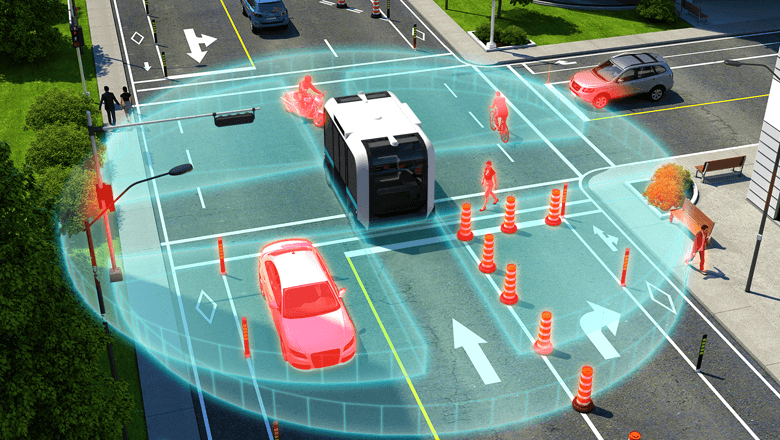
Detecting objects at a great distance
The reflectivity of an object affects detection distance, or its visible range. For example, pedestrians with 10 percent reflectivity are ‘seen’ by LeddarTech lidars up to 200 meters away. Objects with higher reflectivity, such as license plates, are detected at even greater distances. This was successfully demonstrated during CES 2019.
Besides reflectivity, the field of view also depends on the laser's intensity. The more power, the larger the field of view. There are limits to increasing laser intensity, as lasers are used in public areas and should not blind passersby.
Racine adds: “We place a high value on safety. Additionally, we comply with the strict legislation for pulsed lasers. With our software, we ensure that we achieve optimal performance within those limits.”
Combining technologies
Experts agree that you cannot build a fully autonomous vehicle without Lidar. “But it will never succeed with a single sensor type,” emphasizes Leeggangers. “Lidar must be combined with cameras, GPS, and other technologies. Only then will you get reliable measurements.”
Fields of application
Because fully autonomous cars are still mostly research objects for the time being, Leeggangers is looking ahead. “The market for autonomous vehicles is booming. Think of the Second Maasvlakte where carts drive autonomously on a closed site. You also see more and more AGVs in controlled environments like large warehouses and in agriculture.”
In many mobile applications, there are plenty of opportunities for solid-state lidar. “But you can also perfectly use the technology to detect, for example, if drivers are changing lanes in time during a lane closure.’
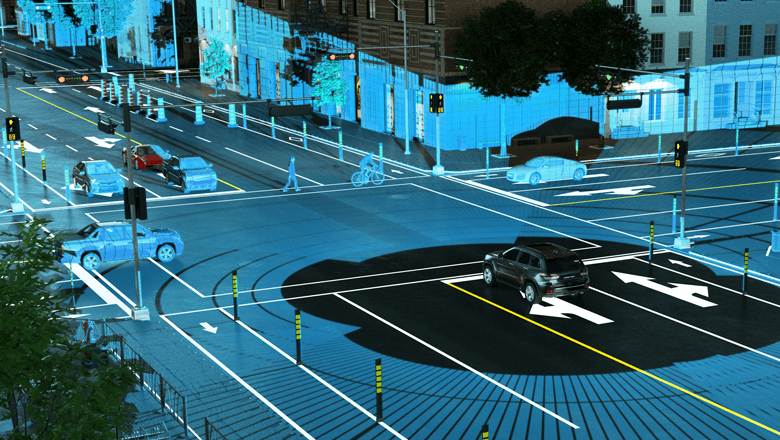
Innovating with lidar
LeddarTech is currently working on several innovations, including various 3D versions. “We started with 2D lidars. They are fine for simple collision detection, for example,” says Racine. “With 3D lidar, you can see more and recognize objects more easily. This technology is now in full development to meet the requirements of automotive and other mobility applications, such as autonomous shuttles and robotaxis.”
Long-range and high-definition 3D lidars are also planned. “Those system-on-chip devices are based on MEMS technology. Although they do have moving parts, they can still be classified as solid-state components. This is also because their dimensions and robustness make them resistant to shocks and vibrations,” according to Racine.
Collaboration for Successful Integration
A few years ago, Sentech signaled the rise of lidar technology. The market wasn't ready for high-end scanning sensors at that time. So, an alternative was sought. In 2016, they discovered LeddarTech's solid-state lidars.
“LeddarTech was looking for a partner who could provide high-level customer support, particularly during development and integration,” says Olivier Gernier-Lafond, Distribution Network Manager at LeddarTech. “We have specialized partners in Germany, France, and Asia, among other regions. The Netherlands has a dynamic market with many innovative companies that we want to connect with.”
Marco Leeggangers of Sentech adds: “Lidars are not simple systems. You always have to integrate them with other hardware and software. They produce an enormous amount of data that you have to translate into usable information with complex algorithms. Sentech can help with that. We can also advise on the position of the sensors and what images that will yield. We often draw on our experience with radar for this, because the technologies and applications are comparable.”
Explore the possibilities of lidar
Where do you start with the integration of lidar? There are various lidar technologies on the market. The speed of the vehicle and the reflectivity of surrounding objects determine the required field of vision. And therefore, which technology is needed to make your vehicle safely drive autonomously.