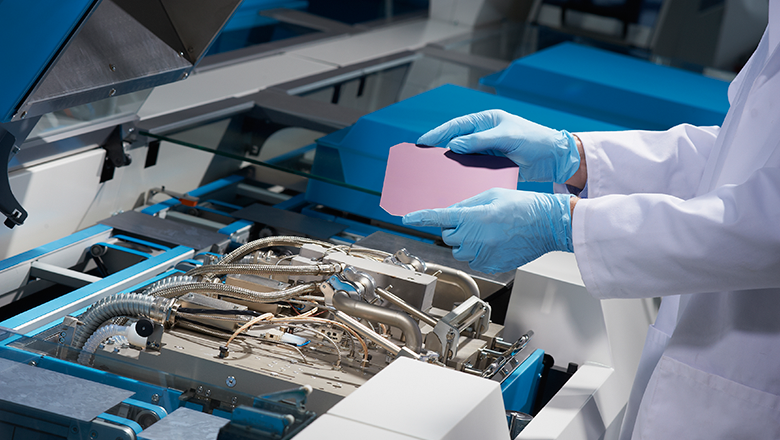
It proved difficult for PV machine builder Solaytec to find a sensor within budget that could determine the position of solar cell wafers in their deposition machines. The company approached Sentech, which developed a custom-made sensing sensor.
Sentech and TNO spin-off Solaytec have been collaborating since 2012 on the development of atomic layer deposition (ALD) machines. With this nanotechnology, optimized by Solaytec, manufacturers achieve significantly higher yields from their solar cells.
Sentech has developed sensor solutions for the machines as an R&D partner to effectively monitor the ALD process – solutions that other sensor suppliers could not offer within Solaytec's budget. Together, the Brabant-based companies now deliver a feat of precision engineering worldwide.
Achieve higher efficiency from solar cells with ALD
ALD is a deposition technology that allows layers to be deposited at the atomic level. A substrate is sequentially brought into contact with two different process gases. After each gas pair, exactly one atomic layer has been formed through two consecutive chemical reactions. The desired layer thickness is achieved by repeating the cycle more often.
ALD has a distinct advantage here: because the chemical reaction stops by itself once the surface is covered, the process is self-limiting. This allows the layer thickness and homogeneity of the material to be controlled with unprecedented accuracy.
Although ALD has existed for a long time, the technology was far too slow and expensive to be industrially applied. TNO has changed that. In 2008, the research institute began research to make ALD significantly faster.
In the same period, several institutes, including TU Eindhoven, demonstrated that a layer of aluminum oxide applied with ALD leads to a significant improvement in efficiency for silicon solar cells. “For an optimal effect, a nice, homogeneous film of aluminum oxide is very important,” explains Solaytec CTO Ronald van Dijk.
An average solar panel has an efficiency of eighteen to twenty percent. Adding aluminum oxide as an extremely thin ALD film to a solar cell improves the absolute efficiency by more than one percent. Relatively, this is a significant improvement of five to seven percent.
ALD machine processes 4000 wafers per hour
In 2009, TNO achieved a breakthrough that enables solar cell manufacturers to apply the efficiency-boosting aluminum oxide ALD layer to their products, as the research institute's spatial ALD process allows the film to be deposited quickly yet precisely. Until then, TNO had used the standard temporal ALD, in which the substrate is sequentially exposed to the different gases in one chamber.
With spatial ALD, it has managed to shorten the purging phase by a factor of a thousand. One cycle, during which the silicon solar cell wafer is transported contactlessly through a series of deposition units, now takes milliseconds instead of six seconds.
In the first unit, the precursor gas trimethylaluminum (TMA) forms half of the first monolayer. In the space after that, water vapor completes the layer through a reaction between the TMA and water. Depending on the desired thickness, this process is repeated several times in the deposition unit. Between the deposition units, inert nitrogen gas provides curtains that prevent the precursor gases from coming into contact with each other.
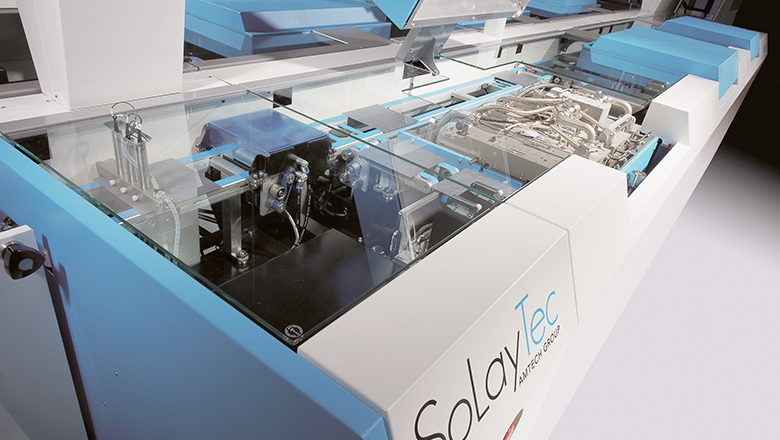
TNO's research led to a patented deposition head in a prototype in 2010. ALD machine. “The breakthrough brought a business case within reach,” says Van Dijk. “In 2010, Solaytec was established as a spin-off, with the prototype ALD machine as the basis for commercializing the TNO invention.”
According to Van Dijk, the challenge at the time was to get more electrical power from the same solar cell at constant costs. “The hectic start-up phase led to the first production machine with a single deposition unit. We further developed this into a machine with multiple deposition units, which can now process a maximum of four thousand wafers per hour.”
Solaytec has customers worldwide, but the machines are especially in demand in China. Van Dijk: “The solar energy market is a growth market that is sensitive to economic cycles. China has an energy and pollution problem and mass-produces solar panels for the whole world.”
Only Sentech was able to meet Solaytec's sensor needs.
Erik Kremers, system architect at Solaytec, explains how Sentech became involved. “Our first machine had a number of motion sensors to determine wafer movement through the deposition unit. The sensor we used for this did not meet our requirements regarding reliability and cost. Reliable measurement of the wafer position in the closed deposition unit at a temperature of two hundred degrees Celsius is crucial for the performance and uptime of our machines. If the wafer does not move according to the setpoint, this can lead to malfunctions and breakage, resulting in a production stop for our customers. Downtime costs our customers money.”
The sensor measures the edge of the wafer as it passes by at different positions in the deposition unit. With the measurement data, Solaytec can software-adjust the wafer's position so that it follows the desired setpoint.
Kremers: “We drew up specifications for a new sensor and submitted them to the then-supplier and other sensor suppliers. None of them could supply a sensor that fit within our budget. That is, until Sentech came into the picture.”
Peter Verstappen, account manager at Sentech, then sat down with Solaytec to develop a cost-effective sensor solution from scratch. Verstappen: “Sentech is a specialist in sensor integration and the development of sensor solutions. We first want to know the specific needs of a customer. You can't find Solaytec's needs in a sensor catalog. Solaytec needed an R&D partner. The technology wasn't the problem, but the price at which the sensor solution had to be delivered was. Too high a price would make the ALD machine too expensive to achieve the desired efficiency advantage for solar panel manufacturers.”
Temperature and cost are the biggest challenges
According to Verstappen, the biggest challenge was the high temperature in the deposition unit. Through open collaboration, Sentech succeeded in integrating a completely new sensor solution within the intended production budget into the first generation deposition unit: the DU 1.0, within a few months.
This optical positioning sensor contains a fiber optic transmitter with an amplifier, which sends a red light beam to a receiver. Digital detection occurs at a number of positions when the edge of the wafer passes the sensor and interrupts the light beam, resulting in eleven measurement values.
According to Van Dijk, Sentech has satisfied Solaytec's R&D needs for its production machines with the DU 1.0 to a great extent. “But Solaytec wants more,” adds Kremers. “I still had the desire to have a sensor that could continuously measure the wafer position instead of the current discrete points. We would prefer a line sensor across the full stroke of two hundred millimeters that the wafer makes in the deposition unit. During a brainstorming session, Peter Verstappen did not immediately say no when I sketched my idea. Sentech understood very well why I need the wafer's position: to improve the reliability of future machines.”
Co-R&D leads to a scoping sensor that improves the reliability of ALD machines
“Digital detection with the DU 1.0 has its limitations because the sensor only registers a few values. We started working with analog signaling because it allows you to measure positions in space. This resulted in a scoping sensor, which also measures lateral movement, as a supplement to the positioning sensor. Combined, the measurement values from both sensors provide a spatial overview of the wafer's movement through the deposition unit.”
According to Kremers, that result comes quite close to his original wish. “The new version offers such a wealth of new information that helps us take further steps.”
Kremers and Van Dijk appreciate Sentech's openness regarding its development process. Van Dijk: “Together, we practice open innovation. The success of co-R&D is determined by the openness and willingness to share R&D insights with each other. Both Sentech and Solaytec possess this open-minded culture.”
The way of working in successful sensor integration
During a sensor integration project, you always weigh three interests: cost, quality, and delivery time. What are the risks and consequences of my choice? Is the technology I had in mind the right solution for my application?
Scroll through our e-book for the answers to these. You'll also read practical examples of common sensor issues and solutions.