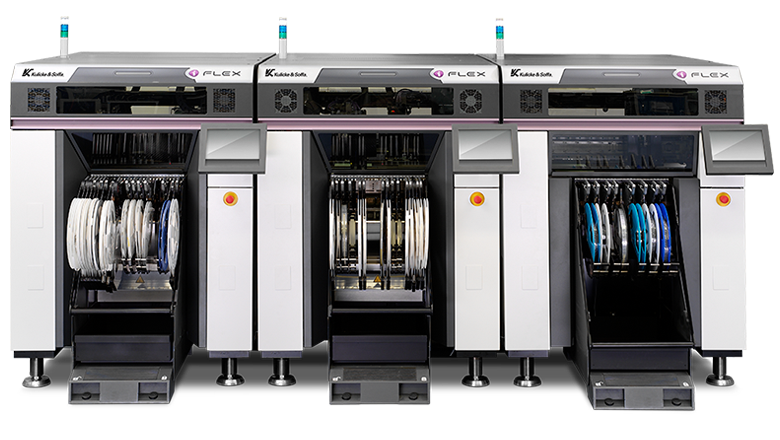
The iFlex pick & place SMT (Surface Mount Technology) placement machines introduced by K&S are based on the ‘dual lane’ concept. Sentech's optical sensor assemblies are used for reliable detection of printed circuit boards (PCBs). This solution emerged as the best in an open innovation process for a complex detection problem.
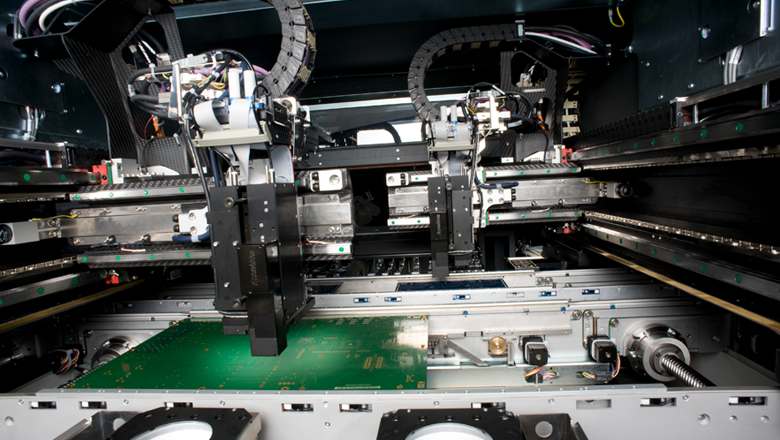
The board transport module has been completely redesigned and re-engineered for this purpose. The detection of printed circuit boards (PCBs) presented the necessary challenges until the very end, which were effectively resolved through close collaboration between K&S, Frencken Mechatronics, and Sentech.
Reliable detection of PCBs in SMT machines
Marco Leeggangers, business development manager at Sentech, on the challenge: “The challenge was to detect a wide variety of PCBs, in a limited space and with very high reliability. These three factors led to a very close collaboration between the engineers of all involved companies.”
In the old system, a sensor looked at the underside of the board. “Due to the limitation in construction space, the number of required sensors, and the wide variation in the shape of the PCBs, it was decided to detect from the side. However, to do that, space was needed again, and that was precisely what was lacking.”
To find a good sensor solution for this, Sentech conducted tests with different types of printed circuit boards. It quickly became clear that fiberglass was not the solution.
“The light intensity is not evenly distributed. If a thin PCB passes underneath the spotlight, there is such a low ‘signal drop’ that it does not fall below the threshold, and therefore the PCB is not detected.”
Custom sensor solution – optical sensors from STM
Sentech found the solution in an optical sensor from STM. Leeggangers: “With miniature optical sensors, a much more uniform light distribution of the light beam is achieved. For this, we found a small optical transmissive system with a separate amplifier at the German STM Sensors. Due to the separate amplifier functionality, we could integrate 9 or 18 amplifier circuits on one printed circuit board. This saves costs. So we opted for a sensor assembly with a control board, which also communicates with the control system via EtherCAT.”
To evenly distribute light intensity, STM has developed its own LED. In this process, a plastic layer is applied to the die using an injection molding process. The curvature of this layer is measured during growth.
Once the optimal curvature is reached, allowing the light to exit beautifully straight, the process stops, resulting in a lovely uniform exit angle.
After a follow-up test with the new and standard LED, the narrow beam still caused problems, especially with different shapes of reflections. This showed that not a bundled source, but a ‘very large, diverging lamp’ gave the best results. Affordable LEDs were the solution to a high-tech problem in this case.
Complex sensor challenge?
We'd be happy to help you think things through. Ask your question.