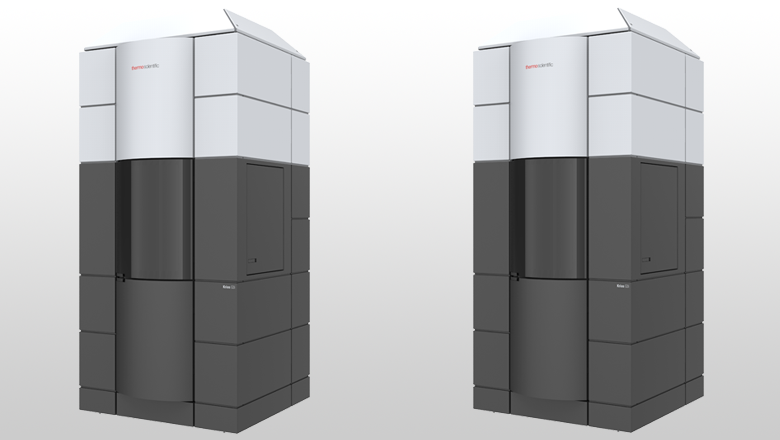
At high-tech Eindhoven, groundbreaking technology is being developed, enabling scientists to make exciting new discoveries. Thermo Fisher (formerly Fei) develops and assembles electron microscopes there that can push the boundaries of the laws of physics. Sentech is allowed to contribute to two important components of the Talos™ and Krios™ transmission electron microscopes (TEMs), namely the Aperture mechanism and the Compustage.
For this, the Eindhoven company, acquired by Thermo Fisher in 2016, has relied on Sentech's sensor knowledge for 15 years. Thermo Fisher is even one of the reasons for Sentech's founding. Sensor technology ensures that the electron beam lands exactly on a specimen and that the specimen is in the correct zero position.
It can't be long now before the Eindhoven nanotechnology of Thermo Fisher, with sensor technology from Sentech, leads to the next scientific breakthrough.
Scientific research at the nanometer scale
Sentech's origin story is closely linked to Thermo Fisher. The company develops and produces high-quality technology for scientific research and diagnostics.
Thermo Fisher complements this technological spectrum with microscopy for nanometer and even picometer research. For microscopic research on the smallest scale, the company develops the most advanced and extremely powerful electron microscopes.
The TEM (Transmission Electron Microscope) and SEM (Scanning Electron Microscope) image samples down to the sub-nanometer level. A scale that is barely imaginable. They make individual atoms and molecules visible.
What was previously invisible to humans can now be visualized in high resolution. Thermo Fisher's electron microscopes literally defy the ultimate boundaries of our universe.
It's no wonder that groundbreaking scientific discoveries are being made with Thermo Fisher microscopes. Nature has declared cryo-electron microscopy (cryo-EM) as the ‘Method of the Year 2015,’ a microscopy technique that can only be performed with Thermo Fisher microscopes (Krios™).
For the first time in history, scientists can examine protein structures (RNA and DNA) at a molecular and atomic level. Scientists from universities and pharmaceutical companies expect to develop new medicines and treatment methods for diseases from this.
Thermo Fisher microscopes are also crucial for semiconductor research, mineral research, industrial research, and other nanometer-level research.
Sentech sensors crucial for TEM electron microscope
The Krios™ TEM It is three meters high and is assembled in Eindhoven using components from various suppliers. A beam of electrons is sent down through a column of electronic ‘lenses’ towards the sample. The material to be examined is located on the 4-axis stage (Compustage).
A portion of the electrons are absorbed by the material. The passing electrons then form a ‘still image’ of the sample in the image acquisition and detection unit. Software translates the images into a two- and/or three-dimensional high-resolution image of the material.
The TEM consists of several main components that are precisely integrated into the assembly. For a perfect image of a protein structure or the surface of a semiconductor, it is crucial that the sample is positioned in the correct spot within the electron beam by the Compustage.
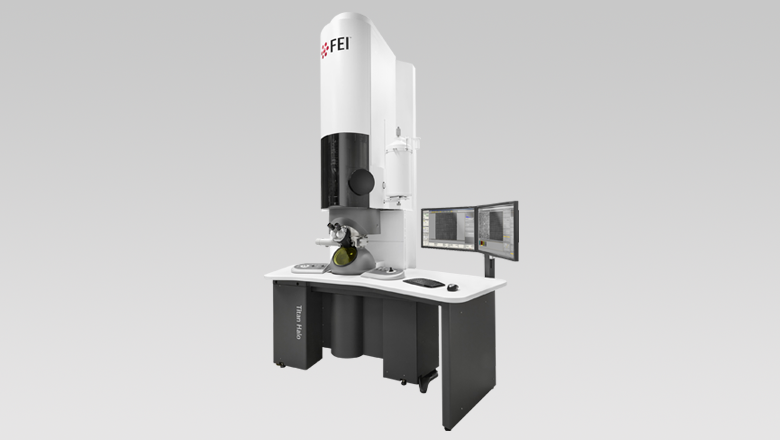
Titan Halo microscope with Sentech sensor technology
Sentech's sensor technology has ensured the stability and correct positioning of this stage for 15 years. And for the control of the aperture mechanisms, which precisely direct the electron beam towards the sample.
Sentech stepped into the sensor gap left by Honeywell when it divested its sensor product line. The company developed two types of sensor assemblies for the TEM versions.
The inductive sensors provide homing (returning to the starting point) or detection of the stage, depending on the application. The proximity sensor indicates whether the stage is present in the vacuum chamber. This sensor prevents the chamber from remaining open during vacuum evacuation.
The microscope contains multiple aperture mechanisms. These position the aperture in the electron beam. Sentech supplies the sensor assemblies with inductive sensors to first-tier suppliers, including Frencken. Frencken manufactures and supplies the aperture mechanism.
Partnership – improvements through close collaboration
Sentech works closely with the operations engineers at Thermo Fisher in Eindhoven and with Frencken, the supplier of the Aperture mechanism. Sean Ram, account manager at Sentech, about the collaboration: “In the past 15 years, the development of the TEM has not stood still, particularly in the field of imaging. The cameras and images have improved enormously.”
Due to product changes at Thermo Fisher and advancements in sensor technology, several modifications have been made to the sensor assemblies. “We don't see ourselves as a sensor supplier, but as a sensor integrator who collaborates with our clients. We feel like an R&D extension of Thermo Fisher. For example, recently the integrated circuit (IC) in certain sensors was replaced because the previous one was outdated.”
Professional supply chain guarantees high quality
Sentech supplies its sensor assemblies (including wiring) on a just-in-time basis. Ram: “Sentech adheres to an extremely high quality standard that we have secured throughout the entire chain, from development to distribution. Only in this way can you meet the high quality requirements of high-tech clients like Thermo Fisher.”
The quality mindset is ingrained in all employees. “This also means that we deliver exactly to the right place and at the right time when sensor assemblies are needed in the production and assembly process. We cannot afford mistakes. The entire supply chain is advanced and optimally regulated, including a cleanroom with production, testing, and packaging facilities,” Ram concludes.
You optimize your machine like this with sensor integration
It won't be long before the Eindhoven nanotechnology from Thermo Fisher, with sensor technology from Sentech, brings about the next scientific breakthrough. Big data will then be indispensable in making your machine smarter.
Based on customer needs and the future outlook, you determine what data you need. Furthermore, you need the right sensor solution to collect big data.
What can you expect from technologies? Let us inspire you free e-book.