In 2016, Tridec approached Sentech with the question: How do you integrate an oil level sensor into an electro-hydraulic steering system for truck trailers? An open collaboration quickly led to a robust sensor assembly with an optical level sensor. For Tridec, this modern steering aid is the prelude to autonomous driving.
Take a look into the world of heavy transport. Discover how smart steering systems and suspensions, with the help of sensors, make road transport easier, cheaper, and more sustainable.
Advantages of steering system and independent suspension
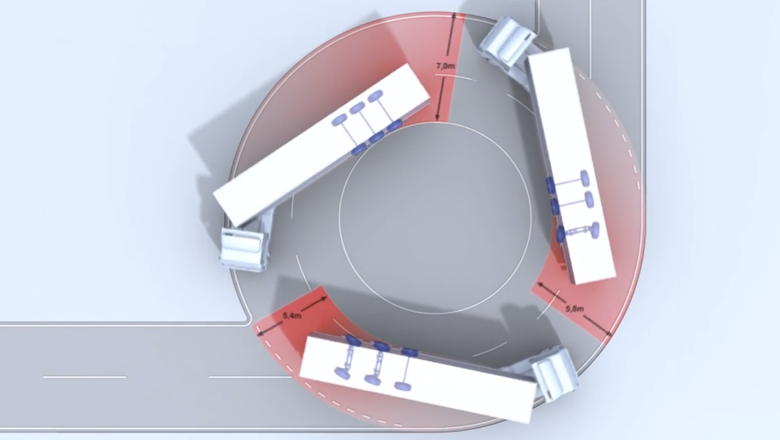
According to product manager Francois Bronckers, Tridec is the market leader in the development and production of steering systems and suspensions for towed equipment. A trailer equipped with a steering system improves the maneuverability of a truck combination.
Bronckers names a number of other advantages:
- Cost advantage
“Carriers can use a more agile combination to deploy a larger trailer in city centers or on farms, for example. This makes it possible to transport with one large trailer instead of multiple small trailers. Our steering systems can achieve cost savings of up to 30 percent.” - Sustainability
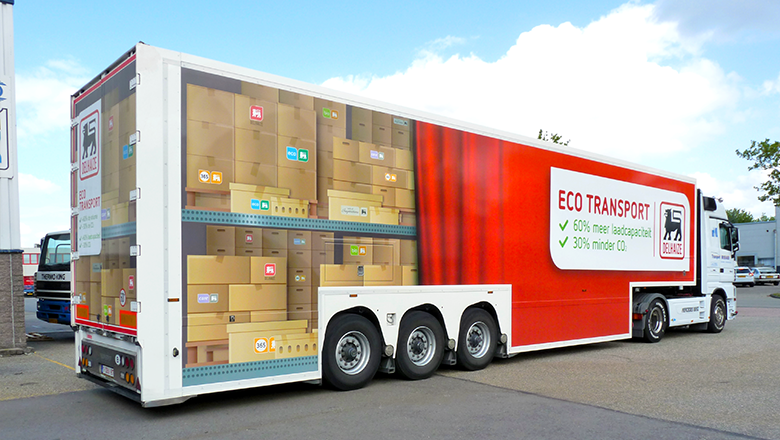
“Carriers need fewer transport movements. This relieves the road network and city centers. They emit less CO₂ and particulate matter. We also make independent suspensions, which make useful use of the space around the wheels.” This allows for two loading compartments of 1.80 meters stacked on top of each other: the so-called double-deck trailers. “These trailers are successfully used for supplying supermarkets and other stores, among other things. The extra deck provides 60 percent more loading capacity. Just calculate the environmental and cost benefits.”
Recognition in Brussels
Bronckers expects growth in the market for steerable trailers and independent suspensions. “Many trailers in the Netherlands and Germany are already equipped with a steering system because they offer advantages, especially in densely populated areas. A combination with special suspensions is also slowly starting to be recognized by Brussels.”
The product manager is referring to the climate agreements imposed on all EU countries. “We expect this to boost sales. A successful chain of affordable items, with over 1,000 branches, operates entirely with our suspension systems.”
Using standard components
Tridec supplies components to trailer manufacturers, who assemble them into a vehicle. The wide variety of vehicle configurations is a challenge, according to Bronckers, because many trailers are developed and built to order. “With as few components as possible, we serve as many trailer variants and applications as possible. That's why we integrate standard parts into a custom-made solution.”
Koen Wich is involved in these technical challenges as an engineer and project leader. With his colleagues, he staffs Tridec's R&D department. He adds, “Each steering system and each wheel suspension has its own unique drawing and bill of materials. We use standard components that are integrated to measure.”
Exceptional transport
Legislation requires exceptional transports, with special dimensions, to be equipped with a steering system to safely travel on the road. “This allows transporters of wind turbines, for example, to avoid conflicts with street furniture. We have specific products for that,” says Bronckers.
Tridec also serves the extremely heavy transport market. “Then you're talking about equipment with a few hundred wheels,” he continues. “In 2010, we helped an American company that had to transport a nuclear vessel through the narrower roads of San Diego. In America, good load distribution is crucial because the roads and bridges are in poor condition.”
Harsh conditions, challenge for fluid detection
Tridec came into contact with Sentech at a trade show a few years ago. Sentech account manager Sean Ram shared some challenges with the Tridec team there. They got into a discussion about the sensor challenges Tridec was dealing with. Ram: “It was about position measurement of hydraulic cylinders, measurement of the trailer's angle of rotation, and fluid detection.”
“We were open to a collaboration, because at that moment we had a concrete challenge with the level detection of oil in the reservoir of the electro-hydraulic steering system,” responds Wich. “We had already found a sensor, but it was not resistant to conditions such as weather influences and vibrations that trailers encounter in practice.”
Oil level sensor for electronic fuse system (EFS)
Tridec's newest steering system is called EF-S. Within the company, employees use the working name steer-by-wire. The electro-hydraulic system is comparable to the fly-by-wire systems found in modern airliners. A computer transmits the driver's steering input to the hydraulic system that controls the trailer axles.
One part of the system is the oil reservoir for the hydraulic oil that moves the cylinders. “In addition to a sensor that monitors oil pressure, we needed a second safety measure,” Wich explains. “An oil level sensor that monitors whether there is still enough oil in the system. A level that is too low indicates a leak.”
“You need to be on top of that. An exceptional transport with a defective steering system on the road makes the news,” Bronckers responds.
Product requirements for optical liquid detection
Which describes the challenge with the level sensor. “We already had a usable sensor, but it was unsuitable for industrial application. For Sentech, we drafted a product requirements document.” The sensor solution had to meet a number of requirements. Sentech fulfilled these as follows:
- Robustness
The infrared sensor is protected by a stainless steel housing and securely fastened with a weld nut. - Reliability
The robust design with thicker cabling and an industrial connector ensures that the sensor will function reliably for many years. The DEUTSCH connector, with an automotive standard from the renowned manufacturer TE Connectivity, is widely used in agriculture. - Installation dimensions
The installation space for the sensor assembly was limited. The housing and electronics have been adapted accordingly. - Integrability
The sensor solution is delivered as a complete assembly that can be installed in a jiffy; plug and play. The sensor solution can easily be used in another application for level measurement simply by changing the weld nut. - Affordability
The complete solution must remain affordable and reliably continue to do its job. Therefore, Sentech stuck to Tridec's initial choice: a simple but very reliable infrared sensor from IST. In addition, Sentech has put together the most efficient sensor assembly possible.
How does level detection work?
Ram explains how level detection with optical sensors works. “The optical sensor solution is the successor to the mechanical float. The infrared sensor (without mechanical parts) contains a transmitter that continuously emits the light signal. In the same sensor housing is the receiver, which can pick up the light as long as the hydraulic oil remains at level. As soon as the oil drops below the sensor's level, the signal is interrupted. And that triggers a fault notification.”
The driver is equipped with a robust handheld device for operating the steered trailer axles. He also receives any fault notifications on this device, including potential issues with the fluid level. Depending on the fault, he receives instructions for the necessary action. For instance: “call service” or "stop immediately."
Open collaboration quickly leads to robust level sensors
The development time from idea to integratable product took three months. At the end of 2016, Tridec began the first delivery of the EF-S system, including the robust level sensor.
Bronckers and Wich are satisfied with the collaboration with Sentech. Bronckers: “Tridec is an innovative technology company and needs suppliers who truly have expertise in their field. We understand steering systems, but not sensor technology. That's why we seek knowledge partners who bring something extra.”
Wich says: “I find the collaboration with Sean and his colleagues very pleasant. They know exactly how something works. The people aren't focused on selling a product, but on finding the best solution for us. We know what we want, and Sentech fills that in excellently and solution-oriented.”
Ram responds affirmatively: “We share an open agenda. I appreciate that in François, Koen and the other Tridec employees. Everything starts with the application. Sparring openly with each other about the challenge leads to the most efficient solution.”
EF-S stepping stone to autonomous driving
The first experience with Sentech has led to a structural cooperation in the field of sensors. Wich believes that Sentech provides a good overview of the possibilities of sensor technologies.
According to Bronckers, there's more to come. “We are currently working on other, more extensive applications that require more sensor technology. For instance, we are testing a lidar sensor system from Sentech. EF-S is the stepping stone to" autonomous driving. All that's needed is even more sensors.”
Ram responds: “The basis was a clear expectation with the elements you want to measure and the associated conditions. We compared lidar and radar. For this application, we found that lidar offers the best results in terms of measurement reliability.”
Successfully implementing sensor technology
Integrating successful sensor technology presents challenges. How do you prepare for environmental factors you are not yet aware of? And what sensor trends can you expect in the future as an engineer?
In our free e-book, you'll find answers to these, including practical examples of common sensor issues and solutions.