In 2014, Sentech came to the attention of PLS, Patient Lifting Solutions, in Renswoude. One of Sentech's technology partners, Zilvertron, referred owner Marcel van den Brandt to Sentech when he was looking for sensor solutions for his exclusive lifting systems.
Unique systems used by healthcare institutions and hospitals to support intensive patient care. Sentech has since developed sensor solutions for the lifting unit's rail system.
Sentech and PLS are a good fit because both companies strive for perfection and therefore want to continuously improve. The collaboration has now resulted in a hall sensor that ensures reliable control of the rail system. Sentech is currently even working on the new design of the hand control.
The desire for continuous improvement requires a development partner
PLS's rail and lift system for healthcare facilities is unique due to its ease of use, high level of automation, and contactless operation. This requires less maintenance – an attractive feature for users. PLS systems are therefore exported to various countries in Europe, as well as to Australia and Asia. PLS is constantly seeking improvement opportunities.
“I don't see the developments slowing down,” says van den Brandt. “We ask our customers for feedback on error messages from the rail system. Fortunately, we don't get many, only 2 out of 500 connections. However, we want to improve the product based on these error messages. PLS offers exclusivity in the higher market segment. That's why I strive for perfection.”
Van den Brandt also seeks perfection from his suppliers and development partners. Van den Brandt: “The drive for perfection and a solution-oriented approach also characterize our partners. We may be international, but we prefer to source the development knowledge and parts for our products locally. We value short communication lines and flexibility. Our suppliers are therefore located within an hour's drive of Renswoude. They are willing to bring something by in the afternoon if we call them in the morning. In a development process, you need partners you can rely on, and who can react quickly.’
Technical Challenge: From Mechanical to Electronic
PLS came to Sentech with a clear development request. Van den Brandt: “We were looking for a supplier that could replace two different positioning sensors (reed switches) with a Hall sensor. There was no standard sensor for this that you would find in a catalog.” For the rail system, PLS supplies rails, couplings, switches, and turntables. Everything in the rail system is controlled by sensors.
PLS was looking for a generic sensor because it wanted to replace the mechanical components and the control with reed switches with electronic components. “Electronic components and control are more reliable and less prone to failure than mechanical ones,” said Van den Brandt.
Sentech has developed a Hall sensor in a custom housing for contactless control. As the name suggests, the sensor is based on the Hall effect. The sensor measures the magnetic field strength in a magnetic field, or in other words, the presence of a magnet near the sensor. This passes directly through the profile of the lifting system.
A hall sensor is ideal for contactless detection and also makes it possible to adjust the rail system as desired.
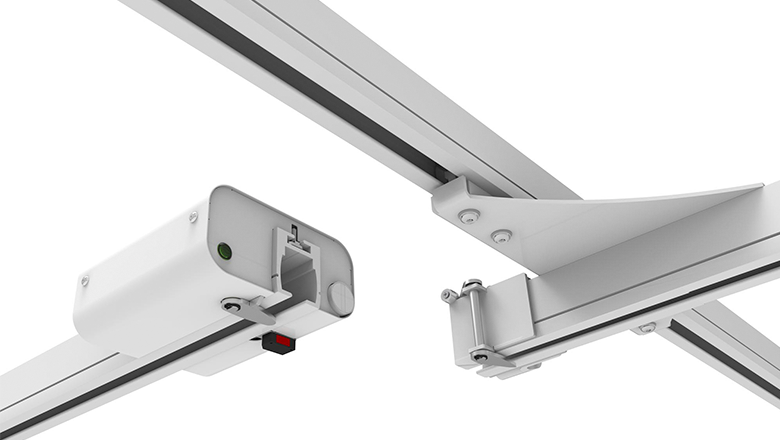
Sean Ram, account manager at Sentech, has guided the development of the hall sensor from the very beginning. “We first look at the problem and consider all factors and circumstances before we start devising solutions. Based on that, we try to find suitable standard sensors for the specific sensor tasks and conditions. That is the fastest and most effective. If that doesn't yield an optimal solution, then we proceed to modify suitable sensors.”
From the relatively short development process, the hall sensor emerged as the most suitable. Ram: “Sentech now only supplies the sensor and wiring. The next step is to create a complete assembly, which could make the entire unit even more reliable.”
New developments in an ‘open kitchen’
Ram appreciates the open attitude of PLS and Van den Brandt: “We work together in a kind of open kitchen. We share as much as possible about our development processes to get the best out of it. I often come to Renswoude to go into the workshop with Marcel and brainstorm about progress and new developments. Because everything is demand-driven, we don't know in advance where we will end up.”
In the spring of 2016, PLS approached Ram with a new development request. A request that, at first glance, didn't seem like a sensor-related question. Van den Brandt: “We've been using standard hand-held controls for operating the lift system for some time. The design of these controls isn't entirely optimal for our application. For example, the cord is mounted underneath, whereas we'd prefer it on top for added comfort and convenience. The controls are also not splash-proof.”
Something new was needed that also had a more exclusive feel. “The current supplier cannot provide that. I told him in an open conversation about our need for a new hand control. Sean surprised me by saying he saw potential in that.”
Van den Brand hits the nail on the head with that. Sentech is a sensor integrator that develops complete sensor assemblies with sensors, wiring, housings, and connectors. Ram on his reaction to PLS: “My first thought was that this didn't seem like sensor technology to me. But when you dive into it, you discover that manual operation actually falls perfectly within Sentech's competencies. So I immediately passed the question on to our engineers.”
R&D also involves a degree of creativity. So the engineers got to work on this challenge. They came up with a custom integral technical design, including an injection molded model for a new exclusive look of the casing. Ram: “I hope we can move from development to production early next year.”
How open is your kitchen? Share Your challenge with us.
With a Sentech vacuum sensor, Delmic's SECOM 2.0 is conquering the international microscopy world. This is the only device in the world that enables fluorescence and electron microscopy in one integrated setup. The unique microscope is compatible with all types of SEM electron microscopes.
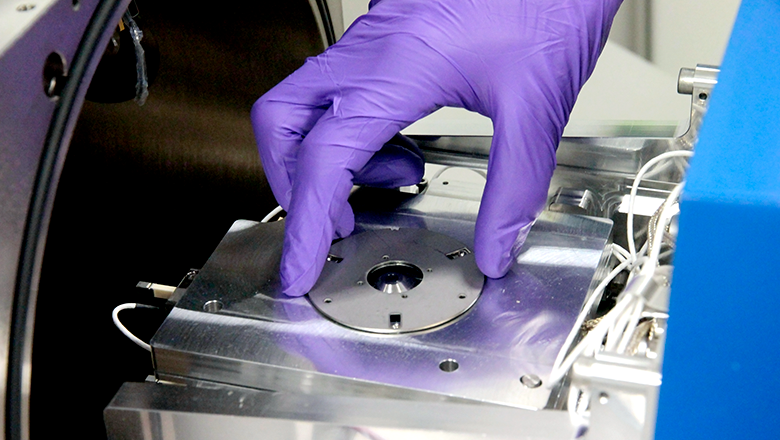
Sentech has developed a vacuum-compatible optical encoder solution for sample positioning in the vacuum chamber. The independent sensor integrator supplies the solution as a sensor assembly, allowing Delmic to easily integrate it into the SECOM 2.0.
Combination of fluorescence and electron microscopy
At Delmic, 13 people work on the development and manufacturing of high-quality microscopy technology. Its product range offers SPARC solutions for materials research, and SECOM solutions for biomedical research, among others.
“Delmic combines fluorescence and electron microscopy in the SECOM system,” begins Andries Effting, CTO and co-founder of Delmic. The correlative light and electron microscope (CLEM) can be integrated as a module into almost any scanning electron microscope (SEM).
The physicist is building on research from TU Delft and AMOLF with his colleague Sander den Hoedt. In 2011, that research resulted in the SECOM 1.0 prototype.
“It took us about 2 years to bring a suitable microscope to market from the prototype. The SECOM 2.0 looks very different from the prototype, but the concept has remained the same,” according to Effting.
With the high-tech microscopy technologies in Delmic's system, scientists are conducting groundbreaking biomedical research.
Fluorescence microscopy
Fluorescence microscopy, invented in the 1970s, is an optical method for investigating cell function. Researchers add chemical markers to a specimen, which bind to specific proteins.
In the image produced by the microscope, the marked proteins light up in various colors. Proteins are responsible for all processes in living cells. With fluorescence microscopy, scientists gain insight into processes that lead to disease.
Electron Microscopy – TEM and SEM
A electron microscope shoots a beam of electrons toward the specimen to be examined. Accelerated electrons have a much smaller wavelength than photons (light), allowing for a resolution that can be 2000 times higher than an optical microscope.
A transmission electron microscope (TEM) shoots an electron beam through the specimen, creating a kind of slide projection. The method allows for magnifications up to one million times: 0.1 nanometers.
A scanning electron microscope (SEM) focuses electrons towards the material and captures the backscattered electrons point by point to create an image. SEM enables magnifications up to 100,000 times and very sharp 3D images.
Benefits of CLEM for medical science.
According to Effting, Delmic's CLEM has several advantages over standalone systems:
- Ease of use
The researcher no longer needs to make two recordings with separate devices and then process them in software. - New research opportunities
Short-shelf-life preparations can be investigated. The actual uptake of a preparation takes only 1 minute. - Technical quality of the recordings
The recordings offer incredible levels of detail that are not possible with other devices. - Time saving
When research time is a factor, the system offers enormous time savings. Short machine time, for example, allows for rapid population studies.
Featured Benefit: Open Source Software
Effting jokingly calls his company “a photo company.” This explains Delmic's choice to offer its customers open-source software for image processing. “The software just has to be good,” he believes.
“Excellent software ensures a better product experience. We see our software as the instrument's calling card. Competitors leave gaps there. When our customers discover a bug or problem, we simply fix it. They don't have to wait for releases and updates, and they don't pay license fees, but they do pay for the actual support provided. Open source offers transparency to the user. The code is simply online,” according to the CTO.
Integration into almost all SEM types
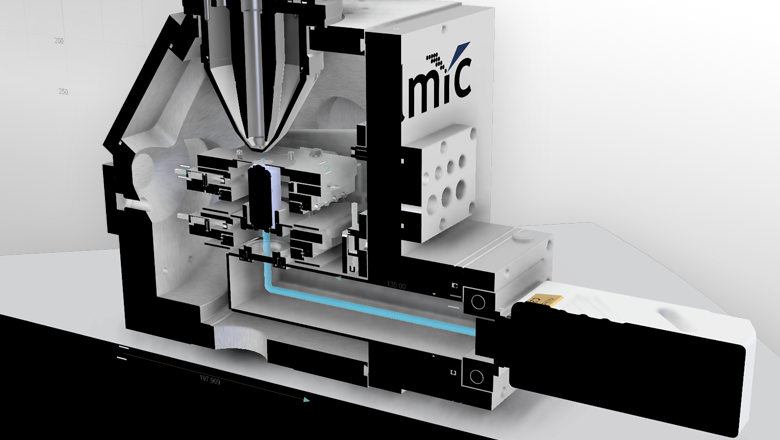
“We provide the optical microscope and software,” Effting explains. “There are plenty of companies that supply excellent SEMs. Our system fits on the SEMs of the five major suppliers, such as ZEISS, Tescan, Hitachi, Fei, and JEOL.”
The SECOM stage replaces the SEM stage. Effting continues: “For this, we developed microscope-specific interfaces. We optimized the software for each SEM type. Our customers can order the SECOM as an option from the SEM supplier, or directly from Delmic.”
Groundbreaking bioscience research
Delmic's CLEM microscopes are now finding their way to various universities and research institutions around the world.
Dr. Ben Giepmans The microscope is used, for example, in diabetes research by his cell biology research group at the University of Groningen.
He and his scientists are focusing on the Islets of Langerhans in the pancreas. They are thus investigating the triggers and new treatment methods for type 1 diabetes.
The Francis Crick Institute, under the leadership of microbiologist Lucy Collinson, uses SECOM for cancer research, among other applications.
Vacuum sensor development for the vacuum space
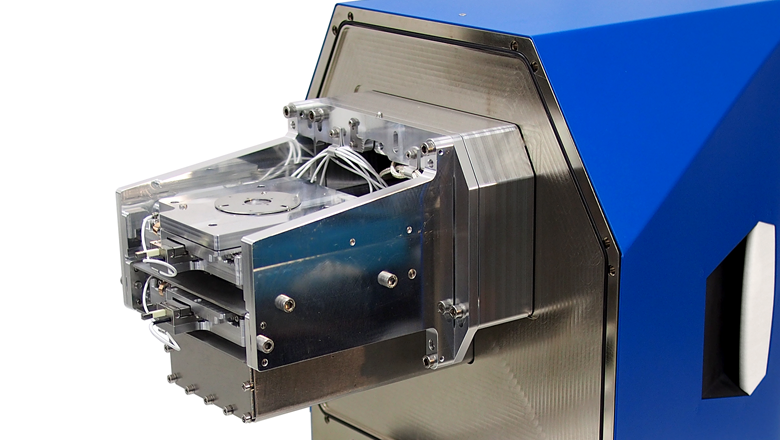
The SECOM 2.0 owes its extreme accuracy and high resolution to a unique optical vacuum sensor. Sentech supplies the customized MicroE optical sensors in a fully tested and calibrated assembly.
Delmic receives three sensor assemblies per CLEM system, one for each axis of movement, which can be quickly and easily assembled.
Encoder sensor MicroE for precise positioning
Delmic was looking for a reliable sensor solution for accurately positioning the sample in the vacuum chamber. Sentech came onto Delmic's radar after a Google search.
This led to a joint search for a suitable sensor solution based on the accuracy requirements and the circumstances of the internship.
Peter Verstappen, account manager at Sentech, explains the development process. “The challenges were: accuracy, vacuum conditions, and the limited installation volume. We're talking about nanometers and an extremely precise focal point for the optical microscope.”
Accurate position sensor – material usage and low energy consumption
The vacuum limited the search spectrum for the position sensor in terms of material usage and energy consumption. In a vacuum, outgassing occurs with various materials such as plastics, which ‘contaminates’ the sample and environment.
Another problem is the lack of air cooling. Therefore, a sensor was needed that generates as little heat as possible.
“We put the entire MicroE line, along with a position sensor, through testing, as well as a number of competitors. Based on the specifications, the 90% was immediately ruled out,” said Verstappen.
Effting reacts: “We quickly agreed on the application of a MicroE optical encoder. It was pleasant to be able to talk about our wishes and the specifications in an easy way.”
How an optical encoder works
The optical sensors determine their position on the motion axis using a read head and a very fine ruler, on which a pattern of lines is placed with a period of 20 µm.
The linear optical encoder does not contain an LED as a light source, but a VCSEL-controlled element that requires much less energy. The absence of a lens also contributes to the most compact possible position sensor.
“We adjusted the ruler according to the accuracy requirements,” said Verstappen. The light source shines on a pattern of reflective and non-reflective stripes, creating ‘nodes’ in the reflection pattern.
These are coinciding crests and troughs of the specific wavelength and are captured by the sensor receiver. Similar to the principle of light passing through a diffraction grating. This way, a displacement can be made visible per period in a movement.
Incremental measuring system with interpolation
The incremental measuring system converts movement into counting pulses. The movement is accurately controlled with respect to a fixed unique point on the ruler: the index.
Verstappen on accuracy: “The sensor interpolates the intrinsic period of 20 micrometers to steps of 1.2 nanometers, or a multiple thereof. We needed the highest accuracy for the z-axis movement.”
He continues: “For cost and handling reasons, we have decided to use the optical nanosensor for each axis.”
High-quality materials in optical sensor assembly
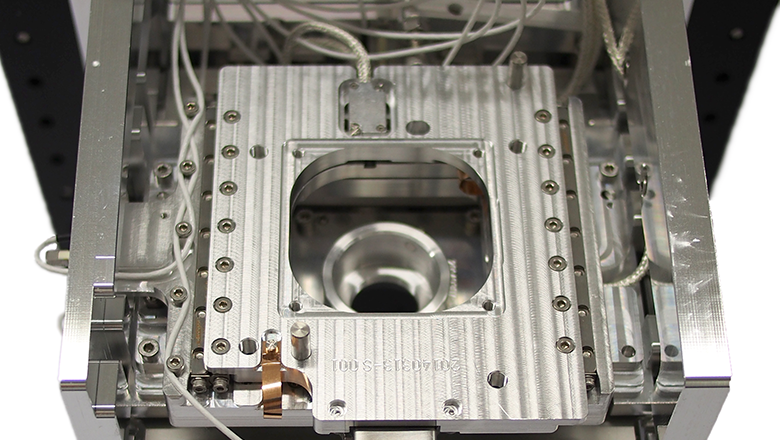
Sentech and Delmic have paid a lot of attention to the quality of the other components, in addition to the specific sensor. Effting wanted to avoid discussions with various suppliers about sensor components.
“We offer a high-tech system. Then you shouldn't skimp on costs with cheap connectors and cabling, for example. You don't want hassle about liability afterwards.”
Semiconductor industry experience
Sentech utilized its experience in the semiconductor industry. “That's why we chose the standards and high quality from the semiconductor industry and advised Delmic to solder the connections rather than screw them,” explains Verstappen.
The semiconductor experience also led to the logical choice of producing and packaging the sensor assembly in Sentech's cleanroom.
“Sentech makes it incredibly easy for us because we know that the complete sensor application has been tested. In our assembly facility, we just need to take the sensors out of the packaging, and we can assemble them directly and quickly,” says the satisfied Delmic founder.
Conquering the world with reliable sensors
According to Effting, satisfaction with Sentech doesn't just stem from the pleasant collaboration in an open development environment. “The SECOM 2.0 has been on the market since 2013. To date, all sensors have been working flawlessly. The promised specifications and performance have been delivered.”
The SECOM platform has proven its worth and is slowly but surely conquering the microscopy world.
Your outcome too?
For reliable sample positioning in a vacuum environment, a vacuum-resistant optical encoder was the solution for Delmic. Are you also looking for a reliable sensor solution for your positioning and control challenges?
Let us Your challenge and we'll help you!
In 2025, Microsure will begin clinical trials for its microsurgery robot. The encoder systems, which ensure highly precise movements, were designed by the Eindhoven-based company in consultation with sensor specialist Sentech, who sat at the table as a development partner with Microsure and system builder MTA.
This article was written by Alexander Pil and appeared in Link Magazine
Sentech became involved in the development of the Musa-3, the third generation of Microsure's microsurgery robot, at an early stage. Because Sentech also works very regularly with MTA, who is involved in the project as a system developer and production partner, the triangle was quickly formed. ‘It was quite a challenge in the first phase because it was clear which direction we needed to go, but how do you translate that into actual specifications?"
’The numbers were sometimes more gut feeling than exact science,‘ recalls Sean Ram, Account Manager at Sentech. ’It occasionally rubbed in a positive way, by challenging each other and by continuing to ask questions. We could brainstorm openly.'
As a sensor specialist, Sentech sat at the table to advise Microsure and MTA on all possible sensor techniques. ‘What are the pros and cons of each choice? How big or small is it? And what specs can you achieve with it?’ Ram lists. But importantly, it helped translate the specs. ‘You can easily say: I want an accuracy of 0.01 degrees. But what does that mean in practice, at the system level and at the sensor level? Because if a sensor is installed incorrectly by a tenth of a millimeter – and that's very human – the error is already ten times too large. How do you deal with that? We had interesting discussions to question each other thoroughly.’
To say no
Pieter van Wegberg, Project Leader at MTA, on the collaboration with Sentech: ‘There are many companies that, frankly, just move boxes. Sentech, however, is very good at thinking along.’ To be able to properly control the rotational movements in the robot arm, an encoder was needed that could offer that little bit extra within a limited installation space. ‘We ultimately settled on a standard component that we all got the most out of.’

Pieter van Wegberg, Project leader MTA
“They're also brave enough to say ‘no’ when something really isn't possible. Not everyone does that. In that regard, Sentech is not a supplier but a development partner.’
Apart printed circuit board
Ram adds: ‘There were also alternative components on the table, but they were exorbitantly more expensive. Then you have to wonder if that's worth it.’ It is because of considerations like that that Van Wegberg values Sentech: ‘They are very good at finding a solution that fits the business case.'.
The chosen absolute encoder is actually no more than a small chip. It was an option to integrate it directly into the small PCB that contains all the electronics for such a joint. ‘But what if that encoder breaks? Then you have to replace the entire module,’ says Jurre van Son, Account Manager at Sentech. ‘With our knowledge and expertise in sensor technology and integration, Microsure has therefore come up with a design where the encoder chip is on a separate circuit board.’
Sentech is responsible for the production of that sensor PCB. They have also set up the supply chain for it. ‘There are quite a few critical process steps involved in processing those encoder chips correctly’, according to Van Son. ‘That's why we prefer to manage it ourselves so that we can take responsibility if something goes wrong.’ The same applies to the ruler with the stripe pattern that the sensor uses to determine its position. Together with Sentech, MTA has designed and produced a small hub for this, onto which Sentech then very accurately glues the ruler. Van Son: ‘We check if the design has been executed correctly and arrange the supply chain.’
Flexible and rigid at the same time
When asked about the greatest challenge, Ram mentions the flexibility required during prototype development combined with a process that needs to be strictly regulated. ‘After all, it's a medical application, so your methodology must comply with the ISO 13485 standard. This requires very structured processes where everything is well secured. At the same time, you're in the middle of a development where something inevitably changes regularly. You have to keep your head in the game to ensure you continue to meet the standards while still being able to adapt flexibly.’
Sentech regularly works on medical systems, but these are usually patient assistance systems or equipment for laboratory environments. This project was therefore a new application. Van Son: ‘For our automotive customers, we integrated the very strict IATF standard into our organization. A great deal of precision also needs to be guaranteed there. In this process with Microsure, we had to record and document things differently, but the underlying structure and how you deal with tightly controlled processes and supply chains was not new to us.’
Ram excitedly decides: ‘It's super cool that we can be involved with this kind of development in the Netherlands. Someone comes up with something and within a radius of 60 kilometers, there's a complete chain that can answer the question in open collaboration: how?’
This is how you integrate successful sensor technology
Integrating successful sensor technology presents challenges. How do you prepare for environmental factors you are not yet aware of? And what sensor trends can you expect in the future as an engineer?
In our free e-book, you'll find answers to these, including practical examples of common sensor issues and solutions.