

Four years ago, Aebi Schmidt Nederland (formerly NIDO) approached Sentech for a solution to a sensor problem with its spreaders. Due to the harsh conditions in which spreaders operate, the sensors frequently failed. Sentech then developed a sensor solution.
The sensor assembly with a mechanical encoder has now been in use for two and a half years. The results are astonishing: zero percent failure rate, and the solution is half the price of the old sensor.
Problem: Rotary encoders failing due to harsh conditions
Rob Pieters, account manager at Sentech, explains the development of a sensor solution for Aebi Schmidt Nido: “NIDO came to us with a problem. The sensors (incremental rotary encoders) used on salt spreaders for dosing and distributing salt were constantly breaking down. Because these sensors contain moving parts, they are sensitive to harsh conditions (brine, frost, moisture) and temperature fluctuations. Furthermore, the drivers also used the part with the sensor as a step to check the brine level.”
Sentech then worked with Aebi Schmidt engineers to devise a solution with a shaftless mechanical encoder: waterproof, contactless, with an O-ring seal, and with a sturdy low housing so drivers could no longer step on that part. The sensor solution is also fully compatible with all salt spreaders who are already driving on the road.
Problem analysis at Sentech leads to an effective sensor solution
Sentech first thoroughly analyzed the problem by studying the usage conditions and operational requirements in detail. Pieters: “The following questions play a big role in this: What should the sensor do? Where will the sensor be placed and what are the conditions? This leads to a set of realistic requirements and constraints. We then search for the optimal sensor, cabling, connectors, and housing. We are always honest in such a development process. If we cannot deliver a solution, we say so. In those cases, I simply refer companies to businesses that can. Because I believe you should always help someone if it doesn't cost you anything.”
According to Pieters, however, it rarely happens that Sentech cannot develop a solution. “Sentech can do anything. There is a solution for every sensor issue, but that solution must, of course, be affordable and economically viable. At Aebi Schmidt, we succeeded in developing a custom sensor assembly with a mechanical encoder, cabling, connectors, and a robust housing. We not only expected the performance to be excellent; the assembly is also half the price of the old sensor.”
Let us Your challenge and we'll help you.
For several years now, Sioux CCM has been working on a highly precise and fast-moving belt for inkjet printing systems, among other applications. The latest generation of the device uses Azbil sensors, supplied by Sentech, which was also closely involved in the integration.
CCM from Nuenen – part of Sioux – is known as a developer and supplier of mechatronic modules and systems. The company usually does this for external clients, but it also develops products independently.
One of these is the Generic Substrate Carrier (GSC), a steel conveyor belt that is suitable for moving a substrate very precisely and at high speed under, for example, a series of inkjet heads.
“A normal conveyor belt is constantly mechanically corrected so that it doesn't slide off the rollers,” explains CCM CTO Arend-Jan Beltman. “This means such a belt never stops, but is constantly wobbling.”
An alternative method to check the belt is to vary the distance between the rollers. “However, that introduces stresses into the belt and the center of the belt moves. You don't want that either.”
Gert van Ooik, mechatronics designer at CCM, adds: “For a resolution of 300 dpi, it's still possible with conventional systems. You have to set them up very well and then, above all, not touch them anymore. But if you want to go to 600 dpi or even 1200 dpi, that's no longer sufficient. Over a distance of about two and a half meters, there are various print heads printing different colors. They are spaced so far apart that the image is built up with displacement. So, you have to ensure that the droplets always land in the right spot and that the overlap is correct. This places enormous demands on the mechatronics and the measuring systems.”
10 micrometer accuracy with Sentech sensors
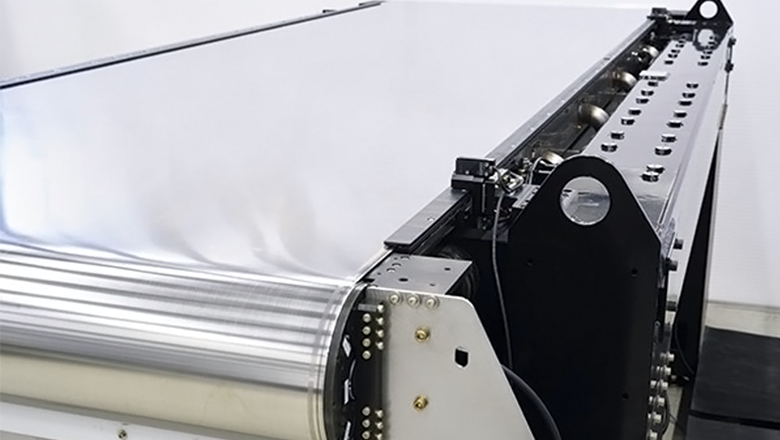
CCM has introduced and patented a technique in which it continuously holds the belt with reluctance actuators. Beltman: “With ordinary rollers, it is impossible to transport a substrate properly and precisely. Small forces in the substrate quickly lead to stress, and then you lose your accuracy. We have devised a solution that removes the substrate's properties from the equation. The trick is that we use a steel belt that is barely sensitive to tension variations and is driven by a segmented roller. With those segments, we can influence the belt and guide it.”
The carrier consists of a highly precise stainless steel belt, 0.3 millimeters thick. It is typically 1.25 meters wide and over eight meters long, but CCM can vary this upon request. The belt has small holes so that the substrate can be temporarily attached with a vacuum.
“In an ideal world, the edge is straight and you can create a simple feedback loop,” says Van Ooik. “In practice, however, there is about half a millimeter of variation. Quite good, but not good enough for the application. We aim for an accuracy of better than 10 micrometers.”
If you want to manipulate, you also have to measure. CCM has therefore introduced two sensors that measure the position of the tire. They have a C-shape with transmitters in the lower leg and receivers in the upper leg. The sensors are approximately two meters apart along the tire.
“Two sensors are needed because there's a second degree of freedom in the band: it can also rotate slightly around the z-axis,” Van Ooik explains.
Best performance with Azbil sensors from Sentech
The current GSC is already the third generation of the machine. In the earlier two generations, CCM used a sensor that only registered light intensity based on position-sensitive device technology. The further the belt was inserted into the sensor, the less light was transmitted.
“It worked reasonably well, but pure intensity turned out to be insufficient as a measure of position in practice,” says Van Ooik. A tiny bit of stray light and you're already off.
CCM switched to CCD technology. “That is less sensitive to these kinds of phenomena,” Van Ooik explains. Although CCM restrains the steel band with a cover strip, small height differences remain. “CCD sensors can handle that well. We've validated that. We measured at different heights, but that had no effect on the output value.”
The designers from Nuenen put three providers through the wringer: Keyence, Sensor Partners, and Sentech. They paid attention to aspects such as accuracy, reproducibility, linearity, resolution, and response time. “Ultimately, Sentech delivered the best performance for this application with their Azbil K1G sensors,” according to Van Ooik. These are also C-shaped sensors with a transmitter-receiver combination.
Sentech account manager Sean Ram: “The transmitter is a row of lasers. Together they form a linear beam seven millimeters wide. The receiver is a series of CCD pixels. If an object enters that light curtain, you can determine the coverage; how many pixels are covered?”
The receiver thus consists of discrete pixels. Ram: “We can interpolate between them to achieve a higher resolution. This can be done by comparing the outlines of the individual pixels. However, this alone will not achieve the resolution we specified in the specs.”
Azbil also employs other methods to improve the resolution of the measuring system, but Ram is not authorized to say much about those. The data from the transmitter and receiver go to a controller. This controller typically includes a range of functions for determining length or width, among other things.
“This system contains a controller that can process four sensor heads simultaneously. The two heads in the GSC are thus connected to the same controller. A third sensor, which is only used during the calibration phase, is also connected to this controller,” according to Ram.
Super-fast response time
The Azbil sensors achieve a resolution of 0.1 micrometers and a repeatability of 1 micrometer. Ram: “For this type of sensor, that's quite accurate.” Van Ooik: “We had a budget of ten microns, but we wanted to allocate only a few mu to the sensor at most. That was successful.”
The sensor's response time was an issue, according to Van Ooik. “It's part of a feedback loop. For fast control, a short sensor response time is essential. In the specifications, I read that Azbil had a sensor in its range with an update frequency of 4 kHz. That's great, I thought, especially for a CCD-based system. Unfortunately, it wasn't available in Europe because it hadn't been EMC-approved yet.”
At Sentech's insistence, Azbil is now trying to get the sensor onto the European market, even though it wasn't on the Japanese company's roadmap. However, this is not strictly necessary for CCM. The current sensor's response time of half a millisecond is sufficient for now.
“At the moment, we only occasionally get requests for a GSC that can run at its maximum speed of 2 m/s,” says Van Ooik, “but it's possible that the print heads will be able to work faster in the future. Hopefully, by then, we'll only need a firmware update to switch from 2 to 4 kHz.”
Successful and effective collaboration
Sentech's effort at Azbil is characteristic of the collaboration between the sensor specialist and CCM. Ram: “Together with CCM, we went through the testing process. You regularly encounter results that are not so easy to explain. How should you interpret those measurements? Due to our good relationship with Azbil, we were able to provide quick answers. And when a sensor was quickly needed for an update for a customer, Sentech arranged for everything to be available within two days.”
CCM-cto Beltman: “That works very pleasantly. Through Sentech, we have direct contact with the sensor developers in Japan.” Van Ooik adds: “Normally, you don't get in there that quickly. Difficult questions for a development department often remain unanswered if you are a small customer like us. You just can't get through.”
Beltman again: “At CCM, we are happy with suppliers who think along. These are generally not straightforward applications for us. This project is not the first; we have also worked successfully with Sentech several times in the past.”
As mentioned, the GSC is intended for transporting substrates. These can be paper, film, glass, or panels. CCM conducts many practical tests with DJM from Harderwijk, a specialist in inkjet printing who contributes a lot of application knowledge. The GSC has already been used in a groundbreaking system to create interconnects between solar cells.
“We see many customers having problems with the transport of substrates, especially when it comes to films,” says Beltman. He doesn't want to name names yet, but Beltman claims there are ‘quite a few interested parties’.
“It's a conservative market and nobody wants to be the first. Many companies view it as an interesting solution to a unique problem. With one customer, we're already well on our way; that could become a nice series.”
Where is your challengeChallenge our challengers!
It proved difficult for PV machine builder Solaytec to find a sensor within budget that could determine the position of solar cell wafers in their deposition machines. The company approached Sentech, which developed a custom-made sensing sensor.
Sentech and TNO spin-off Solaytec have been collaborating since 2012 on the development of atomic layer deposition (ALD) machines. With this nanotechnology, optimized by Solaytec, manufacturers achieve significantly higher yields from their solar cells.
Sentech has developed sensor solutions for the machines as an R&D partner to effectively monitor the ALD process – solutions that other sensor suppliers could not offer within Solaytec's budget. Together, the Brabant-based companies now deliver a feat of precision engineering worldwide.
Achieve higher efficiency from solar cells with ALD
ALD is a deposition technology that allows layers to be deposited at the atomic level. A substrate is sequentially brought into contact with two different process gases. After each gas pair, exactly one atomic layer has been formed through two consecutive chemical reactions. The desired layer thickness is achieved by repeating the cycle more often.
ALD has a distinct advantage here: because the chemical reaction stops by itself once the surface is covered, the process is self-limiting. This allows the layer thickness and homogeneity of the material to be controlled with unprecedented accuracy.
Although ALD has existed for a long time, the technology was far too slow and expensive to be industrially applied. TNO has changed that. In 2008, the research institute began research to make ALD significantly faster.
In the same period, several institutes, including TU Eindhoven, demonstrated that a layer of aluminum oxide applied with ALD leads to a significant improvement in efficiency for silicon solar cells. “For an optimal effect, a nice, homogeneous film of aluminum oxide is very important,” explains Solaytec CTO Ronald van Dijk.
An average solar panel has an efficiency of eighteen to twenty percent. Adding aluminum oxide as an extremely thin ALD film to a solar cell improves the absolute efficiency by more than one percent. Relatively, this is a significant improvement of five to seven percent.
ALD machine processes 4000 wafers per hour
In 2009, TNO achieved a breakthrough that enables solar cell manufacturers to apply the efficiency-boosting aluminum oxide ALD layer to their products, as the research institute's spatial ALD process allows the film to be deposited quickly yet precisely. Until then, TNO had used the standard temporal ALD, in which the substrate is sequentially exposed to the different gases in one chamber.
With spatial ALD, it has managed to shorten the purging phase by a factor of a thousand. One cycle, during which the silicon solar cell wafer is transported contactlessly through a series of deposition units, now takes milliseconds instead of six seconds.
In the first unit, the precursor gas trimethylaluminum (TMA) forms half of the first monolayer. In the space after that, water vapor completes the layer through a reaction between the TMA and water. Depending on the desired thickness, this process is repeated several times in the deposition unit. Between the deposition units, inert nitrogen gas provides curtains that prevent the precursor gases from coming into contact with each other.
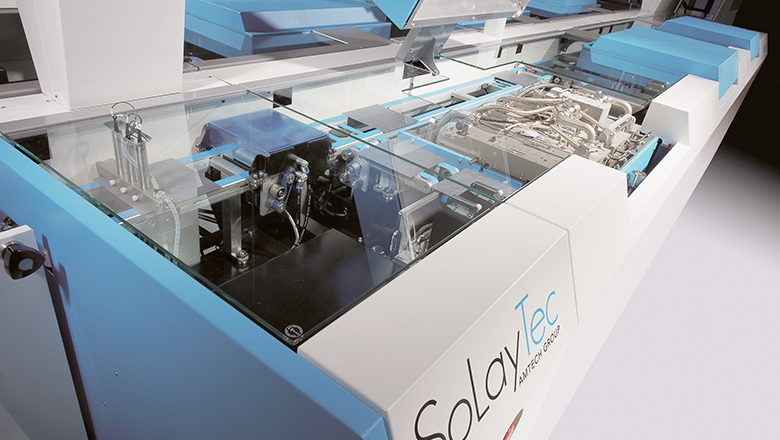
TNO's research led to a patented deposition head in a prototype in 2010. ALD machine. “The breakthrough brought a business case within reach,” says Van Dijk. “In 2010, Solaytec was established as a spin-off, with the prototype ALD machine as the basis for commercializing the TNO invention.”
According to Van Dijk, the challenge at the time was to get more electrical power from the same solar cell at constant costs. “The hectic start-up phase led to the first production machine with a single deposition unit. We further developed this into a machine with multiple deposition units, which can now process a maximum of four thousand wafers per hour.”
Solaytec has customers worldwide, but the machines are especially in demand in China. Van Dijk: “The solar energy market is a growth market that is sensitive to economic cycles. China has an energy and pollution problem and mass-produces solar panels for the whole world.”
Only Sentech was able to meet Solaytec's sensor needs.
Erik Kremers, system architect at Solaytec, explains how Sentech became involved. “Our first machine had a number of motion sensors to determine wafer movement through the deposition unit. The sensor we used for this did not meet our requirements regarding reliability and cost. Reliable measurement of the wafer position in the closed deposition unit at a temperature of two hundred degrees Celsius is crucial for the performance and uptime of our machines. If the wafer does not move according to the setpoint, this can lead to malfunctions and breakage, resulting in a production stop for our customers. Downtime costs our customers money.”
The sensor measures the edge of the wafer as it passes by at different positions in the deposition unit. With the measurement data, Solaytec can software-adjust the wafer's position so that it follows the desired setpoint.
Kremers: “We drew up specifications for a new sensor and submitted them to the then-supplier and other sensor suppliers. None of them could supply a sensor that fit within our budget. That is, until Sentech came into the picture.”
Peter Verstappen, account manager at Sentech, then sat down with Solaytec to develop a cost-effective sensor solution from scratch. Verstappen: “Sentech is a specialist in sensor integration and the development of sensor solutions. We first want to know the specific needs of a customer. You can't find Solaytec's needs in a sensor catalog. Solaytec needed an R&D partner. The technology wasn't the problem, but the price at which the sensor solution had to be delivered was. Too high a price would make the ALD machine too expensive to achieve the desired efficiency advantage for solar panel manufacturers.”
Temperature and cost are the biggest challenges
According to Verstappen, the biggest challenge was the high temperature in the deposition unit. Through open collaboration, Sentech succeeded in integrating a completely new sensor solution within the intended production budget into the first generation deposition unit: the DU 1.0, within a few months.
This optical positioning sensor contains a fiber optic transmitter with an amplifier, which sends a red light beam to a receiver. Digital detection occurs at a number of positions when the edge of the wafer passes the sensor and interrupts the light beam, resulting in eleven measurement values.
According to Van Dijk, Sentech has satisfied Solaytec's R&D needs for its production machines with the DU 1.0 to a great extent. “But Solaytec wants more,” adds Kremers. “I still had the desire to have a sensor that could continuously measure the wafer position instead of the current discrete points. We would prefer a line sensor across the full stroke of two hundred millimeters that the wafer makes in the deposition unit. During a brainstorming session, Peter Verstappen did not immediately say no when I sketched my idea. Sentech understood very well why I need the wafer's position: to improve the reliability of future machines.”
Co-R&D leads to a scoping sensor that improves the reliability of ALD machines
“Digital detection with the DU 1.0 has its limitations because the sensor only registers a few values. We started working with analog signaling because it allows you to measure positions in space. This resulted in a scoping sensor, which also measures lateral movement, as a supplement to the positioning sensor. Combined, the measurement values from both sensors provide a spatial overview of the wafer's movement through the deposition unit.”
According to Kremers, that result comes quite close to his original wish. “The new version offers such a wealth of new information that helps us take further steps.”
Kremers and Van Dijk appreciate Sentech's openness regarding its development process. Van Dijk: “Together, we practice open innovation. The success of co-R&D is determined by the openness and willingness to share R&D insights with each other. Both Sentech and Solaytec possess this open-minded culture.”
The way of working in successful sensor integration
During a sensor integration project, you always weigh three interests: cost, quality, and delivery time. What are the risks and consequences of my choice? Is the technology I had in mind the right solution for my application?
Scroll through our e-book for the answers to these. You'll also read practical examples of common sensor issues and solutions.
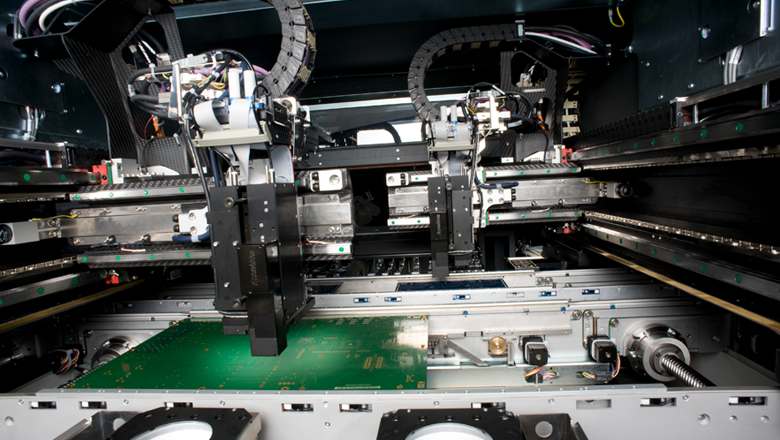
The iFlex pick & place SMT (Surface Mount Technology) placement machines introduced by K&S are based on the ‘dual lane’ concept. Sentech's optical sensor assemblies are used for reliable detection of printed circuit boards (PCBs). This solution emerged as the best in an open innovation process for a complex detection problem.
The board transport module has been completely redesigned and re-engineered for this purpose. The detection of printed circuit boards (PCBs) presented the necessary challenges until the very end, which were effectively resolved through close collaboration between K&S, Frencken Mechatronics, and Sentech.
Reliable detection of PCBs in SMT machines
Marco Leeggangers, business development manager at Sentech, on the challenge: “The challenge was to detect a wide variety of PCBs, in a limited space and with very high reliability. These three factors led to a very close collaboration between the engineers of all involved companies.”
In the old system, a sensor looked at the underside of the board. “Due to the limitation in construction space, the number of required sensors, and the wide variation in the shape of the PCBs, it was decided to detect from the side. However, to do that, space was needed again, and that was precisely what was lacking.”
To find a good sensor solution for this, Sentech conducted tests with different types of printed circuit boards. It quickly became clear that fiberglass was not the solution.
“The light intensity is not evenly distributed. If a thin PCB passes underneath the spotlight, there is such a low ‘signal drop’ that it does not fall below the threshold, and therefore the PCB is not detected.”
Custom sensor solution – optical sensors from STM
Sentech found the solution in an optical sensor from STM. Leeggangers: “With miniature optical sensors, a much more uniform light distribution of the light beam is achieved. For this, we found a small optical transmissive system with a separate amplifier at the German STM Sensors. Due to the separate amplifier functionality, we could integrate 9 or 18 amplifier circuits on one printed circuit board. This saves costs. So we opted for a sensor assembly with a control board, which also communicates with the control system via EtherCAT.”
To evenly distribute light intensity, STM has developed its own LED. In this process, a plastic layer is applied to the die using an injection molding process. The curvature of this layer is measured during growth.
Once the optimal curvature is reached, allowing the light to exit beautifully straight, the process stops, resulting in a lovely uniform exit angle.
After a follow-up test with the new and standard LED, the narrow beam still caused problems, especially with different shapes of reflections. This showed that not a bundled source, but a ‘very large, diverging lamp’ gave the best results. Affordable LEDs were the solution to a high-tech problem in this case.
Complex sensor challenge?
We'd be happy to help you think things through. Ask your question.
A smart pressure sensor with an EMC filter in Flamco's Flexcon PA proved to be the solution to a major problem for heating engineers: unplanned service calls without any actual defects.
Two years ago, Flamco wanted to predict the lifespan of expansion vessels in heating systems using a smart pressure sensor application. However, market research revealed that heating technicians had no need for this. They did, however, appear to be looking for ways to reduce unplanned service visits, which were eroding already fragile profit margins.
In an open innovation process, Flamco and the independent sensor supplier Sentech have developed a revolutionary product centered around a smart and extremely accurate pressure sensor: the Flexcon Pressurization Assistant with an automatic refilling unit. The pressure sensor is neither a high-pressure sensor nor a low-pressure sensor.
The advanced pressure monitor is now on the shelves of wholesalers and in the service vans of heating engineers.
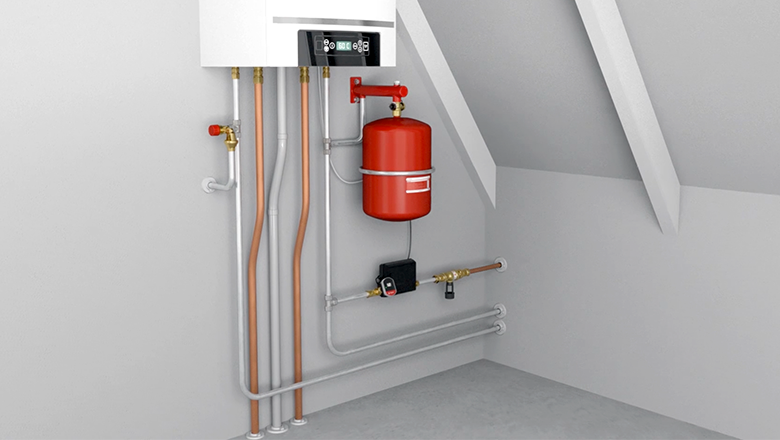
Red expansion vessel next to the central heating boiler, usually from Flamco
Most consumers don't realize they have Flamco products in their homes. There's a good chance the red expansion vessel near your central heating boiler is made by Flamco. Flamco develops and manufactures installation products and fittings.
According to Flamco, there's a Flamco expansion vessel in every mechanic's van. It was installers who gave Flamco a revolutionary idea for accurate monitoring of pressure in a heating system.
Flamco introduced the idea as the Flexcon Pressurisation Assistant at the world's largest installation trade fair, ISH 2017 in Frankfurt. Starring a smart pressure sensor from Sentech.
R&D for the installation industry
With its own R&D department, Flamco is working on the world of tomorrow. Its innovations focus on sustainability, efficiency, and connectivity. A sustainable example is the Ontgasser Vacumat Eco, which prevents damage and malfunctions in a heating system.
From the brain of Flamco's R&D department also comes the Flexcon PA. A cost-saving innovation that the installation industry, according to Flamco, has been eagerly awaiting.
Pressure sensor application for expansion tanks
Spiritual fathers Herman Reezigt, R&D team leader, and Erik Hoenderkamp, product developer, talk about sensor development and collaboration with Sentech.
Flamco looked for a way to predict the lifespan of expansion vessels. An expansion vessel compensates for dynamic volume in the heating system with an air cushion. However, the air cushion disappears over the lifespan, and the vessel's membrane wears out.
Reezigt: “An expansion vessel lasts an average of 7 to 10 years. A Flamco vessel lasts even 15 years. With our open attitude towards suppliers and installers, we thought they would benefit from predicting the lifespan of the expansion vessel. With a pressure sensor application, we could warn when an expansion vessel needs replacing.”
Installation industry asks for a solution to unnecessary service calls
When Flamco tested the market, the installation sector turned out to be less eager for such an automatic warning, according to Reezigt. Reezigt: “Most installers replace an expansion vessel every five years, so well within its technical lifespan. We did receive valuable feedback, which allowed us to take a different direction with the same sensor technology.”
According to Reezigt, two out of three unplanned maintenance visits are due to pressure loss in the central heating system. Reezigt states, “Installers and service technicians usually work on the basis of service contracts, in which they are not paid per malfunction. In most cases, a malfunction simply involves refilling the system. Therefore, installers were looking for a solution to reduce unnecessary visits and automatically refill systems.”
Accurate pressure sensor monitors heating system pressure
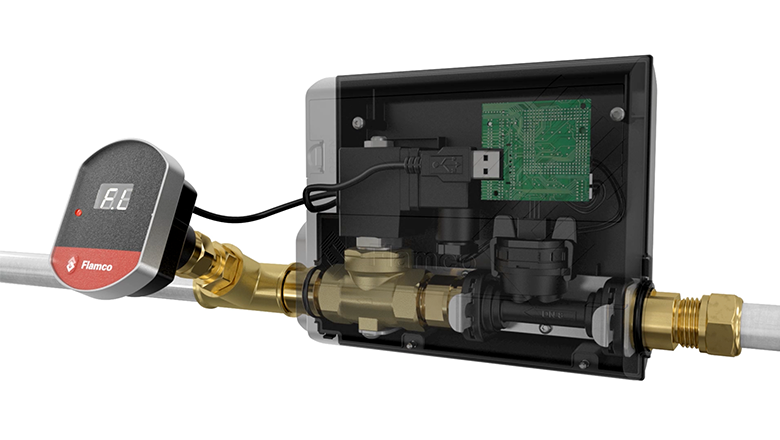
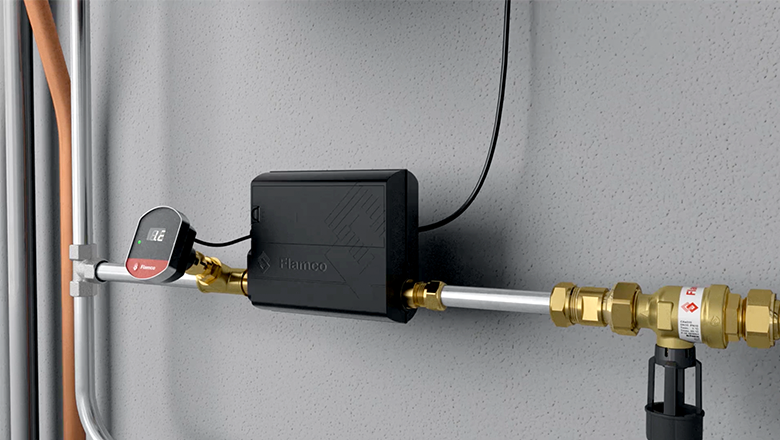
As product developer, Hoenderkamp coordinated the development in-house. Hoenderkamp: “The Flexcon PA has become an extremely handy tool that very accurately measures the pressure in the system. We have linked an automatic refilling device to this. We supply this optionally with the sensor.”
The sensor's measurement data is used for a mobile app that customers download from the Apple App Store and Google Play Store. “During the initial setup, the device even screens the entire heating system. It learns the installation based on subtle pressure differences during the heating cycle. From this, it calculates the ‘hardness of the installation,’ in other words, the specific behavior,” according to the product developer.
The sensor then uses that number as a reference number throughout its entire lifespan. Hoenderkamp: “The pressure sensor must always remain stable and reliable. It only measures subtle pressure differences. But the device is so smart that it can measure and predict a lot based on that.”
Preventive e-assistant for central heating system installers
The Flexcon PA enables installers to monitor pressure in a heating system long-term and intervene preventively in a timely manner. The data from the app offers technicians a wealth of information.
The app shows, among other things:
- or the expansion vessel is about to fail
- or the safety valve emits water
- whether there is a leak in the system
- if the installation needs to be refilled
The automatic refill unit makes it completely easy for installers and customers. According to Reezigt, installers can organize central heating maintenance much more efficiently with the Flexcon PA.
Product development around sensor technology
Reezigt and Hoenderkamp didn't initially know exactly what requirements to set for the product or which sensor specifications that would lead to. Sentech's help came at the right time.
Hoenderkamp met an account manager from Sentech at a trade show. An appointment at Sentech for a presentation soon followed. Reezigt: “Before we got in touch with Sentech, we thought: how difficult can it be? During that presentation, things came up that we had never thought about. That's when you realize we simply lack that knowledge.” According to Hoenderkamp, Sentech, as an independent sensor supplier, has become “a real knowledge partner” that has guided Flamco.
Hoenderkamp continues: “We developed the housing, interface, electronics, and software around the pressure sensor. The Flexcon PA had to be ready for production for ISH 2017.”
“During this open innovation process, Sentech and Flamco have grown much closer,” says Reezigt. “We saw that Sentech is a company that really knows what it's doing. Despite our position in the market, we are still quite small. You need a flexible yet decisive partner in that case,” according to Reezigt.
Sensor Challenge: Lifespan, Reliability, and Price
Sentech creates a sketch of the sensor solution after the initial contact with Flamco. That sketch was perfected by Hoenderkamp. The main challenges for sensor development were:
- a very narrow constant measurement resolution
- the reliability over a lifespan of at least 15 years
- and the cost
Reezigt: “The wholesaler buys our products and sees our broad program as a major logistical advantage. This allows them to optimally serve installers and construction companies. However, the lowest possible price is a crucial condition for the marketability of the Flexcon PA. Furthermore, the regular adjustment of the scope was a challenge. A partner really needs to be able to handle that!”
Custom sensors from the automotive sector
There was no clear picture yet of what Flamco was looking for. Based on the objectives, I thought about the direction for sensor development. What do I need and where can I get something that fits the concept? When you think about it, you automatically arrive at the automotive industry. There are large volumes, reliable products, and they are ISO TS-certified companies. They understand what quality is.
All specs, all pros and cons were laid out. Over the course of the ride, more and more fell away. I finally ended up in China with a company that makes sensors for automotive coolant systems. Pressure measurement in such a system is almost comparable to a heating system.
Knowledge partner sensor technology
Reezigt: “We have found a reliable knowledge partner in Sentech. Sentech is very flexible. It's nice to notice that Sentech is fully committed. Director Marcel Figge's enthusiasm is also contagious.”
Hoenderkamp adds: “Keeping agreements is very important in such a development. You shouldn't have any surprises leading up to a deadline. The product simply had to be available for the ISH. We had confidence the whole way through that it would turn out fine.”
You can come up with something beautiful, but in the end, you have to be able to sell the product on the market. Moreover, communicating via Bluetooth with an app requires a lot of integration expertise. Despite the high demands, we were still able to create a solid business case.
Fine-tune Electromagnetic Compatibility with an EMC filter
During development, Sentech and Flamco refined the sensor specifications to a Proof of Concept. You still encounter a number of challenges, such as adjusting the EMC sensitivity of the sensor.
Electromagnetic radiation interference caused too much fluctuation in the measurement of subtle pressure differences. We succeeded in minimizing the electromagnetic interference with a redesign of the sensor circuit and additional software filtering. The demo version then passed the test flawlessly.
On to the next sensor development
The Flexcon PA is now on wholesalers“ shelves and making its way to installers and their customers. Reezigt: ”It is suitable for heating systems up to 45 kW. You find these in homes and small offices. However, there is increasing demand for larger systems in bigger buildings."
There are plans for further development towards application in larger installations, but also in hybrid heating systems. “In that regard, there is still much in store for our collaboration with Sentech,” Reezigt concludes.
Innovate to prevent
Flamco started an open innovation process and came up with the best solution with Sentech. Are you also looking for good sensor tools to improve maintenance and service provision? Or are you experiencing a lot of unplanned breakdown visits?
Prevent these directly and explain to us Your challenge Fore!
In 2016, Tridec approached Sentech with the question: How do you integrate an oil level sensor into an electro-hydraulic steering system for truck trailers? An open collaboration quickly led to a robust sensor assembly with an optical level sensor. For Tridec, this modern steering aid is the prelude to autonomous driving.
Take a look into the world of heavy transport. Discover how smart steering systems and suspensions, with the help of sensors, make road transport easier, cheaper, and more sustainable.
Advantages of steering system and independent suspension
According to product manager Francois Bronckers, Tridec is the market leader in the development and production of steering systems and suspensions for towed equipment. A trailer equipped with a steering system improves the maneuverability of a truck combination.
Bronckers names a number of other advantages:
- Cost advantage
“Carriers can use a more agile combination to deploy a larger trailer in city centers or on farms, for example. This makes it possible to transport with one large trailer instead of multiple small trailers. Our steering systems can achieve cost savings of up to 30 percent.” - Sustainability
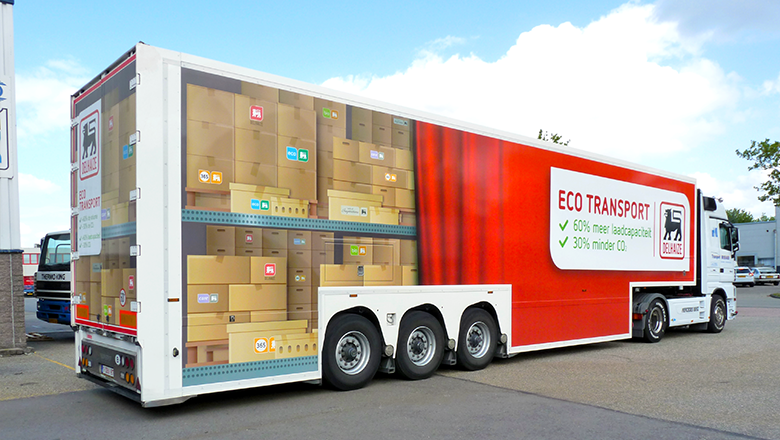
“Carriers need fewer transport movements. This relieves the road network and city centers. They emit less CO₂ and particulate matter. We also make independent suspensions, which make useful use of the space around the wheels.” This allows for two loading compartments of 1.80 meters stacked on top of each other: the so-called double-deck trailers. “These trailers are successfully used for supplying supermarkets and other stores, among other things. The extra deck provides 60 percent more loading capacity. Just calculate the environmental and cost benefits.”
Recognition in Brussels
Bronckers expects growth in the market for steerable trailers and independent suspensions. “Many trailers in the Netherlands and Germany are already equipped with a steering system because they offer advantages, especially in densely populated areas. A combination with special suspensions is also slowly starting to be recognized by Brussels.”
The product manager is referring to the climate agreements imposed on all EU countries. “We expect this to boost sales. A successful chain of affordable items, with over 1,000 branches, operates entirely with our suspension systems.”
Using standard components
Tridec supplies components to trailer manufacturers, who assemble them into a vehicle. The wide variety of vehicle configurations is a challenge, according to Bronckers, because many trailers are developed and built to order. “With as few components as possible, we serve as many trailer variants and applications as possible. That's why we integrate standard parts into a custom-made solution.”
Koen Wich is involved in these technical challenges as an engineer and project leader. With his colleagues, he staffs Tridec's R&D department. He adds, “Each steering system and each wheel suspension has its own unique drawing and bill of materials. We use standard components that are integrated to measure.”
Exceptional transport
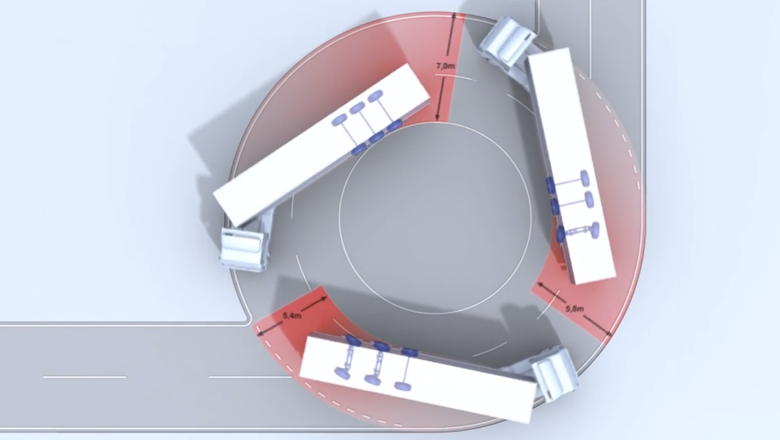
Legislation requires exceptional transports, with special dimensions, to be equipped with a steering system to safely travel on the road. “This allows transporters of wind turbines, for example, to avoid conflicts with street furniture. We have specific products for that,” says Bronckers.
Tridec also serves the extremely heavy transport market. “Then you're talking about equipment with a few hundred wheels,” he continues. “In 2010, we helped an American company that had to transport a nuclear vessel through the narrower roads of San Diego. In America, good load distribution is crucial because the roads and bridges are in poor condition.”
Harsh conditions, challenge for fluid detection
Tridec came into contact with Sentech at a trade show a few years ago. Sentech account manager Sean Ram shared some challenges with the Tridec team there. They got into a discussion about the sensor challenges Tridec was dealing with. Ram: “It was about position measurement of hydraulic cylinders, measurement of the trailer's angle of rotation, and fluid detection.”
“We were open to a collaboration, because at that moment we had a concrete challenge with the level detection of oil in the reservoir of the electro-hydraulic steering system,” responds Wich. “We had already found a sensor, but it was not resistant to conditions such as weather influences and vibrations that trailers encounter in practice.”
Oil level sensor for electronic fuse system (EFS)
Tridec's newest steering system is called EF-S. Within the company, employees use the working name steer-by-wire. The electro-hydraulic system is comparable to the fly-by-wire systems found in modern airliners. A computer transmits the driver's steering input to the hydraulic system that controls the trailer axles.
One part of the system is the oil reservoir for the hydraulic oil that moves the cylinders. “In addition to a sensor that monitors oil pressure, we needed a second safety measure,” Wich explains. “An oil level sensor that monitors whether there is still enough oil in the system. A level that is too low indicates a leak.”
“You need to be on top of that. An exceptional transport with a defective steering system on the road makes the news,” Bronckers responds.
Product requirements for optical liquid detection
Which describes the challenge with the level sensor. “We already had a usable sensor, but it was unsuitable for industrial application. For Sentech, we drafted a product requirements document.” The sensor solution had to meet a number of requirements. Sentech fulfilled these as follows:
- Robustness
The infrared sensor is protected by a stainless steel housing and securely fastened with a weld nut. - Reliability
The robust design with thicker cabling and an industrial connector ensures that the sensor will function reliably for many years. The DEUTSCH connector, with an automotive standard from the renowned manufacturer TE Connectivity, is widely used in agriculture. - Installation dimensions
The installation space for the sensor assembly was limited. The housing and electronics have been adapted accordingly. - Integrability
The sensor solution is delivered as a complete assembly that can be installed in a jiffy; plug and play. The sensor solution can easily be used in another application for level measurement simply by changing the weld nut. - Affordability
The complete solution must remain affordable and reliably continue to do its job. Therefore, Sentech stuck to Tridec's initial choice: a simple but very reliable infrared sensor from IST. In addition, Sentech has put together the most efficient sensor assembly possible.
How does level detection work?
Ram explains how level detection with optical sensors works. “The optical sensor solution is the successor to the mechanical float. The infrared sensor (without mechanical parts) contains a transmitter that continuously emits the light signal. In the same sensor housing is the receiver, which can pick up the light as long as the hydraulic oil remains at level. As soon as the oil drops below the sensor's level, the signal is interrupted. And that triggers a fault notification.”
The driver is equipped with a robust handheld device for operating the steered trailer axles. He also receives any fault notifications on this device, including potential issues with the fluid level. Depending on the fault, he receives instructions for the necessary action. For instance: “call service” or "stop immediately."
Open collaboration quickly leads to robust level sensors
The development time from idea to integratable product took three months. At the end of 2016, Tridec began the first delivery of the EF-S system, including the robust level sensor.
Bronckers and Wich are satisfied with the collaboration with Sentech. Bronckers: “Tridec is an innovative technology company and needs suppliers who truly have expertise in their field. We understand steering systems, but not sensor technology. That's why we seek knowledge partners who bring something extra.”
Wich says: “I find the collaboration with Sean and his colleagues very pleasant. They know exactly how something works. The people aren't focused on selling a product, but on finding the best solution for us. We know what we want, and Sentech fills that in excellently and solution-oriented.”
Ram responds affirmatively: “We share an open agenda. I appreciate that in François, Koen and the other Tridec employees. Everything starts with the application. Sparring openly with each other about the challenge leads to the most efficient solution.”
EF-S stepping stone to autonomous driving
The first experience with Sentech has led to a structural cooperation in the field of sensors. Wich believes that Sentech provides a good overview of the possibilities of sensor technologies.
According to Bronckers, there's more to come. “We are currently working on other, more extensive applications that require more sensor technology. For instance, we are testing a lidar sensor system from Sentech. EF-S is the stepping stone to" autonomous driving. All that's needed is even more sensors.”
Ram responds: “The basis was a clear expectation with the elements you want to measure and the associated conditions. We compared lidar and radar. For this application, we found that lidar offers the best results in terms of measurement reliability.”
Successfully implementing sensor technology
Integrating successful sensor technology presents challenges. How do you prepare for environmental factors you are not yet aware of? And what sensor trends can you expect in the future as an engineer?
In our free e-book, you'll find answers to these, including practical examples of common sensor issues and solutions.
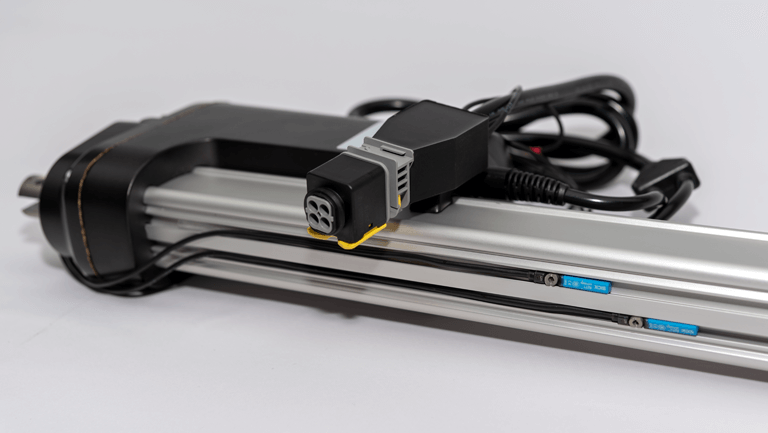
Through the integration of magnetic sensors, LINAK linear actuators are now easily adjustable. This allows end-users to adapt the stroke length of standard actuators to their application without programming the settings. Especially in markets with unique applications, the demand for diverse stroke lengths is high. Sensor integration thus provides a universal solution.
Sentech developed a ‘magnetic sensor assembly’ that allows the end user to set the stroke length of the linear actuator themselves. Discover how we integrated this sensor solution together.
Through the integration of magnetic sensors, LINAK linear actuators are now easily adjustable. This allows end-users to adapt the stroke length of standard actuators to their application without programming the settings. Especially in markets with unique applications, the demand for diverse stroke lengths is high. Sensor integration thus provides a universal solution.
Sentech developed a ‘magnetic sensor assembly’ that allows the end user to set the stroke length of the linear actuator themselves. Discover how we integrated this sensor solution together.
How do you integrate a magnetic sensor into a linear actuator?
With its linear actuators LINAK for smooth push and pull movements. These actuators are found in a wide range of applications: from agricultural vehicles to adjustable furniture and industrial automation.
They were looking for a way to integrate a magnetic sensor onto their linear actuator. This allows the end-user to set the stroke length themselves, without a software adjustment. Many of LINAK's customers create custom products, which means the stroke length needs to be adapted to the application.
Henk Lafeber, Account Manager at LINAK, explains: “Every application is different in size, which means the stroke length needs differ. This requires settings. How do we solve this without pre-programming? In many markets, it's difficult to determine in advance what exact lengths are needed. We want a universal product that can be adjusted during actuator implementation.”
Collaborating for sustainable sensor integration
Lafeber explains that a link already existed between LINAK and Sentech: “In the past, we met during networking events. We ourselves were considering a sensor as a possible solution, so it was a logical step to enlist Sentech's help.”
LINAK already had an idea of how to solve this and created a prototype themselves. With this concrete idea, they approached Sentech.
“Our prototype was a good start, but it didn't meet all the requirements yet. Sentech asked critical questions: Does the product need to be waterproof or water-resistant? What IP ratings are needed? What currents flow through the wires?’ We hadn’t thought extensively about those aspects ourselves,” says the Account Manager of LINAK.
Integration of magnetic sensors on the actuator spindle. The end-user can now easily set the actuator's stroke length themselves.
Logical technology choice: magnetic sensor
The technology choice for this application is not surprising. In the past, when designing the actuator, future needs have already been taken into account. For example, the spindle nut is equipped with a magnet.
“As soon as the magnet reaches the sensor, there is a switching moment. The motor then no longer receives a steering signal, causing the actuator to remain in that position,” explains Wolters.
Important quality requirements for the sensor solution
Then the following challenges crossed the project. How do we ensure that the magnetic sensor can be easily integrated by the end-user along with the actuator? And that it is also waterproof?
Based on the quality requirements, Wolters was looking for a connector: “Ultimately, we proposed a future-proof connector that meets the specifications. The prototype LINAK had made had six or seven wires. We reduced this to four wires. The design also included double crimps, which are disastrous if you want to make a product waterproof. Using the prototype as a basis, we devised a solution that meets all requirements.”
The end product, the ‘magnetic sensor assembly’, had to be easy to integrate onto the actuator. The solution is designed so that end-users can connect the actuator and the sensor assembly themselves.
Listening to end-user needs
Halfway through the ride, an additional question arose. Besides an assembly with one sensor, LINAK also wanted an assembly with two sensors. Lafeber: “When we went into the field with the actuator with one sensor, we discovered that there was also a need for actuators with two sensors. With one sensor, you can only set the outgoing movement. If the user also wants to set the incoming movement, a second sensor is needed.”
The LINAK Account Manager continues his story: “This is particularly valuable for applications in the market segment for trailers. They don't build in series, but build something different each time. This means that a different stroke length actuator is needed for each build. Now the builder can adjust the actuator on the trailer themselves.”
Creative engineering process
A waterproof housing had already been developed for the ‘magnetic sensor assembly’ with one sensor. The mold for making the overmold was also already available.
“Thanks to the creativity and flexibility of our Engineers, we found an efficient solution for this. With an insert, we could also make the housing for the assembly with two sensors using the same mold. This was more cost-effective than making a second mold. We also simplified the product. That's why it's good to always have a Project Engineer thinking along,” explains Wolters.
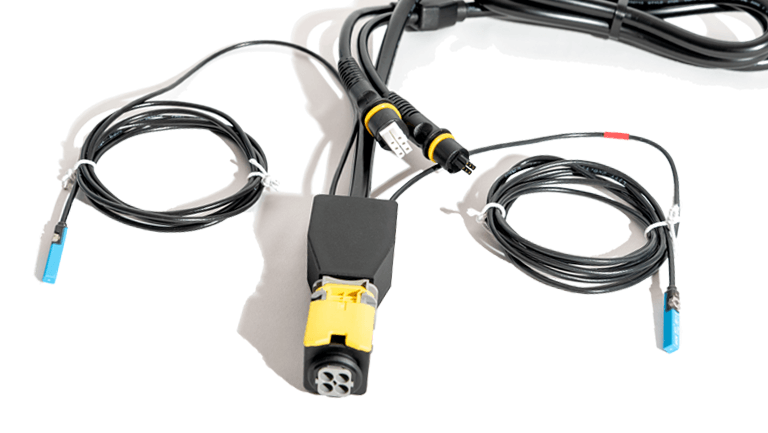
‘Magnetic sensor assembly’ with two magnetic sensors. The second sensor allows for the adjustment of both the outgoing and incoming movement of the actuator.
Monitoring quality with project management
With this sensor integration project, we also followed our work processes. This way, we can be sure that the sensor assembly will have the same quality level in the future as the first assembly.
“The process from the development assignment to the first series production took 5 months. Such a lead time is necessary to go through all process steps of our way of working. We identify risks and ensure quality,” Wolters explains.
Lafeber: “In one year, we went from a complicated solution to a simple one. That's where Sentech's greatest added value lies. Ultimately, we have a good product. A product with which we can help customers in diverse markets: from agricultural vehicles to market stalls and yachts.”
Innovative sensor solution: adaptable standard product
To supply countless applications with a linear actuator with the correct stroke length, only two types of magnetic sensor assemblies are now needed. The actuators are standard LINAK products. With this innovative sensor solution, the customer can now adjust the drives themselves.
“We supply two different motors that differ in installation size and maximum stroke length. The customer's installation size determines the choice of motor. The vehicle manufacturer or user then adjusts the stroke length themselves. This way, I can serve a large group of customers with a standard product,” says Lafeber.
Adjust stroke length at any time
Even after integration, the end-user can easily adjust the stroke length. For example, with an actuator in a mower, so the farmer can set the mowing height themselves.
Setting the stroke length is self-explanatory. If the user wants a different stroke length, they simply move the sensors in the actuator. Lafeber: “The assemblies with sensors are also sold separately, so end-users can integrate them into their actuator later on as well.”
This is how you integrate successful sensor technology
Integrating successful sensor technology presents challenges. How do you prepare for environmental factors you are not yet aware of? And what sensor trends can you expect in the future as an engineer?
In our free e-book, you'll find answers to these, including practical examples of common sensor issues and solutions.