In many high-tech applications, regular air is more of a hindrance than a help. This is why the semiconductor industry, precision instrumentation, and lab automation operate in vacuum environments. In these spaces, there are virtually no air particles left. This prevents contamination and interference, but also places extreme demands on components like sensors that must function there. In this blog, we dive into the world of sensors in a vacuum: what makes measuring in such an environment so challenging, and what are the solutions?
In a normal environment, atmospheric pressure typically hovers around 1000 millibars (or 100 kilopascals). This is the value displayed on a barometer, which experts use to predict the weather. For many (high-tech) applications, it is necessary to work in a specially conditioned vacuum environment. Consider the semiconductor industry, where the EUV light used is absorbed by the air. Or high-precision positioning measurements, for which disturbances from air currents and turbulence must be minimized to an absolute minimum.
Floating dust particles and molecules can be a contaminating and even hindering factor in those types of applications, which – especially when they start to accumulate – can make the process impossible.
There are many gradations between atmospheric pressure and the – theoretically achievable – perfect vacuum of 0 Pa. Whether it's the semiconductor industry, (medical) instruments, lab automation, or nanomaterials, each application area has its own specific requirements regarding the necessary vacuum level, the degree of contamination that is still permissible, and the molecules that are most critical. For vacuum technology specialists, it is very common to work with vacuum environments up to approximately 3 Pa.
An environment with minimal air pressure is not easy to achieve and therefore places high demands on all objects and materials that you want to place in such a vacuum chamber. This also applies to the desired sensors. And they are almost always needed. Consider a pressure sensor to determine how high the vacuum in the chamber actually is, a temperature sensor or distance measurements to monitor the process, or encoders to regulate movements in the vacuum. In this blog, we will discuss the challenges and solutions, and show you the possibilities.
Sensors in vacuum environments: challenges and solutions
Measuring in vacuum environments presents unique challenges. Materials can outgas, heat has nowhere to dissipate, and not every component can withstand the vacuum. Nevertheless, sensors must continue to perform reliably under these conditions. What challenges and solutions do you encounter with sensors in vacuum environments?
Exhaust gases
One of the major challenges is that all materials ‘outgas’ in a vacuum. Through evaporation or sublimation, they release small amounts of gas in a vacuum environment that can barely or not at all be pumped out, thus contaminating the vacuum chamber. This is easy to imagine with contaminants such as residual moisture, sealants, or lubricants, or if the wrong glues and epoxies are used. However, many hard materials such as metals or glass also emit small amounts of gas in a vacuum.
The first step is obviously to choose sensors and materials that are least affected by outgassing, for example, because they can be pre-treated well. A good selection is essential. For instance, it helps to make sensor heads out of ceramic. For potting, Tra-Con Bipax is a commonly used material, for example. Potting is used for finishing components and for filling empty spaces in a system that would otherwise be difficult to vacuum.
The second step in minimizing outgassing is to thoroughly clean all components before they enter the vacuum. Because the less contamination introduced, the higher the achievable vacuum level will be. This means a sharply organized production process and, of course, just really good cleaning with the right cleaning agents. But it goes further. The construction of a system is also important. Deep corners or a profile on a part may be convenient in production, or aesthetically interesting, but they are places where contaminants can accumulate. Therefore, always think carefully about how essential and functional design choices are, as they can affect a vacuum environment.
Bake-out oven
Ultra cleanliness is naturally achieved by thoroughly pre-treating all components before they enter the vacuum chamber. This can be done, among other things, by carrying out the outgassing process beforehand in a so-called bake-out oven. The heat causes all ‘loose’ particles to evaporate and sublimate, so you won't have any issues with them when that component or module is later placed in a vacuum. At Sentech, we have a bake-out oven. to be able to deliver our sensor modules ultra-clean.
The duration and temperature for a component in a bake-out oven depend on the vacuum requirements for its intended use. However, there are limits to how high the temperature can be raised. All sensors have a maximum temperature they can withstand. And since the process also becomes more expensive the longer the oven is on or the higher the temperature, it's important to always find the right balance.
The production process must be checked on a sample basis. For this step, this is done using residual gas analysis (RGA). Because we don't want to judge our own work, we have this carried out externally by a qualified party. These kinds of checks are necessary throughout the entire chain. If it turns out afterward that a mistake was made somewhere and the contamination level is too high, it is very complicated to determine the root cause. By continuously validating and monitoring, we can catch any potential problems early on.
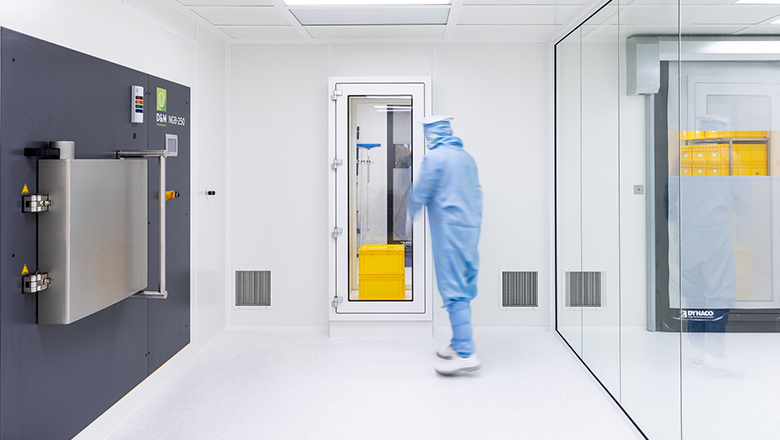
Bake-out is a process in which materials are heated to remove gases, moisture, solvents, or other contaminants.
Temperature and cooling
A disadvantage of a vacuum is that there is literally nothing to dissipate any heat from the process or from the (electronics) components. Cooling by means of air convection is therefore not an option. This means you have to think carefully about temperature management. If a system heats up, temperature drift can negatively affect a sensor measurement; heat generation comes at the expense of accuracy. Therefore, opt for sensors with low power consumption, so that heating is minimized. Because here too, the cliché applies: prevention is better than cure.
If it is absolutely necessary, and the design allows for it, there is the option to add active cooling. For example, by dissipating heat through water pipes. However, such a solution immediately makes a design considerably more complex.
Vacuum-resistant components
It's obvious, but all components, electronic parts, and sensors used in a vacuum chamber must also withstand the vacuum. Communication and experience are incredibly important in this regard, as vacuum compatibility is a property that is generally not listed on a spec sheet. As a module builder or system supplier, you must constantly remain in dialogue with manufacturers and clients. It's a chain of responsibility. And because it is also a field that continues to evolve, everyone learns from each other, and suppliers, specialists, and end-users raise vacuum developments to a higher level as partners.
Signal transmission
The measurement signal from a sensor needs to be processed. Especially for accurate measurements, it's important that the processing is also accurate. It is advisable to place the processing unit outside the vacuum chamber, as the required electronics generate more heat than is desirable in that environment, and moreover, take up valuable space.
There are quite a few so-called feed-through solutions available that can ensure signal transmission from inside to outside the vacuum chamber. It doesn't matter which sensor technology is chosen – optical, inductive, capacitive. Of course, it is also important to select cables that are suitable for vacuum use.
7 tips for sensors in vacuum
- Choose materials that are easy to clean and emit as few fumes as possible.;
- Do not change the construction method so that there are no hidden nooks and crannies.;
- Use low-power components, as heat dissipation is a challenge.;
- Place the signal processing outside the vacuum chamber;
- Use suitable cable feedthroughs for the transition from a vacuum to an atmospheric environment.;
- Test modules under realistic conditions, so that no one is surprised in the end.;
- Collaborate with a vacuum integration specialist; together you know more.
Assistance with your sensor integration in vacuum
Sensor integration in vacuum requires more than just the right component. It demands the right material selection, thoughtful design, thorough validation, and, depending on your application, the right sensor technology. These are disciplines we have in-house at Sentech: from application analysis and engineering to production, validation, and continuous supply.
Do you want to brainstorm about sensor integration in your vacuum application? Fill out the contact form and we will contact you as soon as possible.