

The first question you ask yourself when searching for a suitable encoder is: do I want to know the absolute position value or is it sufficient to record only incremental positional changes?
Until recently, the balance usually tipped in favour of incremental solutions, but that is changing. Absolute encoders are increasingly becoming the answer.
Absolute encoders always know their position without the need for homing. This means the machine starts up quickly. Moreover, with an absolute encoder, in the event of unforeseen circumstances such as power outages, the machine can continue where it left off. This reduces the risk of downtime.
Not every sensor technology allows absolute measurement to be easily integrated into the encoder. The majority of our capacitive encoders are available with absolute measurement at a competitive price.
What technologies are available?
There are four main technologies for encoders: optical, inductive, magnetic, and capacitive. Basically, they work roughly the same way. A transmitter sends a signal or field to a scale with a repeating pattern that affects that signal. A receiver registers that change and can deduce from the sinusoidal variation how many steps have been taken on the scale.
Optical encoder
Optical encoders are widely used, and are especially suitable for the high-tech market. The transmitter is an LED or a laser. The light is reflected off a etched bar pattern and the receiver registers the variation in intensity. The LED variant is cheaper than a laser solution, but a lens is required to converge the beam, so this variant is slightly larger. The resolving power of optical encoders is very high.
The size of the steps that can be distinguished can even be as small as a nanometer. These optical encoders themselves are also small. Nowadays they are available in chip sizes of about six by six millimeters. This makes them easy to integrate into your design, which is interesting, for example, in medical robotics. They are suitable for vacuum and are insensitive to electromagnetic fields, but they are less resistant to contamination such as dust and moisture. Even when there are large variations in the distance between the sensor and the scale, you should opt for another technique.
Inductive encoders
Inductive encoders use two coils and a scale with copper strips that affect the field of the transmitter coil. Because there is a limit to how precisely you can place those strips, you do not achieve the resolution of optical encoders. However, for many applications, an accuracy of a few micrometer (or 0.05°) is more than sufficient.
Inductive encoders can cope with greater variations in reading height and are resistant to contamination. They are also considerably cheaper than optical encoders.
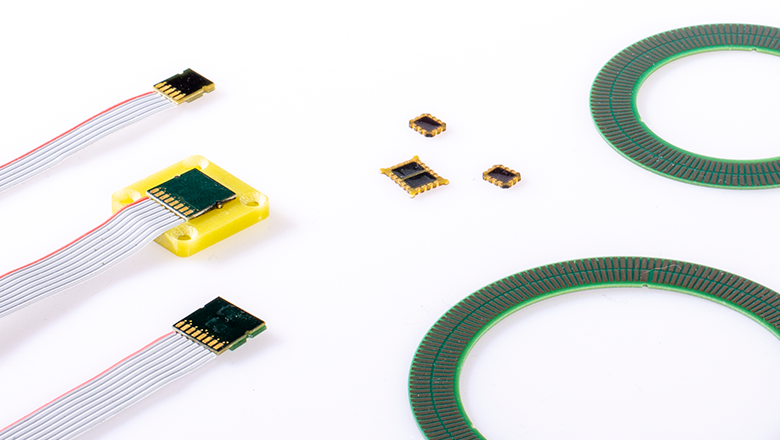
An encoder, such as this inductive encoder, consists of two parts: the scale (linear or rotating) and an encoder head.
Magnetic encoders
The scale in magnetic encoders consists of alternating north and south poles. The pitch of these poles is relatively large, which forms the basis of the accuracy. These encoders are therefore not super precise, but can handle very well with variations in motion. You need to pay much less attention to the accuracy of the movement across the scale than with optical and even less than with inductive encoders.
One drawback is that the electronics consume a fair amount of power. As a result, they are not suitable for use in a vacuum, as they cannot dissipate their heat in that environment and will burn out. Naturally, magnetic encoders also do not work in the vicinity of permanent magnets and motors.
Capacitive encoders
A capacitive encoder builds an electric field between two elements. The moving element affects the capacitance value of this system, allowing precise positioning to be determined. Capacitive encoders offer high resolution and accurate positional measurement, up to 1 μm (or 5 milligrams). They are insensitive to contamination such as dust, oil, and other organic materials. Furthermore, they are not affected by magnetic fields. However, this type of encoder is sensitive to moisture. Due to the relatively high installation tolerances, it is easy to install a capacitive encoder and is insensitive to vibrations.