Do you think the ISO 9001 quality standard is sufficient for developing a sustainable sensor solution? This is not the case for industries such as Automotive. They go a step further and work with IATF 16949. In your market as well, this high quality standard ensures a reliable and sustainable end product. You can fully adapt such a process to your quality needs. Read in this article what IATF entails and how to apply it to your project.
IATF 16949 is a step up from ISO 9001. But how do they relate to each other? According to Marco Leeggangers, Operations Director at Sentech, you can compare it like this: “ISO 9001 is equivalent to the Eredivisie (top Dutch football league), and IATF is like the Champions League.”.
Quality monitoring at the highest level
With the 9001 standard, companies accurately record how they operate. By following processes, the result is established and quality is monitored. For the automotive industry, that is not enough. The bar is set considerably higher there. “Significant requirements have been added to ensure quality even better. Such as the way of developing and producing, work processes, the development of your people, and continuous improvement,” according to Leeggangers.
If you want to supply parts to the automotive industry, you must be IATF 16949 certified. The collaboration with DAF was the reason for Sentech to obtain such a certificate. The latest certificate is valid until July 9, 2021. The Operations Director explains how it went: “It took about a year and a half to meet the strict standards of IATF. Working according to IATF means documenting your development process through Advanced Product Quality Planning (APQP). In this way, the standard ensures that you develop a product and production process through a well-thought-out step-by-step plan.”
Ultimately, it's all about the customer's request. “At the start of a collaboration, you discuss the delivery performance, logistical setup, warranty, and lifespan, among other things. By following the processes within the strict Automotive standard, we meet those customer wishes,” says Leeggangers.
How does IATF 16949 work?
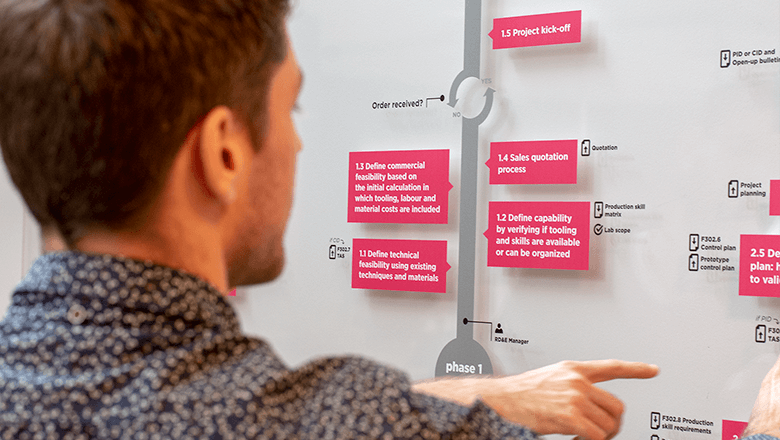
IATF 16949 requires companies to use so-called ‘core tools’. These are prescribed methods, tools, and documents that are used throughout all development phases. Leeggangers explains what such a process looks like: “The first phase of a sensor integration project consists of a feasibility study. Failure Mode and Effects Analysis (FMEA) is part of this, through which we accurately map out risks.”
Analyzing and eliminating risks is also captured by the process. “The process forces you to document how you mitigate a risk. If a risk is truly too great, you investigate whether the design is even feasible. This clarifies early on whether the requirements are realistic within the agreed-upon frameworks. Additionally, this allows you to implement checks at the right moments in your production process,” explains the Operations Director.
Documenting for quality assurance
Continuous monitoring is central to the automotive standard. This also includes monitoring the expected lifespan. Leeggangers provides an example: “If a sensor solution needs to last one million kilometers, we develop a test setup and process for it. With those tests and checks, we gather important input for the production process.”
Monitoring also includes documentation according to IATF conditions. Although rules, documents, and procedures are often not an engineer's favorite activity, according to Leeggangers, they are very necessary: “In addition to devising a technical solution, you must also demonstrate that your idea corresponds to what you have agreed upon with the customer. Quality plays an important role in this. By checking your own work, you ensure that you ultimately deliver the quality the customer expects.”
Semicon also helped with IATF
The path to becoming IATF certified was a considerable investment, especially considering Sentech only had one automotive client at the time, DAF. “However, we quickly noticed that the quality system also adds value in other industries. Increasingly, customers from other markets are requesting documents and procedures. This is fully embedded within IATF,” explains the Operations Director.
A good example is the semiconductor industry, where quality and reliability are paramount. These companies in the Semicon sector often outsource projects. For their partners, it is therefore even more important to demonstrate that they deliver on their promises.
Efficient checks
Many processes in the semiconductor world take place in a vacuum. Johan van den Biggelaar, Senior Project Engineer at Sentech, knows that materials in these applications must not outgas: “Together with the client, we make agreements on how often we share an outgassing report. Sometimes they specify that we have to perform a residual gas analysis for each instance. Of course, that's possible, but it does increase the costs.”
However, a periodic check is sufficient if you ensure that the process remains the same. “Our sensor solution is often part of a larger module, which in turn is subjected to a residual gas analysis. Because our processes are thought out in detail, many of our customers opt for a semi-annual or annual check,” says Van den Biggelaar.
Accurate follow-up of work instructions
If anything in the process changes, you need to register it. John van Schaik, Production Engineer at Sentech, explains that a single detail concerning Grade 2 cleanroom components can have consequences: “For example, when cleaning an adhesive surface. If you replace the prescribed alcohol with acetone, that can cause problems later in the process.”
It is extremely important that production employees follow the work instructions accurately. “They should also always ask questions if they are unsure. No matter how insignificant the detail may seem. In such situations, we act quickly and consult with the customer if necessary. This way, we make the right decision and prevent mistakes. This is especially important in industries like Automotive and Semiconductor,” says van Schaik.
You don't just change a process. The Production Engineer explains how it's done: “Every adjustment to the process is tested again with an FMEA. If new risks arise from that adjustment, we trace them at that moment. Thanks to the IATF core tools, vigilance lives throughout our entire organization.”
Adjust quality level to your needs
The very high standards of IATF are not essential for all projects. For many clients, the guidelines of ISO 9001 are sufficient. Leeggangers admits that he and his colleagues found it challenging to strike the right balance: “We want to deliver quality. But if we follow the enormously extensive IATF procedure for every project, we are not accessible enough for some clients.”
Yet, the solution lies with IATF. “We start every project with the first phase, namely the feasibility study. At that point, we determine which steps of the process we will and will not carry out. This is how we adapt the quality level to the customer's needs,” according to Leeggangers.
Which 5 phases do you go through in a sensor integration project?
Every sensor integration requires a certain quality. You document this at the start of a project. Whichever market you are active in, the adaptable roadmap of the quality standard IATF 16949 ensures a reliable and sustainable solution for every sensor integration project.
The well-thought-out action plan is divided into 5 phases. In addition to mapping risks, these steps compel you to find the balance between quality, costs, and lead time. How do you develop a reliable sensor solution that seamlessly integrates with your application?
Door loop The 5 phases of a sensor integration project plan.
This article appeared in Mechatronics & Mechanical Engineering no. 4 2020 and was written by Alexander Pil