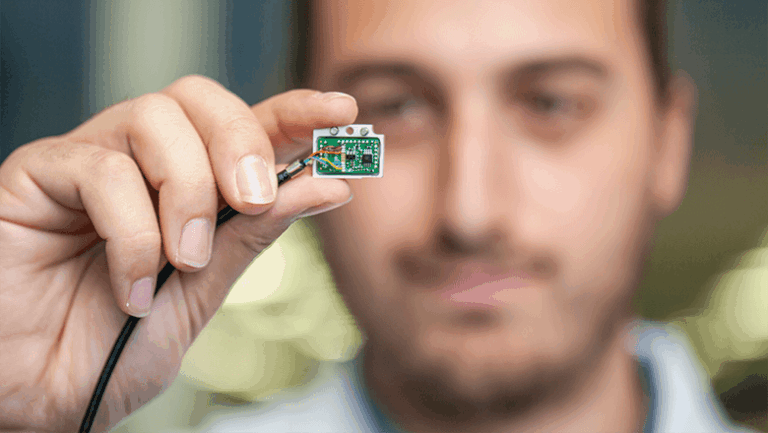

It's not surprising that acoustic sensors are increasingly being used for measurement tasks. Everything around us produces vibrations and can therefore be measured acoustically. They are versatile and still in the early stages of their development.
At Sentech, we've been closely following the developments around acoustic sensors for years. Below are the main highlights from our analysis.
Why acoustic wave sensors?
Acoustic wave sensors are incredibly versatile sensors whose commercial potential is just beginning to be realized. They are cost-effective, robust, sensitive, and intrinsically reliable. Additionally, they can be applied passively and wirelessly. Wireless sensors are useful for monitoring parameters on moving objects, such as tire pressure in cars or torque on axles (for predictive maintenance).
Sensors that do not require a power supply are essential for remote monitoring of chemical vapors, moisture, and temperature. Other applications include measuring force, acceleration, shock, angular velocity, viscosity, displacement, and flow. The sensors also have an acoustic-electric sensitivity, enabling the detection of pH levels, ionic contaminants, and electric fields.
Acoustic surface wave sensors have generally proven to be the most sensitive due to their high energy density at the surface. For liquid sensing, a special class of shear-horizontal acoustic surface wave sensors, called ‘Love wave sensors,’ has proven to be the most sensitive. Much work remains to be done in the development of these sensors for future applications.
9 types of measurements with acoustic sensors
Acoustic sensors can measure various physical quantities by detecting sound waves or vibrations. Here are 9 examples of what they can measure:
- Distance
Acoustic sensors measure the time it takes for a sound wave to return after reflecting off an object. This is similar to echolocation. - Strength
They measure the force exerted on a surface by analyzing how sound waves propagate through the material. - Displacement
Vibrations or displacements of an object can be measured by changes in sound waves traveling through the object. - Temperature
Acoustic sensors detect temperature changes by measuring the speed of sound waves in different materials. - Fluid levels
By measuring the time it takes for sound to travel from the sensor to the liquid surface and back, they can determine the liquid level in tanks or pipes. - Shocks and acceleration
They detect the speed and direction of shocks or accelerations by looking at how sound waves react to movement. - Humidity
Acoustic sensors measure changes in air humidity by observing the influence of water vapor on the sound signal. - Chemicals
Some sensors can detect chemicals and contaminants by analyzing how sound waves interact with molecules in the air or on surfaces. - Viscosity
Acoustic sensors measure the viscosity of liquids by observing how sound waves change in response to the fluid.
A Century of Innovation
The history of acoustic wave technology spans over 60 years, with its largest application being in the telecommunications industry. This industry uses approximately 3 billion acoustic wave filters annually, primarily in mobile phones and base stations. These filters, typically Surface Acoustic Wave (SAW) devices, are crucial in the radio frequency and intermediate frequency sections of transceiver electronics. Recently, there has been a growing interest in using acoustic wave sensors in various other sectors, such as the automotive industry, the medical sector, and industrial applications.

Acoustic sensors are suitable for predictive maintenance. They can, for example, detect abnormal noises from conveyor belts, which may indicate wear. In this way, they reduce the chance of unexpected failures.
The operation of acoustic wave sensors
Acoustic wave sensors use a mechanical or acoustic wave as the detection mechanism. When an acoustic wave propagates through or on the surface of a material, changes in the propagation path affect the wave's velocity and/or amplitude. These velocity changes are detected by measuring and correlating the sensor's frequency or phase characteristics with the measured physical quantity.
From piezoelectric substrate to sensor
The production of these sensors begins with the careful polishing and cleaning of a piezoelectric substrate, such as quartz, lithium tantalate, or lithium niobate. These materials are chosen for their specific properties, including cost, temperature dependence, and propagation speed. The manufacturing process involves depositing a metal layer, typically aluminum, and using photolithographic techniques to form an interdigital transducer (IDT).
Bulk waves versus surface waves
Acoustic wave sensors are distinguished by their propagation modes, such as bulk wave and surface wave. The most commonly used bulk acoustic wave (BAW) devices are the thickness-shear mode (TSM) resonator and the shear-horizontal acoustic plate mode (SH-APM) sensor. Surface wave devices such as the surface acoustic wave (SAW) sensor and the shear-horizontal surface acoustic wave (SH-SAW) sensor are also popular. The choice of device depends on the specific application and required sensitivity.
From the automotive to the medical sector: the versatility of acoustic sensors
Acoustic wave sensors are applied in a wide range of sectors. In the automotive industry, they are used for torque and tire pressure sensors. In the medical sector, they are found as chemical sensors. They can also be used in industrial and commercial applications as vapor, humidity, temperature, and mass sensors. Thanks to their sharp price, robustness, high sensitivity, and reliability, these sensors are rapidly gaining popularity. Furthermore, some sensors can be read out passively and wirelessly, offering additional advantages in certain applications.
The future of acoustic wave sensors
Recent developments in acoustic wave technology include the creation of higher frequency and sensitivity sensors, utilizing advanced materials and micro-fabrication techniques. These innovations open doors to new applications and improvements in sensor performance. The focus is on increasing sensitivity, reducing costs, and broadening the scope of applications.
Acoustic wave sensors are on the verge of a new wave of technological innovations and applications. With their versatility, cost-effectiveness, robustness, and high sensitivity, they offer promising opportunities for diverse industries. Whether it's monitoring tire pressure in moving vehicles, detecting chemical vapors remotely, or measuring force and acceleration, acoustic wave sensors will greatly advance the way we understand our environment.
Stay ahead in sensor innovation
In a world where technology is developing at lightning speed, it's difficult to stay up-to-date. Do you want to stay informed about the latest developments in sensor technology? Our newsletter will give you a head start.
Via our monthly newsletter receive your technology blogs, news, trends, and background stories in your inbox. Sign up now and discover what sensor technology holds for the future!