
Your sensor issue or challenge, we call our challenge. The path to the sensor solution you truly need touches three interests: cost, quality, and delivery time. These never go hand in hand. How do we find that compromise together with you? With our way of working, originating from the automotive industry, we map and manage risks. This is how we ensure the quality of your end product, balancing it against costs and lead time. A collaboration with you as a customer is essential!
As an R&D Engineer, you often already have a potential solution in mind. But is this the best fit for you? Perhaps another technique is better suited for your application, and it might even be less expensive.
Even as a buyer, you want clarity on price, delivery time, and quality. Our working method focuses on identifying and managing risks. This is how we monitor quality and ensure a predictable logistics chain.
Further on, you'll discover the 5 phases of challenging your sensor solution.
Balance of interests
Besides balancing cost, quality, and delivery time, it is also important to find a balance between the customer's interests, the supplier's interests, and Sentech's interests. Hermen Kobus, Operations Director at Sentech explains: “If interests diverge too much, it can be difficult to find common ground. You look at what you can do to understand each other. If it ultimately doesn't work, you have to be honest enough to go separate ways.”.
Even at an internal level, competing interests are at play. Kobus adds to his story: “An engineer always wants to arrive at the best solution because they think from a technical perspective. If something is good, they will still say, ‘It can be better.’ After the engineer spends many more hours developing the product, it will likely improve slightly, but also become unnecessarily more expensive.”.

Car manufacturers like to work with companies that are IATF 16949 certified. Furthermore, this standard helps to set up work processes efficiently and effectively.
Optimal workflows
Together with you, we map out what is truly important to you. We do this with our work processes, which are based on the high quality standards of IATF 16949 (formerly ISO TS 16949). We monitor these strict standards with the APQP (Advanced Product Quality Planning) development process.
This model was developed in the automotive industry by Ford, Chrysler, and General Motors to deliver new products on time and within budget. By following the APQP phases, we identify and manage risks.
Documents in understandable language
APQP documents are inherently complex to work with. They use terms that not everyone is familiar with. We have simplified this model so that all parties can work with it efficiently. Documents and templates for the processes are written in understandable language.
Scale steps, never skip
Sometimes it is not efficient to follow all steps of APQP extensively. Depending on your expectations regarding quality, time, and price, it is possible to scale certain steps. From the perspective of ‘scale don't skip,’ we never skip steps because we always consider all risks.
“At every process step, we ask ourselves in a multidisciplinary team: ‘Are we going to do this step completely, or can we do it faster?’ Knowing that there are risks involved,” says the Operations Director. We map out the risks and weigh them against the quality standards that are important to you.
For example, if the length of a product is important, then an incoming inspection for dimensions makes sense. Kobus adds: “The moment I catch at incoming inspection that the product is too long or too short, I won't accidentally put work into it and send it to the customer. That costs money. Moreover, hours have already been spent on it. All for quality assurance. You must decide together whether the risk is high or not.”.
“If we know all the risks, we'll never be surprised by them.” - Hermen Kobus, Operations Director at Sentech
In 5 phases from challenge to sensor solution
Based on APQP, we go through 5 phases in a project. By following these phases, we identify risks in a timely manner and make them manageable. This way, you will receive your sensor solution at the agreed quality, price, and lead time.
Phase 0: Mapping the Problem Question
As an engineer, you come into contact with us because you need a specific sensor solution. Perhaps you already have a possible solution in mind. But is this the best solution for your problem?
By asking critical questions and probing further, our Account Team will work with you to determine what you truly need.
The importance of asking further questions
Asking critical questions and probing further are important for making risks clear. Like when the customer asks for a waterproof sensor. Waterproof has varying degrees: from rain-tight (IP X3) to pressure-tight (IP X8).
By asking further in this situation, we will know what the customer means by waterproof. The choice in this also influences the price.
Kobus gives an example where price plays a big role: “The customer says, ‘I want a pressure sensor,’ but it turns out they need a pressure switch. That might sound like a small difference. In terms of cost, there's a big difference, because a sensor can be more expensive than a switch.”.
If we deliver a product that meets all specifications but doesn't fit your application, we haven't done our job correctly.
Discuss your challenge
Phase 0 concludes with an open-up meeting with the full project team: Sales, R&D&E (Research & Development and Engineering), Supply Chain, Quality, Finance, and Production. Here, we pitch the problem statement, and the sensor experts propose a solution. We document this in the Product Initiation Document (PID).
Phase 1: Feasibility and Offering
Sales transfers responsibility to RD&E. In this phase, our Project and Production Engineers investigate the feasibility and capacity of a project.
Capacity
Capacity is central to whether we can and want to make it. The Operations Director gives an example: “Are we going to make 100,000 products, with an assembly time of 20 minutes per piece? That has implications for our capacity. Maybe we need extra personnel for that.”.
Technical and financial feasibility
We also investigate the technical feasibility. The client requests certain specifications. Can we make that? Is that technically feasible? For financial feasibility, our sensor experts, together with the Account Team, examine whether we can produce the product for the discussed price.
Phase 2: Product Design and Development
Once we receive the assignment, we can provide the draft project plan. During this phase, the lead time becomes concrete: we will make it clear when which project results will be delivered, tailored to your needs. Project results range from documents and drawing packages to samples or prototypes.
Prototype
With a prototype, we show you, the (R&D) Engineer, a functionally working product. The prototype is not yet made with the final means. For example, if the final product is to be injection molded.
“This is too expensive to do for just one piece. In that case, we'll 3D-print the housing. Therefore, the material and color may differ. It gives the customer an impression of how the product will turn out in the meantime. He can do tests with it: is this what I want,” Kobus explains.
Design risk management
We address design risks with the Design Failure Mode Effects Analysis (DFMEA). We prioritize risks based on the Risk Priority Number (RPN). We always address the highest RPNs to reduce risks.
Kobus provides an example: “The component is so sensitive to vibrations that we expect it to break down in that machine when vibrations occur. If the risk is too high, we will devise an action to reduce that risk. The description of this will be included in the Control Plan.”.
Critical to quality
This phase focuses on product design. This involves drawings and the software that needs to be included. Apart from drawings, you also discuss critical dimensions. “Like with the development of a load pin. The customer uses this pin in a gearbox. Gears will slide over the pin, so the fit has a certain dimensional tolerance. The pin also must not deflect too much. Here, we describe the critical dimensions, or what is ‘critical to quality’,” adds the Operations Director.
Phase 3: Process Design and Development
Now, the process of producing and assembling the series begins. We will carefully monitor the quality, as established in the previous phases. Details that are ‘critical to quality’ will receive extra attention in this process.
Process risk management
All process-related risks are captured in the Process Failure Mode Effects Analysis (PFMEA). Such as what can go wrong when components arrive at our facility in relation to the agreements with our suppliers.
Kobus sketches an example: “We took the risk of doing business with a supplier who has a delivery time of between three and five weeks. However, we need to deliver 200 sensor solutions to our end customer every two weeks. Then, in the Process FMEA, it may emerge that we need to build up a larger stock of products from that supplier. That way, we have a buffer if the supplier delivers late.”
Measurement system analysis
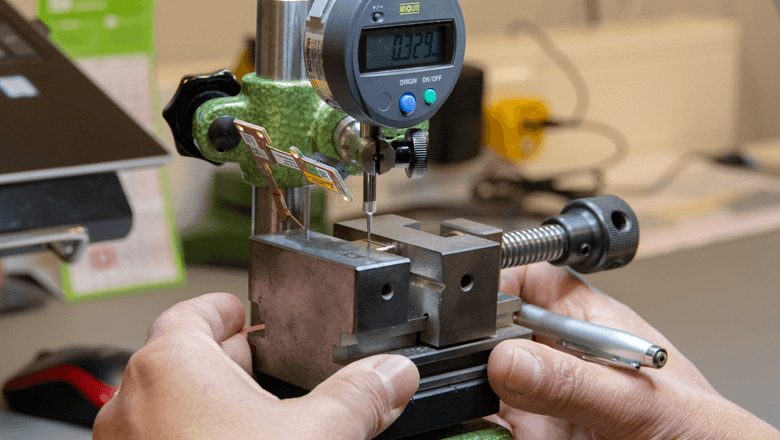
With Measurement System Analysis (MSA), we map out the reliability and reproducibility of our measurement systems. We control the variation of our measurement systems, so that the quality of your final product is consistent with every measurement. Even when multiple Assembly Engineers read data from the same measurement system.
“We make products here where the time of day we measure matters. It's colder in the morning than in the afternoon. So, it's sometimes important that assembly takes place at a constant temperature,’ according to Kobus.
Deployment to Production
For a successful transfer of Engineering to Production, we will create a work instruction for your sensor solution. In addition, the Project Engineer will teach the Assembly and Test Engineers how to assemble and test the product.
Phase 4: Product and Process Validation
Now that the people are trained, we begin the validation phase by producing a small series, for example, 20 units. With care, we ensure that your final product meets the desired quality requirements. We also test feasibility to determine the exact lead time and price.
Feasibility in time
If you need to produce 100 sensor solutions per week, you want to know if that's feasible in terms of time. The Operations Director explains: “We time exactly how long it takes us. This way, we know how many units we can produce per week and that the costs from the last calculation are covered.”.
Quality control
In Statistical Process Control (SPC), we establish quality limits: how much can quality deviate? With a control chart, we monitor quality requirements that are important for your product.
Kobus adds, “For example, if the length of a product is important, we determine how much that length can deviate. We check this with a control chart and test tool. Anything outside the norm is rejected.”.
Lessons learned meeting
We'll conclude Phase 4 with a ‘lessons learned meeting’. All involved team members will come together for this, and you as an (R&D) Engineer will also attend. We'll discuss what went well, what didn't go so well, and what we need to do differently next time.
“It happens that we've done a vibration test in phase 4, but in hindsight, it would have been better to do it in phase 2,” Kobus gives as an example. “This is how we continuously improve our work processes.”
Start series production
Now we know in detail how to create your sensor solution and what we need to consider. There is also now certainty about the lead time and price. Based on this information, we will prepare the quote for series production.
After we receive your order, the Production department will start series assembly of your sensor solution.
Supply chain control
Quality and selecting the right supplier go hand in hand. Kobus adds: “A supplier delivers quality products to me, with an agreed ppm level of 6,000. That means 6,000 parts per million are allowed to be defective. Our customer requires 30 ppm for their end product. In that case, I would rather do business with a supplier who can deliver 30 ppm, even if that supplier is slightly more expensive.”.
The tension between Sales and Engineering
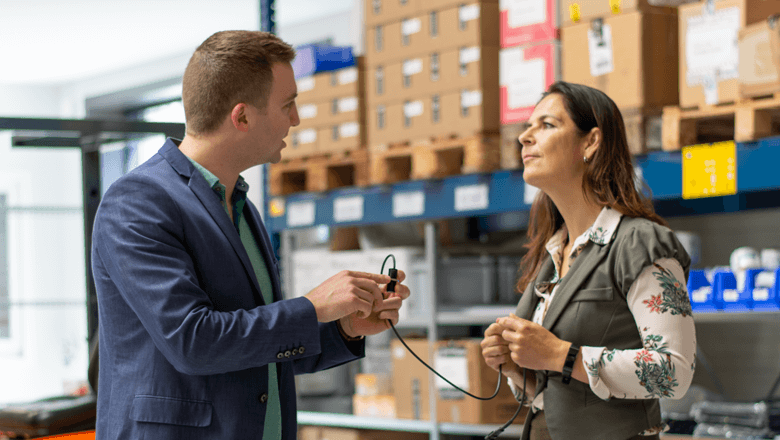
The interests of Sales and Engineering sometimes diverge in a project. Sales wants to offer flexibility to the customer, while Engineering adheres to processes to maintain quality.
When a customer requests faster product delivery, Sales puts pressure on Engineering to make it happen. Because Engineering is responsible for quality, they strictly follow the process. These process steps take time, which sometimes conflicts with Sales' interests.
Through this area of tension, the teams find a middle ground between flexibility and lead time. This allows them to efficiently develop the sensor assemblies, with attention to quality and costs.
Integrate your sensor solution successfully!
During a sensor integration project, you constantly weigh three interests: cost, quality, and delivery time. It can be challenging to make the right choices in this regard. What are the risks and consequences of my choice? Is the technology I have in mind the right solution for my application?
Scroll through our free e-book for the answers to these questions. You'll also read practical examples of common sensor issues and solutions.
Immerse yourself in the world of successful sensor integration Download the e-book directly.