When integrating absolute encoders, OEMs and machine builders push the limits of catalog products. Unfortunately, these off-the-shelf components often prove unsuitable for your application. For instance, they may be too large, too heavy, or have the wrong form factor. Sensor manufacturers are aware of this. And they are responding to this need.
Increasingly, the available features in such a component are becoming the stumbling block. Then there are features included that developers don't need at all, while the functionality that could make a difference is precisely what's missing.
Sensor manufacturers are tapping into this trend. They are bringing stripped-down versions of their products to market. They are going back to the basics of their solutions. The functionality of the sensors remains solid, but the rest of the features have been removed. In other words, bare electronics.
A machine developer or sensor integrator can build a shell around it according to their own wishes and insights. Such a component requires more attention in terms of integration. But then it is also perfectly tailored for the application. The result is more compact and lighter, which is interesting in places where space is limited or mass plays an important role.
For example, a component that was previously only available in a robust aluminum housing is now also available in a stripped-down version. Such a stripped-down sensor consists of a small circuit board or even a single component that the user can place on a circuit board themselves. The complete functionality is retained, while all extraneous elements are removed, allowing such a version to form the basis for many secondary applications.
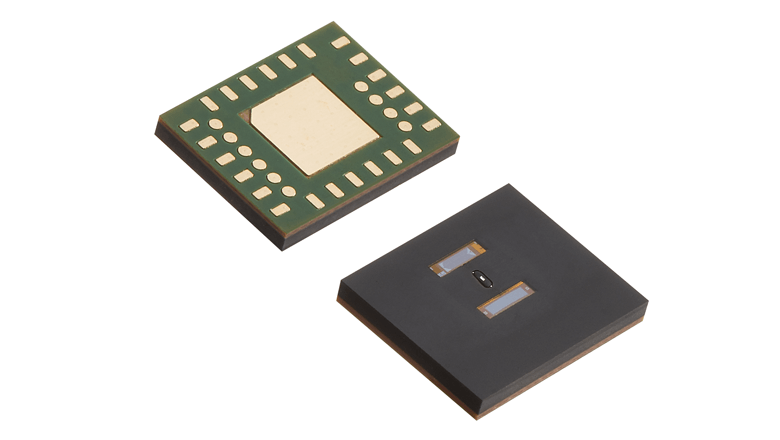
Celera Motion launched a line of absolute optical encoders with a focus on flexibility. The Aura chip encoders stripped of all non-essentials without compromising the intelligence of the sensors. Users can choose which features they want to add and fully customize the encoder for their specific application.
Easily integrable absolute encoder through minimalistic design
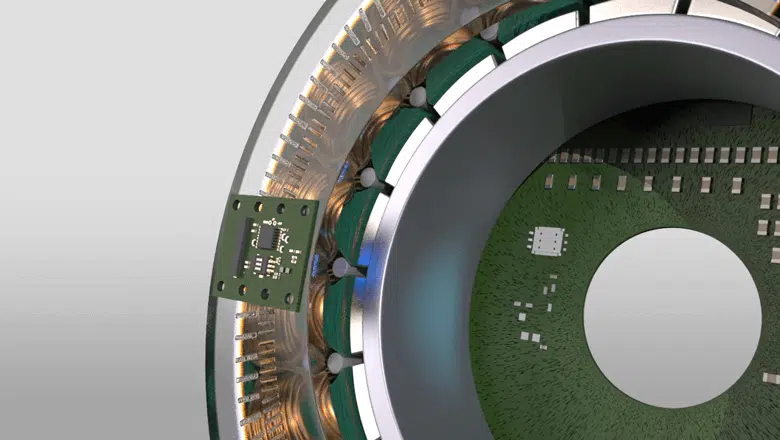
A good example of this development is Celera Motion's Aura encoder line. The variants in this series of absolute optical encoders all have a minimalist design. “They are chip encoders, PCB components that you can integrate into your own design,” says Rob Kuijpers, Product Manager at Sentech. “That's very interesting for OEMs because they can do anything with it. They do have to put in more effort for it. But they can implement it exactly as they want, allowing them to build the encoder system to precisely match their specific application.”
The Aura encoders are highly suitable for applications in, among others, the high-tech market, high-end robotics, and pick-and-place machines. “Think of applications where the sensor needs to be very small or where mass is of great importance, such as when it's integrated into an end-effector,” Kuijpers explains. “And it concerns situations where optical encoders are required to provide a very precise absolute position value.”
Optical miniature encoder
The Aura is not the first absolute optical encoder on the market. Existing solutions are significantly larger and more expensive. Celera Motion's chip encoders are very small (9 by 7 by 1.1 mm), feather-light (about one and a half grams), and considerably cheaper.
Please note that the encoders due to their optical character perform best in relatively clean environments. Dirt and moisture are detrimental to the extremely precise measurement.
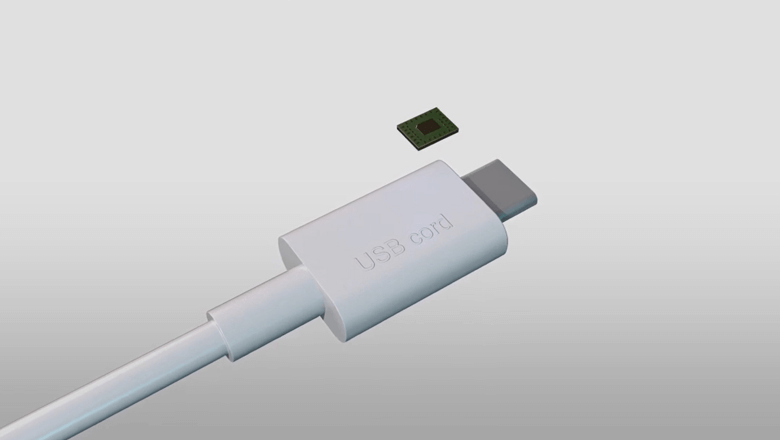
How big is such a chip encoder really? This Aura chip encoder is 9 by 7 by 1.1 mm. Here are the proportions compared to a USB-C connector.
Absolute positive value
The Aura encoders work with an LED as the light source. The light from the LED in the Aura is blue, and this was a deliberate choice. The shorter the wavelength, the smaller the details that can be distinguished. This means that these absolute optical encoders from Celera Motion therefore perform better.
The beam falls on a pattern of chrome stripes deposited on glass. The reflection of light on all these stripes creates a diffraction pattern that can be read out with a receiver. “The Aura encoders contain two such stripe patterns,” Kuijpers knows. “One is neatly repeating, the other semi-random. By combining the two diffraction patterns, the system can calculate an absolute positional value.”
How accurate are Aura encoders?
It's not possible to express exactly how good Aura encoders are with a single number. Usually, three main specifications are considered: absolute accuracy, repetition accuracy, and resolution.
Absolute accuracy
“The first spec is determined by the ruler you use,” explains Kuijpers. Celera Motion has opted for a glass scale with an accuracy of +/- 3 µm per meter. The manufacturer is tinkering with a variant based on a Metal tape measure. That is slightly less accurate at +/- 5 µm per meter, but much cheaper and therefore interesting for applications that don't require the absolute best in terms of absolute accuracy.”
Repeatability
The repeatability of the Aura encoders is, according to the spec sheet, 1 LSB, which stands for least significant bit. Kuijpers explains: “The value depends on the resolution of the encoder. In this case, the repeat accuracy therefore corresponds to the smallest resolution step.”
Resolution
Celera Motion provides a resolution for the Aura's in the range of 12.5 to 200 nanometers. Kuijpers: “You can achieve a resolution of less than a micrometer, that's for sure. Another major advantage of the Aura encoders is that they are very fast. So you can sample quickly, allowing you to average multiple measurements without too many negative side effects, thereby improving the resolution.”
New perspective on integration
The integration of Aura encoders is more involved than with a standard sensor. “It requires a new way of looking at integration. That approach fits well with our way of working, ”in which we work together with our customers towards the best implementation and integration,“ states Kuijpers. ”In consultation, we look at which variations, features, and cabling we add. That ultimate flexibility opens many doors."